
As of 28 June 2025, the European Accessibility Act (EAA) is officially in force across all EU member states. If your hotel offers digital services, this new regulation applies to you. But rather than viewing it as an obstacle, this moment represents a real opportunity to build better digital experiences for everyone. And importantly: while the regulation is active now, some digital products have longer transition periods. In hospitality, many of the guest-facing tools, such as booking engines and self-service kiosks have until 28 June 2030 to reach full technical compliance. That gives you time to prepare, but not a reason to wait. Accessibility isn’t just a requirement, it’s part of great service.


And importantly: while the regulation is active now, some digital products have longer transition periods. In hospitality, many of the guest-facing tools, such as booking engines and self-service kiosks have until 28 June 2030 to reach full technical compliance.
That gives you time to prepare, but not a reason to wait. Accessibility isn’t just a requirement, it’s part of great service.
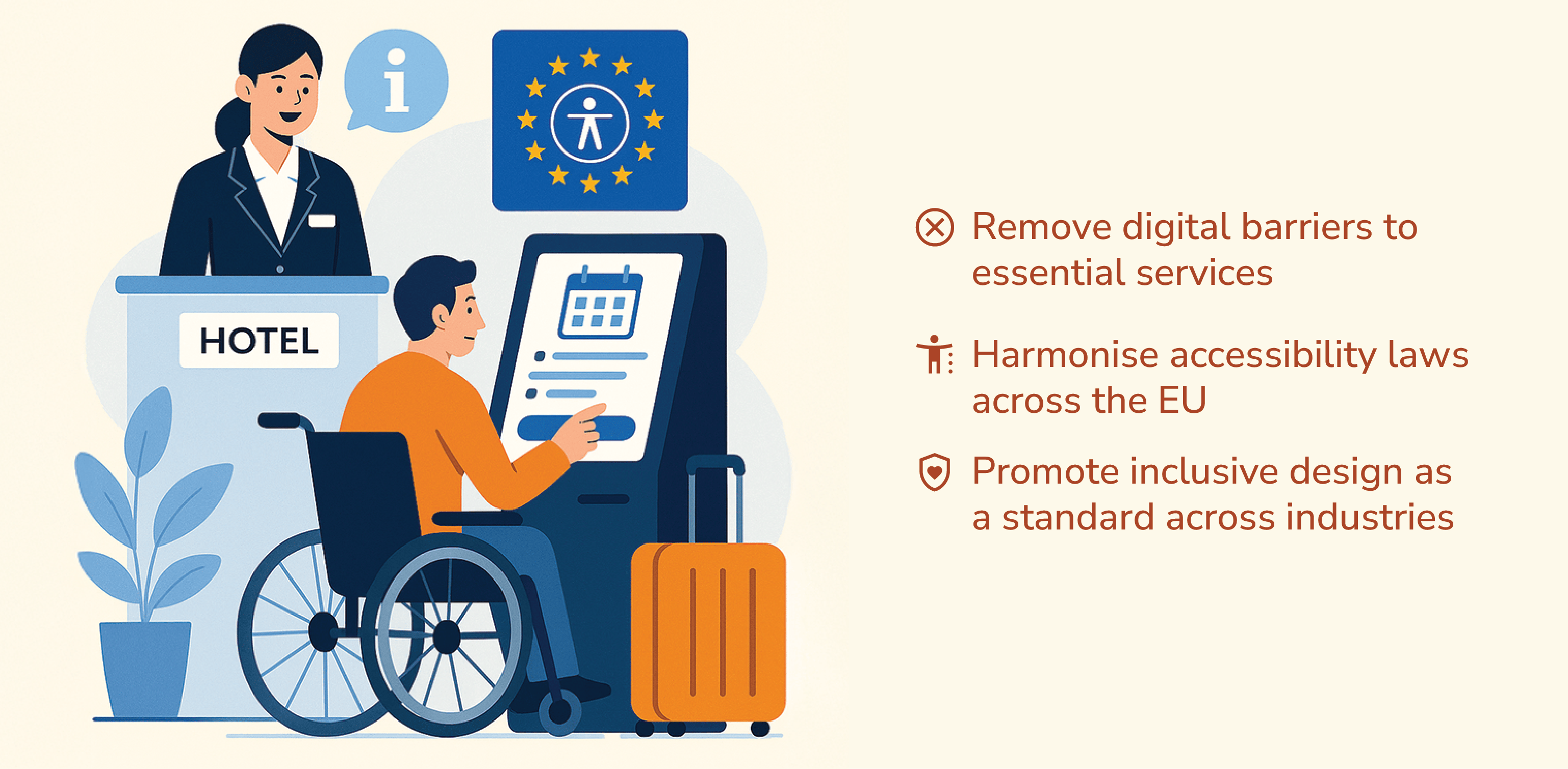
A shift towards digital inclusion in hospitality
Whether it’s booking a hotel room online, using the self-service guest portal, checking in via a kiosk, or purchasing a digital gift voucher, many of today’s hotel interactions happen on screen. But what happens when a guest can’t see the buttons on a form, can’t use a mouse, or struggles to follow the layout of a check-in terminal?
The European Accessibility Act has aimed to change that. It introduces a unified accessibility standard across the EU, ensuring that people with disabilities can access and use digital products and services just like everyone else.
Although the law is now in effect, some requirements will be introduced gradually over the coming years. That’s why now is the right time to take the first steps and continue building towards long-term inclusion.
Why the EAA exists and why it matters to your hotel
Accessibility isn’t just about compliance. It’s about people. Approximately one in five Europeans has some form of disability and that figure is rising as populations age and digital experiences expand.
The EAA was designed to:
- Remove digital barriers to essential services
- Harmonise accessibility laws across the EU
- Promote inclusive design as a standard across industries
For hotels, this includes:
- Hotel websites and booking engines
- Self-check-in and check-out kiosks
- Digital gift shops or voucher platforms
- Guest Portal and in-room devices
If your guest journey includes screens, forms, or digital tools, it’s time to ensure those are accessible for everyone, regardless of their physical or cognitive abilities.
What hoteliers need to know in practical terms
Let’s face it: accessibility requirements can sound abstract. So here’s what the EAA actually means for your daily operations.
Your website and booking engine
These are often the first touchpoint between your hotel and your guests. According to the EAA and WCAG 2.1 AA (Web Content Accessibility Guidelines), your booking engine and website should:
- Be usable with screen readers
- Allow full keyboard navigation
- Include alternative text (alt text) for all images
- Follow a clear heading structure
- Offer high contrast and legible fonts
- Avoid flashing content or visual effects that could cause seizures
Your self check-in kiosks and guest terminals
These should be:
- Usable without a touchscreen or mouse
- Designed with large, high-contrast buttons and simple layouts
- Equipped with spoken feedback or voice prompts
- Available in multiple languages
- Mounted at an accessible height for wheelchair users
Your digital gift shop or voucher platform
These tools should:
- Follow your website’s accessibility structure
- Feature intuitive navigation and clear language
- Ensure forms and checkout processes are screen-reader friendly
- Avoid complex layouts or time-limited interactions without warnings
It’s not just about what you use - but how it’s built
Even if your digital tools look clean and modern, that doesn’t guarantee they’re accessible. Unless your systems were designed to meet WCAG 2.1 Level AA (the widely recognised accessibility benchmark), they may not be compliant.
If you use third-party integrations, plugins, or custom code, it is your responsibility to check they also meet these standards.
How Clock Hospitality Cloud supports accessibility readiness
At Clock, we’re committed to helping hotels not only meet compliance, but deliver better, more inclusive guest experiences.
We also believe in being clear and transparent. While the EAA allows for transition periods, it’s important to note that many hospitality-related digital tools must meet compliance by 28 June 2030, as outlined in Article 32 of the directive. This includes self-service kiosks, booking platforms, and in-room digital systems.
We are fully aligned with these timelines and have already taken action to meet accessibility requirements.
For example, our Hotel Booking Engine+ now supports the addition of alternative text for all images. This allows screen reader users to understand visual content, fulfilling a key requirement of the WCAG framework.
Our existing Check-in kiosks, Self-Service tools, and Digital Gift Shop remain operational under the current guidelines. These systems are continually assessed as we prepare for more comprehensive updates ahead of 2030.
If you’re using Clock today, you’re already working with a provider that’s ahead of the curve and committed to thoughtful, timely progress.
We recommend:
- Reviewing any third-party systems or custom integrations to ensure alignment
- Enabling alt text in your WBE settings
- Starting internal discussions about accessibility as part of your future digital roadmap
We’ll be here every step of the way to support you.
From compliance to competitive advantage
Accessibility isn’t just about rules, it’s a real business advantage. Here’s what inclusive design brings to your hotel:
Wider reach: You open your doors to guests who are too often excluded
Happier guests: Simpler design benefits all generations and international travellers alike
Improved SEO: Search engines reward structured, readable, accessible websites
Long-term alignment: Early action means you won’t scramble at future deadlines
Brand trust: More and more guests actively choose brands that reflect their values
Common questions we hear from hoteliers
“Isn’t this only for government agencies or public institutions?”
No. The EAA applies to private businesses that offer digital services to the public, including hotels.
“I use a third-party vendor, does that mean I’m exempt?”
Unfortunately not. You’re still responsible for ensuring the platforms your guests use meet accessibility requirements.
“We’re not finished with updates, what now?”
That’s OK. For many guest-facing tools, the compliance deadline is 2030. Still, now is the right time to begin. Document your actions and create a timeline.
Final tips for moving forward
- Audit all guest-facing digital touchpoints
- Ask your tech partners about WCAG 2.1 AA compliance
- Enable alt text for your WBE images
- Train your team in inclusive service, on-screen and on-site
- Keep records of your progress
We’re here to help
If you’re unsure about your current setup or what your next step should be, our team is ready to support you.
Talk to our support team to learn more about accessibility and what you can do today.
Looking ahead: building a more inclusive guest experience
The European Accessibility Act marks a new chapter for hospitality not just in legal terms, but in how we serve our guests. Some changes take time. But the work starts now.
Compliance is only the beginning. Inclusion is where true hospitality begins.