Choose your server

Changelog

Clock Update (27 Apr 2026)

Improvements

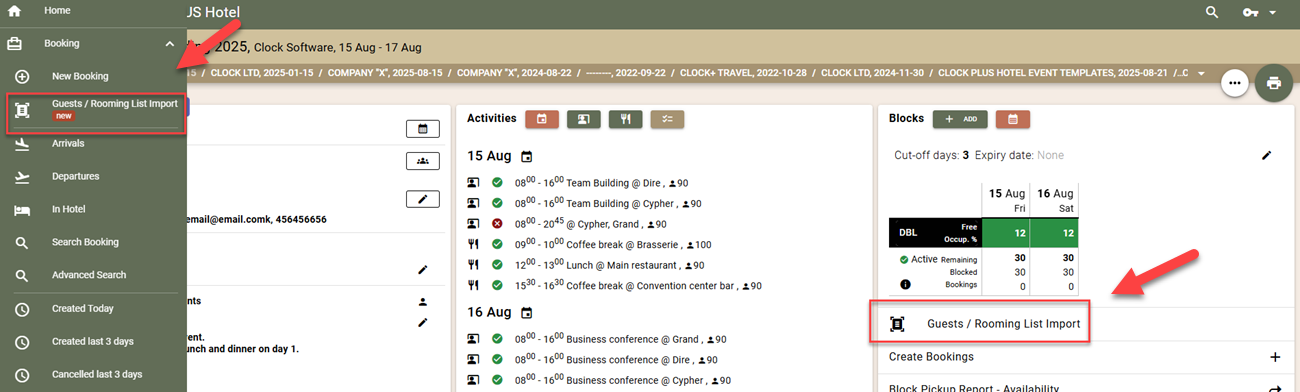
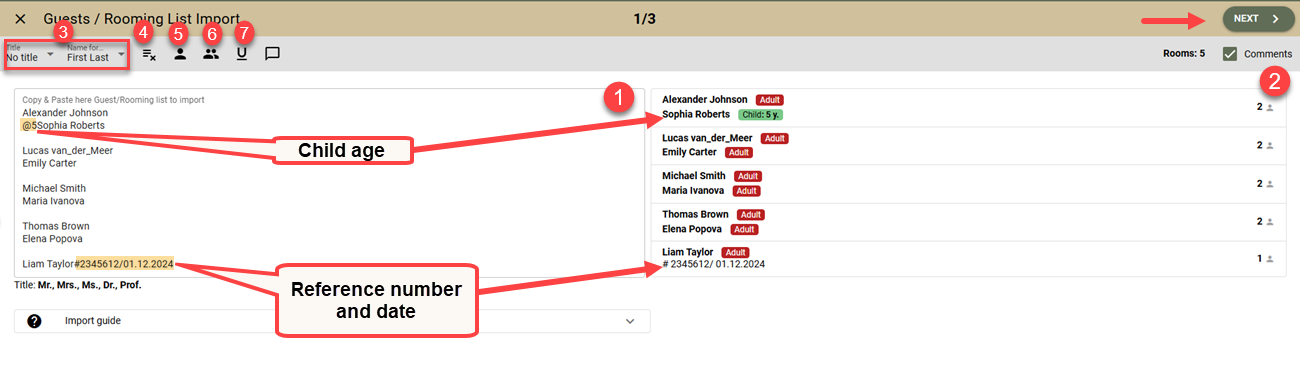
  • Guests / Rooming List Import – AI Assistant. We’ve added a new experimental feature that uses AI to simplify the processing of event rooming lists. Until now, after pasting text from an email or a file from a partner, manual editing was required to meet import requirements—guest names must come first, there must be an “@” for children and their ages, rooms must be separated by a blank line, etc. Now this processing can be performed automaticallyby the new AI assistant:
    • Enter the text as usual and click the rightmost button above the field.
    • Wait for processing – The AI assistant will convert the text according to the import requirements.
    • Review the result carefully. Keep in mind that the AI may make mistakes. At the top, you will see comments and ambiguities that arose during processing.
    • You must select the field for the number of guest names (one, two, or three names).
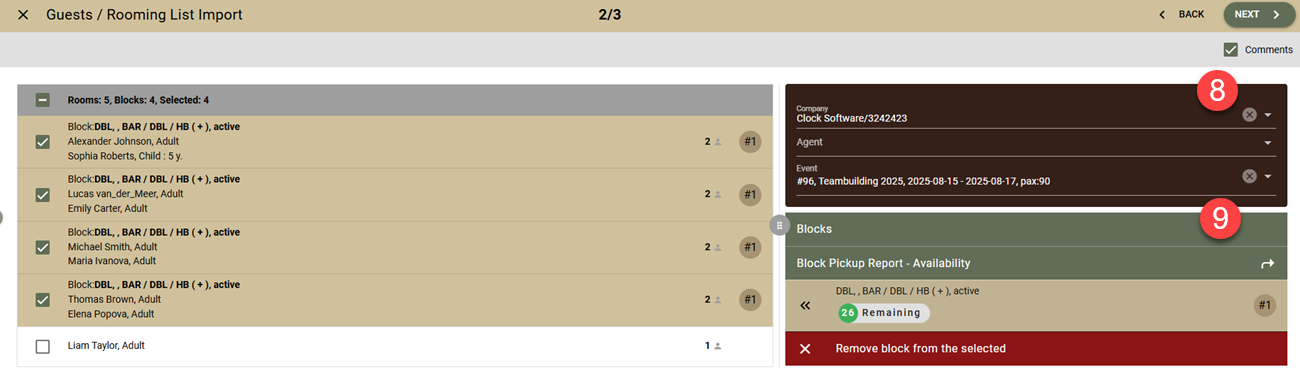
    • Continue the process as before.

Currently, this feature is only available during import and cannot be used when updating the rooming list.

  • City Tax – varies by Room Type.If your hotel has different Room Types (rooms, apartments, villas) with different City Tax rates, you can now use the new City Tax structure. Instead of a single tax rate, the system now supports multiple rates. Each tax rate is defined in the same way as before, but now has a name for easier identification. When creating more than one tax rate:
    • Select which will be the default. It will be used:
      • if no specific tax rate has been selected for a given room type;
      • if the calculation is made without a rate (only with a manual price);
    • Selecting a default tax is mandatory. If not specified, it will not be included in the calculations. This applies mainly to newly created accounts—no action is required for existing ones.
    • For room types with different tax rates, a new field has been added to the room type edit screen where you can select the appropriate rate.

Important: The amount of the City Tax is determined by the room type specified in the rate. If there is no rate in the booking and only a manual price is used, the system will apply the default tax.

  • WBE – display of total price for the stay. We have added a new setting in WBE: “Show 'Total Price' instead of 'Average price per night” (in the WBE rates subsection). When enabled, guests will see the total price for the entire stay instead of the average price per night. This display method is preferred by guests, as it gives them a clear idea of the final cost of the booking right from the initial screens—when selecting Room Types and rates.
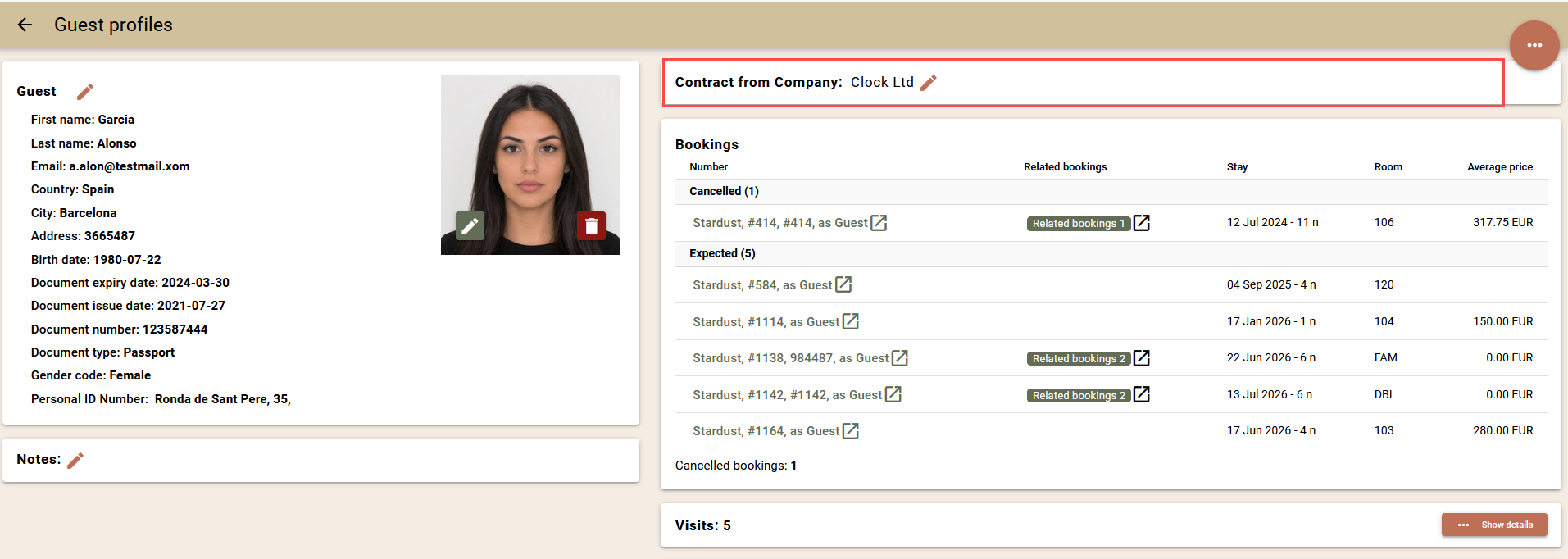
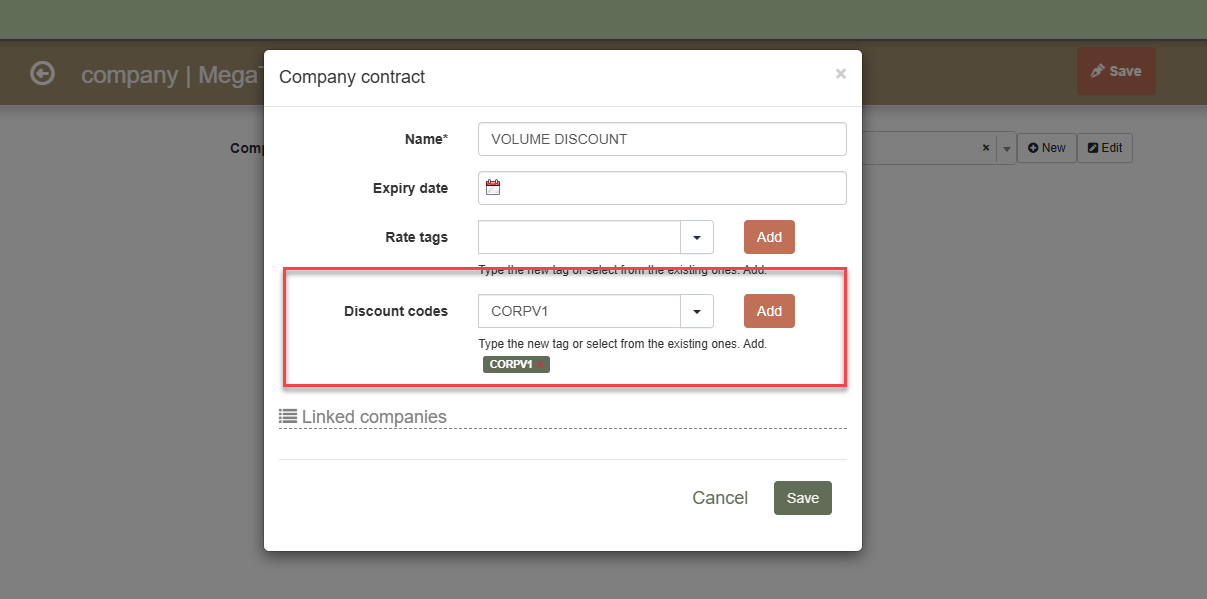
  • Company contracts – deletion option. We have added the ability to delete contracts. A contract can only be deleted if it is not associated with any company.
  • Guest Messaging – new Liquid parameter. A new parameter has been added: Children Ages (booking.children_ages_str).
  • Event Document Templates – new Liquid parameter. A new parameter has been added:  Event – PAX (offer.event.persons).
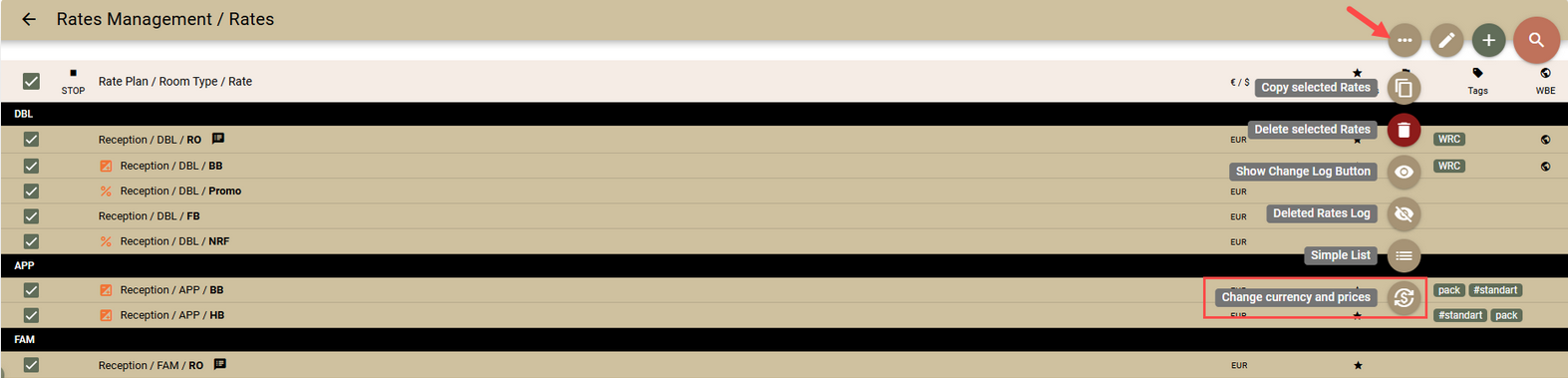
  • Rate Management / Rates – improvements in Channel Manager – Rates. In the “Channel Manager - Rates” tab, you now have quick access to the rates used in the mapping with Booking.com. Using the Booking.com button, you can open all linked rates to edit or change prices.

Fixes

  • Rate and Availability – we improved the creation of bookings with a selected contact person to eliminate errors such as “Attempted to update a stale object…”, which slowed down operations and required a retry.
  • Worldline / SIX Payment – we revised the logic for re-redirection from 3DS, where a payment was not reflected in Clock PMS even though it was successful.
  • Folio Print – the "Gross" and "Net" columns are now hidden in the "Packaged by Dates / Qty" and "Packaged by Qty" views.
  • Events – BEO – we fixed an issue where prices in BEO were empty if the block rate lacked prices for all days of the event.
  • Booking charge routing – the Default Company/Agent Folio field did not reflect the manually set default folio in the company/agent.
  • Occupancy Forecast – when creating bookings, the default stay set in "Booking fields" was not taken into account.
  • Arrivals/Departures Screens – the buttons to navigate to the next/previous date did not function correctly when switching to daylight saving time.

Integrations

  • Adyen – upgrade to the Drop-in version and additional improvements.
  • OTA interface – Occupancy-based pricing - Guests. We’ve added a new feature to the OTA interface for channel managers – sending prices based on the number of guests in the room (Occupancy Based pricing - Guests). Until now, the interface supported sending a single base price per product (rate). Now you can send different prices depending on occupancy. If the channel supports this feature, it allows you to significantly reduce the volume of mapping and improve synchronization speed. How to use:
    • In the rate mapping, leave the “Adults” and “Children” fields blank and use the new “Occupancy-based pricing - Guests” field.
    • In this field, enter the number of guests for whom the price should be calculated, separated by commas. For example: 1,2,3 will send three prices to the channel—for 1, 2, and 3 guests per room.
    • The price values themselves are determined by the rate —according to its terms and calculation for different occupancy levels:
      • if the rate calculates different prices based on the number of guests, different values will be sent
      • if the price is the same, the same value will be sent for all occupancy levels
    • You cannot use both “Occupancy-based pricing – Guests” and the “Adults” / “Children” fields at the same time – choose one of the two approaches.
    • Settings are at the product level – different products can use different methods (Occupancy-based pricing or base price).
  • Private Analytics: The daily synchronisation for some data/tables took longer than expected. The synchronization logic has now been optimised to ensure all data and tables are synchronized within 6 hours after the account’s end of day.
  • Lightspeed POS K Series: When a bill was transferred to more than one folio, Lightspeed POS K Series generated a “No folio found for sale” error. This issue has now been resolved, and the respective amounts are correctly transferred to each of the selected folios.
  • Gastronovi: The End of Day revenue transfer is performed in a designated Clock POS account, isolating the revenue and payments from the hotel’s data. Previously, you had to request the creation of this Clock POS account through our support centre. The process is now automated to speed up operations.

Clock Update (24 Mar 2026)

Improvements

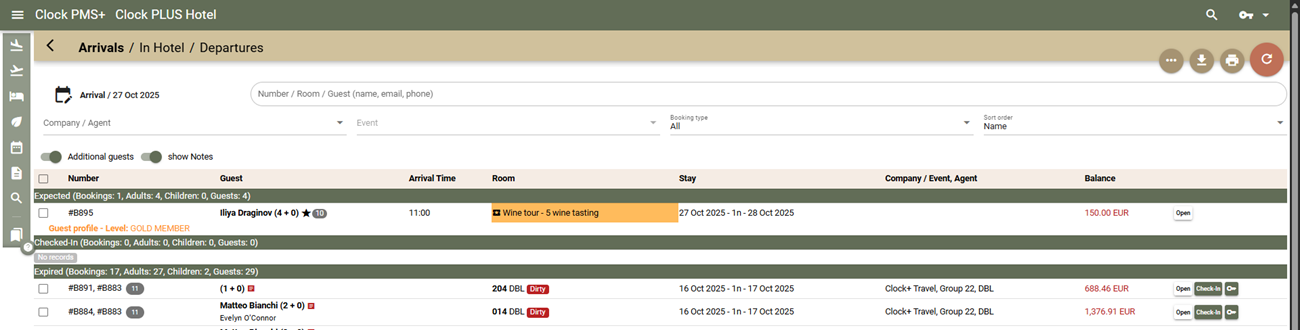
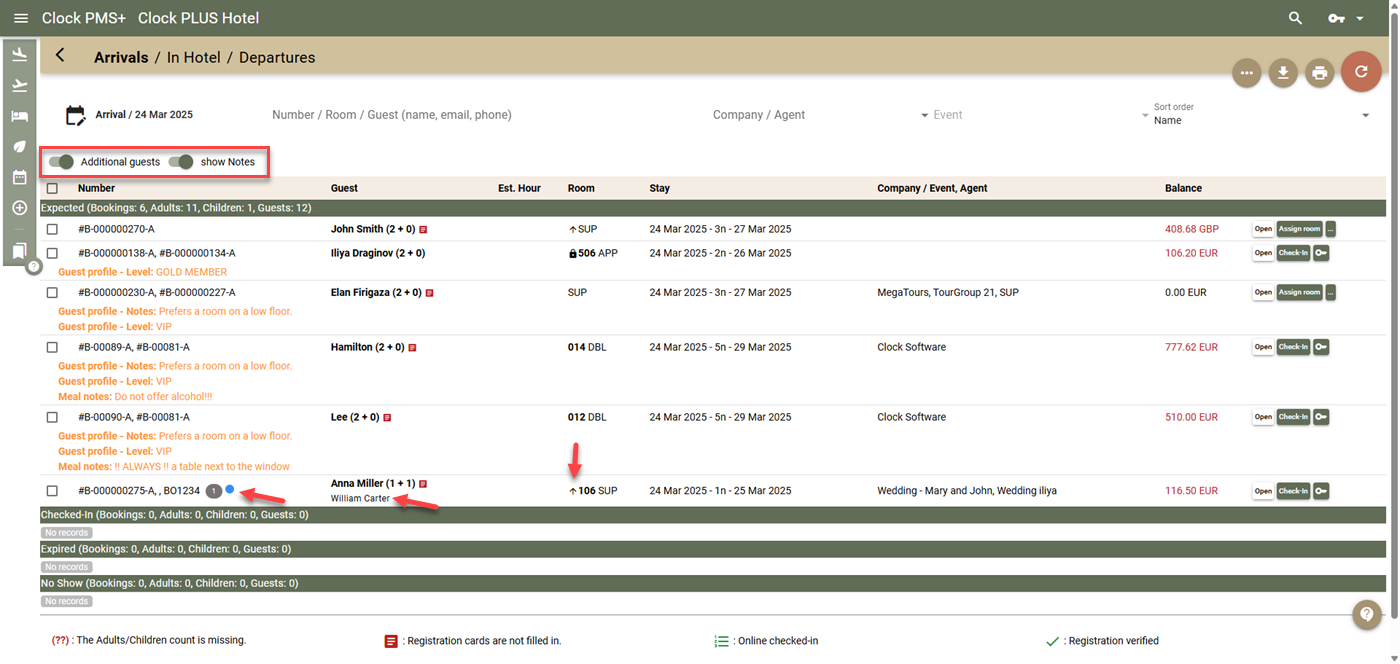
  • Booking Search (Arrivals/In Hotel/Departures screens)
    • We've improved the main search field: we've increased the interval at which the search automatically starts; at least 3 characters are required for the search; you can now start it with Enter as well; if started, the marker remains in the field, unlike before. 
    • A new search field has been added for room number. The separate field ensures that you only find bookings in that room and not other matches, such as by booking number.
    • A quick button has been added to return to the current date
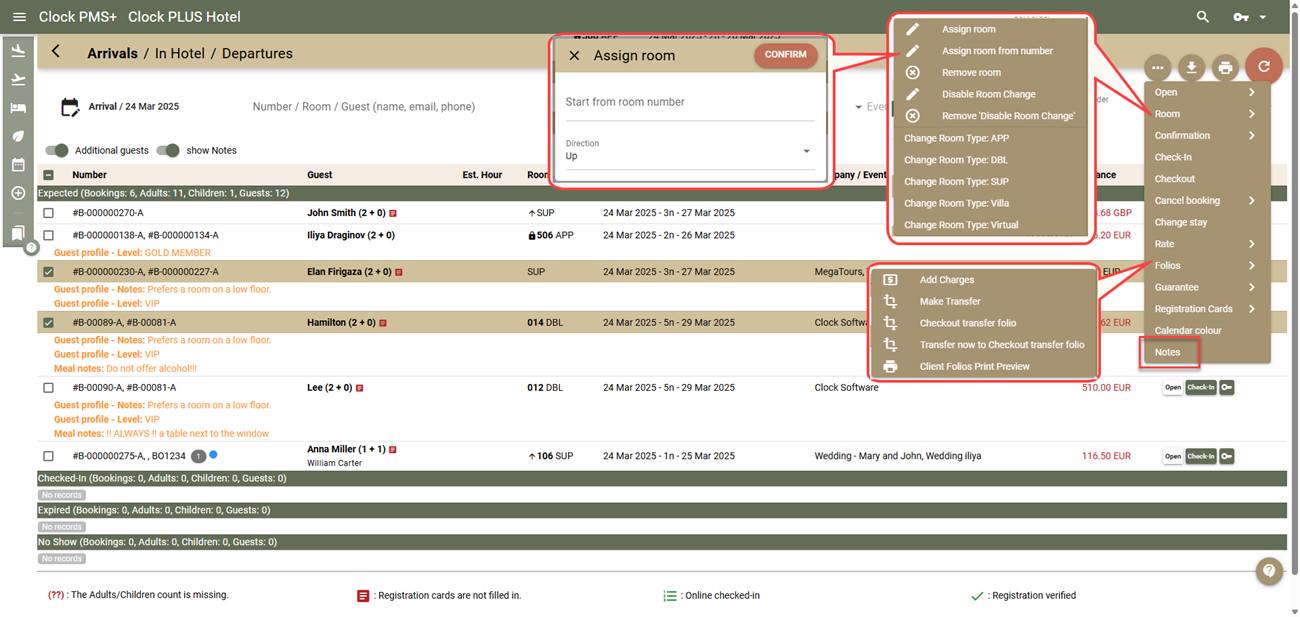
    • In the Mass Functions, under the 'Folios' section, a Multi-Folio view has been added
  • WBE (Web Booking Engine) - Price Breakdown on the last page - We often received reports that this breakdown was unclear and mostly led to confusion instead of helping guests. So, we changed the approach. Currently, the guest only sees the final amount of the booking (against each room and in total), as well as a note that the amount includes all taxes and charges. The guest can see the breakdown for each room using an icon next to the room amount. The breakdown has also been changed so that the entire amount for the rate (package) appears against the Rooms line item, and the remaining services remain in Additional services - either selected by the guest or charged by the system, but not through the rate/package - charge templates for room types or surcharges. If this approach is well-received, we will change the confirmation emails in the same way. 
  • New report - Fire list - The report has been added under 'All Reports' - 'Bookings'. The report has no filters and shows all checked-in bookings with room numbers, floors and guests. There is also a total by floor. It is intended for checking guests against a list if needed. The report has been added to the Bookmark list and can be displayed in the navigation menu;
  • Payments with Credit Cards and Voided Folios - In certain very rare situations, it could happen that while the transaction was being processed by the bank, the folio could be voided by the user. This very rare situation led to discrepancies in the log reports. We have improved the logic, and currently, if such a situation occurs, the payment will be added to a newly created folio instead of the voided one.
  • We've added categorisation of OOS types - For the moment, this categorisation is not used anywhere by the system, but it will be used in new reports we are working on. You do not need to change the settings at the moment. If you decide to change them, assign one of the three categories for each type: Out of order (unexpected problems), Out of service (intentionally stopped from sale - savings, renovation), House Use.
  • Automatic deletion of old To-Do tasks - To prevent the accumulation of unnecessary information that slows down the operational screens, we have added automatic deletion of To-Do tasks older than 1 year. More precisely: If the task has a due date, we keep it for 1 year after that date. If the task does not have a due date, we keep it for 1 year after the date of creation.
  • Rate and Availability screen and Contact Person - Bookings can now be created via the Rate and Availability screen with a contact person who does not have an email address entered. This makes it easier to work when you do not have contact information for the guest. 
  • Room Calendar - three small improvements regarding visualisation
    • We have improved the pop-up screen of the booking, which is now much more compact and takes up less space on the screen.
    • In the filter screen, we have added an option to stop showing the same pop-up screen if you are performing operations where it interferes.
    • The filter screen has also been changed, and with long room type names, the columns do not overlap.
  • Issuing key cards - The suggestions for key card validity when there is a room move have been changed. The default value is now the date of the move and the time of arrival.
  • Channel manager settings (new screens) - a new field "Guest email is masked" has been added to the Company mapping. For the direct interface with Booking.com, the field is one - in the channel settings. For SynXis - there is no such setting. The new field aims to mark in the Guest Profiles coming from a given channel whether their email is "normal" (personal) or "masked" (official, issued by the channel). This information will be used in the future, such as when merging profiles or in online check-in to request a personal email.
  • Booking.com - additional information on stopped products (user/time) is displayed in the maps. This makes it easy to find out when and by whom certain products were stopped without searching for information in the logs. This information will only be visible for those stopped from now on.
  • Links to the Company - We have replaced the links to the Company to show the new Company screens

Fixes

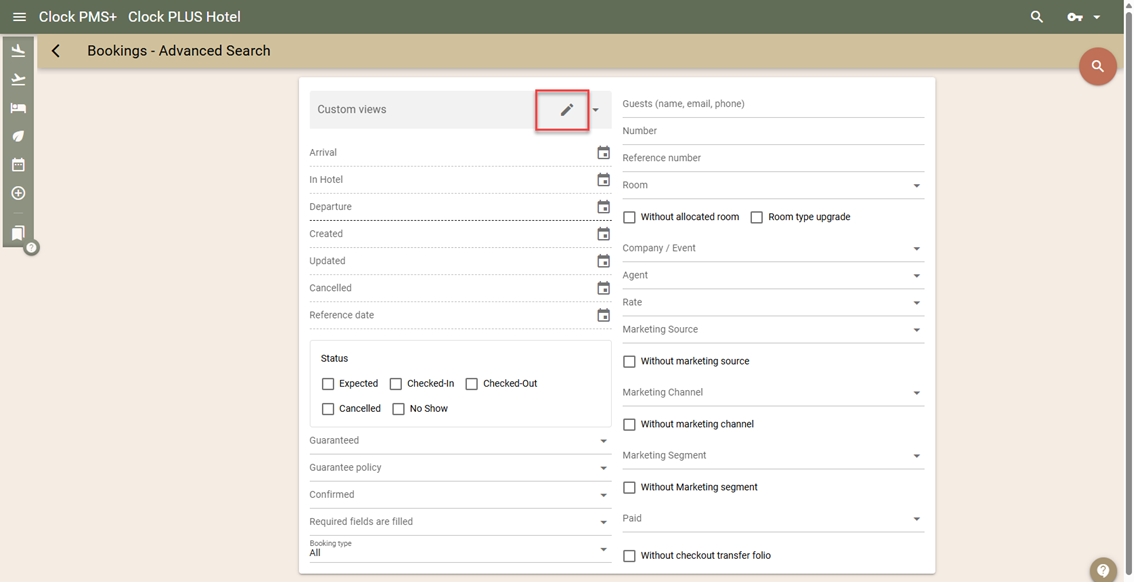
  • Advanced Booking Search 
    • A problem related to searching by guest name only with a large database of profiles has been fixed.
    • Copying key cards sometimes did not give a message, even though the operation was successful.
    • Manual allocation of room number - worked depending on the time zone and sometimes did not function correctly.
  • Charge quantities are now rounded to the 3rd decimal place to make the amount calculations more predictable, as well as due to the requirements of various fiscalisations.
  • Rates and Availability - When creating a reservation, the guarantee policy set at the rate level was applied, but not if one had been set at the season or day level.
  • OTA interface - In certain very rare situations, we were sending updates for yesterday's date, which in turn caused an error on the partner's side.
  • POS/PMS closures - Payments - Summary - the breakdown was not displayed if the total payments was 0.
  • In the rate editor, rates that are used as base rates but were archived were not displayed with their full name. 

Integrations

  • Private Analytics / Google BigQuery Export - A new field "person_title" has been added to the "Guests" table. It contains the title of the guest and complements the existing field "person_title_id".
  • Clock API - A new endpoint has been introduced – booking_booking_charge_template_schema. It allows you to read, create, update and delete daily charges for bookings. For more details, please see the API documentation.
  • Gastronovi POS Integration - We have updated the integration logic. Disabling the “Transfer Tips” option will now only affect the End of Day revenue transfer. Tips will always be transferred to the corresponding guest, company, or event folios.
  • PEPPOL / Billit.be Integration- To improve data accuracy and reduce rounding differences between systems, the export logic has been enhanced. Depending on the account’s tax mode, different values are exported:
  • For:
    • Tax not included in prices, rounding – per line 
    • Tax not included in prices, rounding – total

                    → NET values are exported, allowing TAX to be added on top.

  • For: 
    • No tax
    • Tax included in prices, rounding – per line
    • Tax included in prices, rounding – total

                    → GROSS values are exported, with VAT calculated from the gross amount.

We recommend using rounding – per line, as it minimises rounding differences most effectively. 

To ensure consistency between the Clock document printout and the PEPPOL document layout, we enhanced the logic when Compact mode is enabled. The transferred charges (from Clock POS, LighSpeed POS L series) are compacted based on their source (Bill number), not the print text, even if they have one

  • Private Analytics / Google BigQuery Export - A new field person_title has been added to the Guests table. This field contains the guest’s title and complements the existing person_title_id.
  • QuickBooks Online Integration - The data exchange logic has been optimised to reduce errors in export logs. If a document or payment fails to export successfully after three attempts, it will no longer be retried. This prevents unnecessary errors and delays.
  • Clock API - A new endpoint, booking_booking_charge_template_schema, has been introduced. It allows you to read, create, update, and delete booking Daily Charges. For more details, please refer to the API documentation.

Clock Update (18 Feb 2026)

New Features

Kiosk (new)

We've added new functionalities to the Kiosk: Lost card, Room change and Self Checkout. These features are especially useful for hotels without a 24-hour reception, as their purpose is to expand self-service options and allow for the resolution of more cases without the need for on-site staff.

  • Lost card. If a guest loses their access card or forgets their room number and there is no staff available, the Kiosk can assist them. Once the guest identifies themselves on the Kiosk, they will see information about the room they are staying in and, if necessary, will be able to issue a new key for it.
  • Room change. If a room change is necessary after check-in, for example due to a problem with the current room or an upgrade to a higher category, the guest can get a new key for the new room directly from the Kiosk.
  • Self Checkout. On the day of departure, the guest can use the Kiosk to perform self checkout. The functionality includes:
    • Checking for unpaid charges, accumulated during the stay;
    • Requesting payment of all outstanding charges before finalising the departure;
    • Closing the folios;
    • Sending the documents by email;
    • Marking the booking as checked out.

Marking the booking as checked out provides up-to-date information for the hotel housekeeping scheme and allows the room to be cleaned earlier, which helps to better distribute the workload.

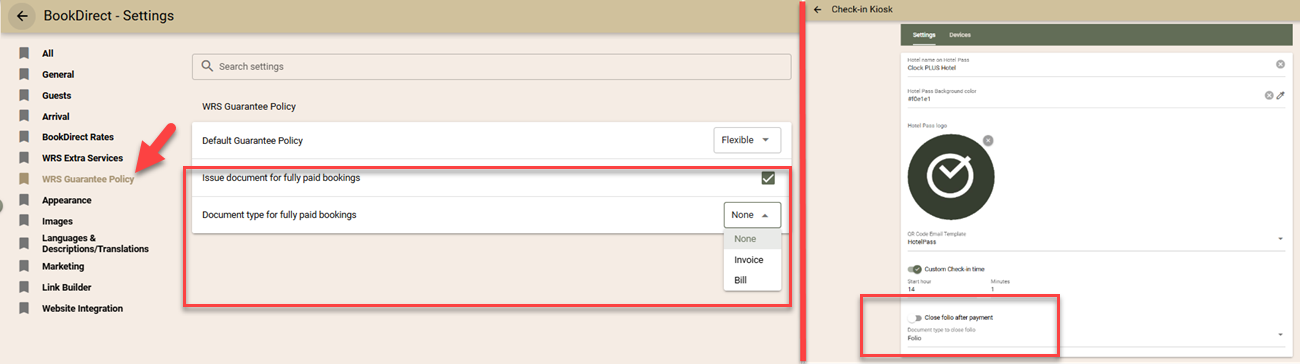
The Self Checkoutfunction via the Kiosk depends on a setting that can be activated from the Kiosk settings screen. When activating, it is also necessary to select the type of document with which to close the guest's folios.

Booking.com

We have made several improvements to the direct integration with Booking.com.

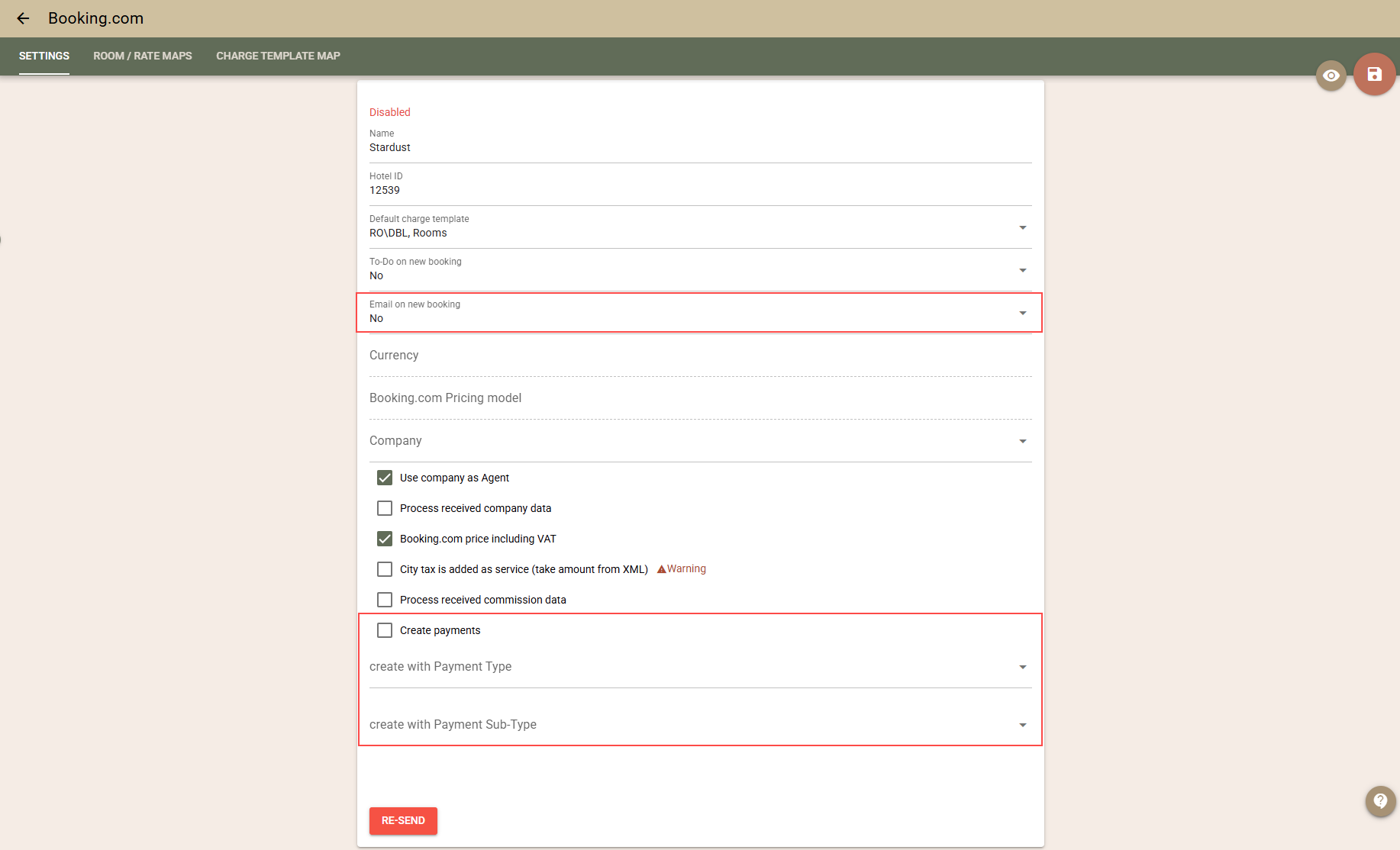
  • Import of payments. If you work with Booking.com on a model where Booking pays you the payments received from guests by bank transfer, this functionality can greatly facilitate your work by automating the addition of payments to the folios. When the new payment import setting is activated, when importing a new booking, if the guest has prepaid a certain amount, it will automatically be added as a payment to the booking's folio. More details:
    • A new setting for payment import has been added, which is disabled by default. Settings for the type and subtype of automatically created payments are also available.
    • The import is performed only when the booking is initially created in Clock. Subsequent updates do not import payments to avoid duplication.
    • The amount of the imported payment corresponds to the amount the guest paid and which was sent in the message from Booking.com.
    • If the guest books several rooms at once, the payment will be added to the first booking in Clock.
    • When initially importing existing bookings (if the setting is enabled), the available payments for them will also be imported.

Important: In certain situations, the initial import of bookings is performed with minimal data, in which case payment information may not be available and will therefore not be imported.

Virtual cards. Can the function be used if Booking.com pays the funds via virtual cards?

Yes, it is possible, but we do not recommend it, as the folios will appear as already paid. This can make your job more difficult because:

  • automatic payment collection tasks will not be able to be used (as the folios will already be marked as paid);
  • tracking the virtual cards that need to be charged will be more difficult.
  • Improvements in the mapping of room types. We have changed the restrictions on the mapping of room types. It is now possible to duplicate the mapping of a room type if it is not exported. This allows, if you use the connection with Booking.com only for importing bookings, to map several room types from Booking.com to one room type in Clock PMS.
  • Email notification upon new booking. We have added the ability to receive an email when a new booking is imported from Booking.com. In the Booking.com settings, there is now a new option to send an email notification for each new booking.

Improvements

  • Booking – "Re-Route charges". We have added a new button to the booking screen that allows you to re-route (Re-Route charges ) the charges on the booking. The function reviews all charges (automatically or manually added), regardless of which folio they are currently in. Based on the currently active router (by Company, Agent, Event or manually selected in the booking) and the current routing rules, the system determines which folio the charges should be in and transfers them automatically. The following charges are not affected by the function:
    • Charges in closed folios;
    • Charges belonging to other bookings;
    • POS transfers.

Example: You have a rule for routing to a company, according to which all charges, except for City Tax, are transferred to the company folio. Later, you find that the City Tax should also be transferred to the company folio. You edit the router, open the booking and execute the "Re-Route charges" function. As a result, the City Tax charges will be transferred to the company folio.

  • Folio prints – merging rows with different VAT. We have added the ability for rows with different VAT rates to be merged in the printouts if they have the same print text.

    To enable this behaviour, you need to hide the tax percentage column: Settings → Documents → Folio Printing - defaults enable: "Hide Tax percentage column". Once the column is hidden, rows with the same print text will be merged.

Example: You have a "bed and breakfast" package where the services have different VAT. Until now, they were printed on separate lines. They can now appear as a single line with a total price.

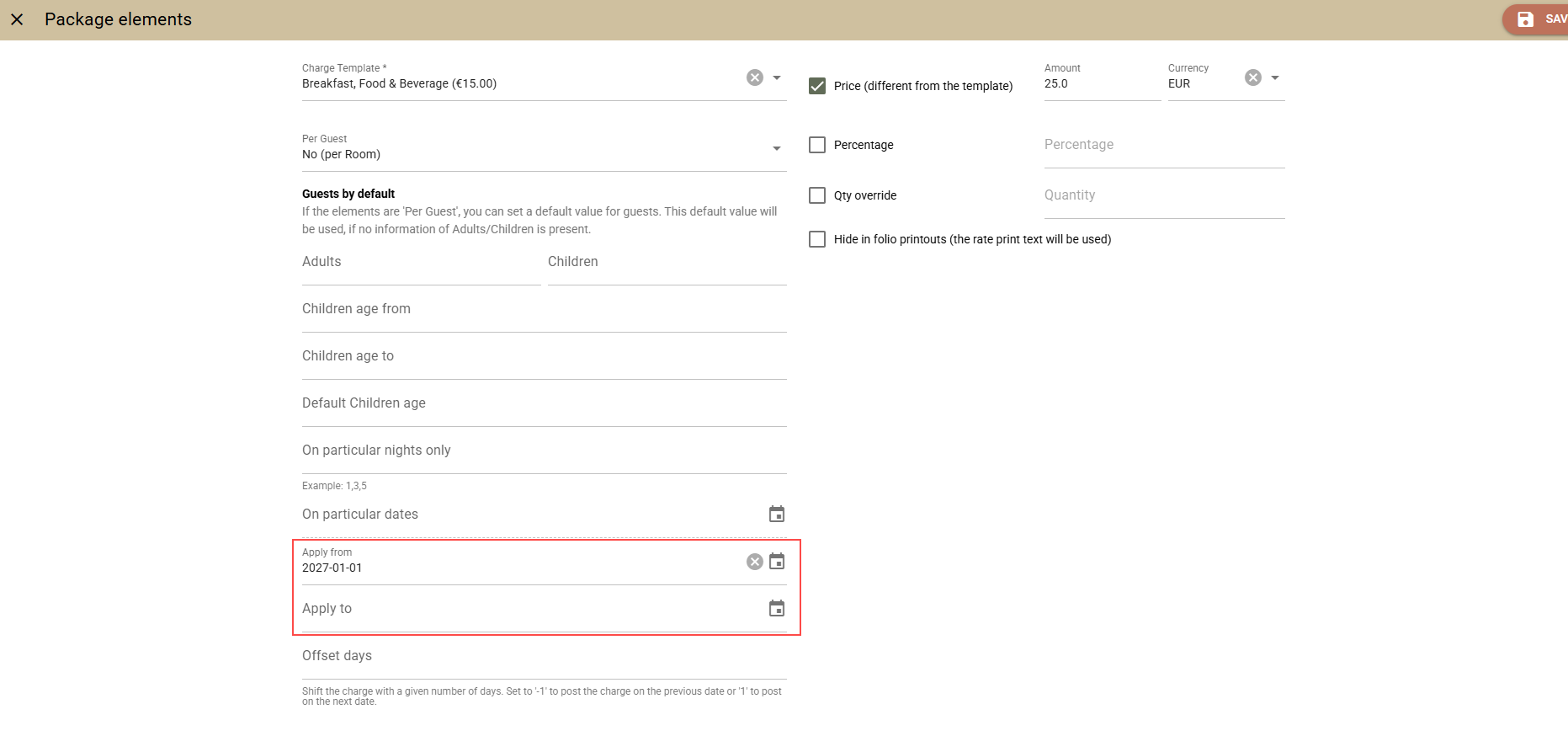
  • Rate Packages  – items valid for a period. Until now, the items in the rate packages could only be limited by specific dates, which is not convenient for long periods (months or years). We have added the ability to define items through a valid period.

    The period can also be "open" – only "from" or only "to" is filled in.

Example: The package may contain:

  • Breakfast for 2026 at a price of EUR 20
  • Breakfast from 2027 at a price of EUR 25
  • Elavon – improved integration stability. We have made a change in the interface with Elavon in order to increase stability and reduce failed transactions. We removed the initial "verifying" transaction, which in certain combinations of payment means and operators could fail for no apparent reason and block the actual payment. Its removal has no negative consequences and we expect significantly more stable behaviour.
  • Arrivals/Departures screens – quick date navigation. We have added buttons for quick navigation to the previous/next date in the new Arrivals/Departures screens, without having to select a date from the calendar.
  • Booking Enquiry – personalised text in the offer email. In the new booking enquiry screen, we have restored the ability (available in the old screen) to add personalised text to the offer email. The Header and Footer fields are displayed respectively before and after the main text of the offer.
  • Availpro – booking agent. Previously, if the submitted agent did not have an IATA number, it was not imported and the booking remained without an agent. We have changed the logic so that in the absence of an IATA number, the system uses the agent specified in the company mapping.

Fixes

  • Events – Rooming list. The created bookings now inherit the marketing segments according to the standard logic (Rate→ Company→ Agent→ Event), as in the other screens (e.g. Rate and Availability).
  • Sorting of rates. We have fixed an issue where changes in the rate sorting screen could not be saved if there were archived rate plans.
  • RoomCloud – Export Log. The "RoomCloud room" and "RoomCloud rate" columns now show not only the ID, but also the name of the room/rate.
  • Search for events. We have added the PAX field in the event search screens, where it was missing.
  • Rate and Availability(new). We have fixed an issue where bookings could not be created in combination: with a company, without guest details and with reference numbers.
  • Booking enquiries – email template: We have fixed an issue where two parameters were not displayed in the email template: booking_offer_item.arrival_bookable.t_name, booking_offer_item.arrival_bookable.t_description
  • OTA / SiteMinder – Export Log. We have corrected the filter by room type, which did not work when selecting a virtual room type. In addition, the room type code is now displayed when mapping to virtual room types.
  • POS – Promotions. We have fixed an issue where after deleting a charge template used in a promotion, the promotion could no longer be edited.

Integrations

  • PEPPOL e-Invoicing (gateway: billit.eu). The rebuild feature logic has been improved.
  • Italian Invoice Export. To avoid rounding differences (especially for Tax mode Tax not included in prices, rounding – total) between the document lines and total, tax rounding difference charges have now been added to the document lines to match the sum of all changes and total amounts for the documents.
  • Mailing list. The +Add guest option has been optimised for better usability and now works faster 
  • Gastronovi POS integration. The End Of Day function is now optional and you can use hotel transfer on its own if you don't need consolidated reporting.
  • Romanian e-Factura. The bank accounts configured as Payment Means can now be configured to be added to all folios regardless of their balance. The Current behaviour is to add them only to the folios with an outstanding balance. The behaviour can be changed using ROMANIA - e-Invoicing / RO eFactura export Settings from the AppConnector menu
  • Standard Sweden Accounting Export (SIE4). A Standard SIE export option has been added to the AppConnector. More information about how it can be configured and used is available in the support article "Standard Sweden Accounting Export (SIE4)"
  • Atomize integration. We have added the ability to open a new Atomize account for those of you who already have one. The feature should be used with caution and after the advice of Atomise as it should be followed by the new Atomize onboarding process.
  • Clock API
    • We added the number of adults and children to the occupancy_forecasts endpoint. More information is available in the relevant API documentation.
    • Rooms and room_types endpoints now provide information of the components for the virtual rooms / room types. More information is available in the relevant API documentation.


Clock Update (28 Jan 2026)

Improvements

  • Instructions for routing charges to monthly folio. New routing instructions have been added to automate monthly invoicing when working with a Company or Agent, where the agreements are based on the month of arrival or departure of the bookings. Two instructions for Company and two instructions for Agent have been added to the existing instructions for creating folios. These allow charges to be automatically transferred to monthly folios based on the month of arrival or the month of departure of the booking.

    Example: All bookings for a given Company arriving in January 2026 can be automatically routed to a folio named "2026-01", those for February to folio "2026-02", and so on.

    Important: These routing instructions differ from the existing Monthly Invoicing functionality, which is designed for long-stay bookings. The difference is that the routing instructions are guided by the month of arrival or departure of the booking, while monthly invoicing is aimed at distributing charges by month for a prolonged stay.

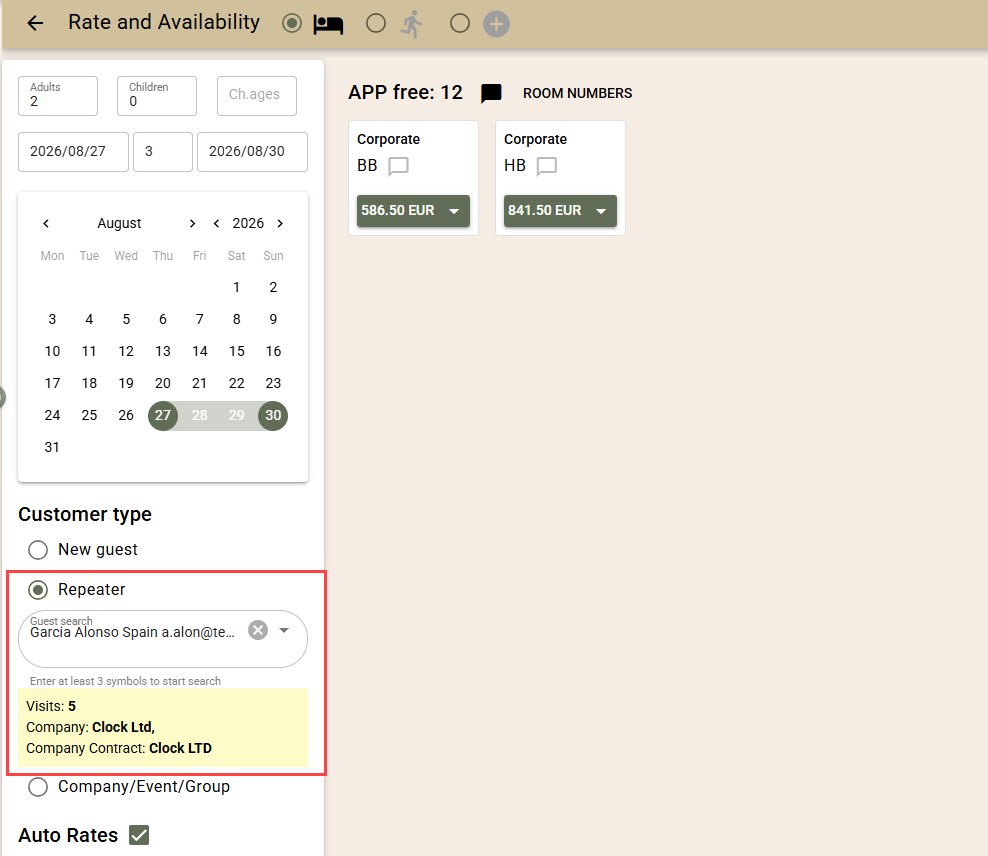
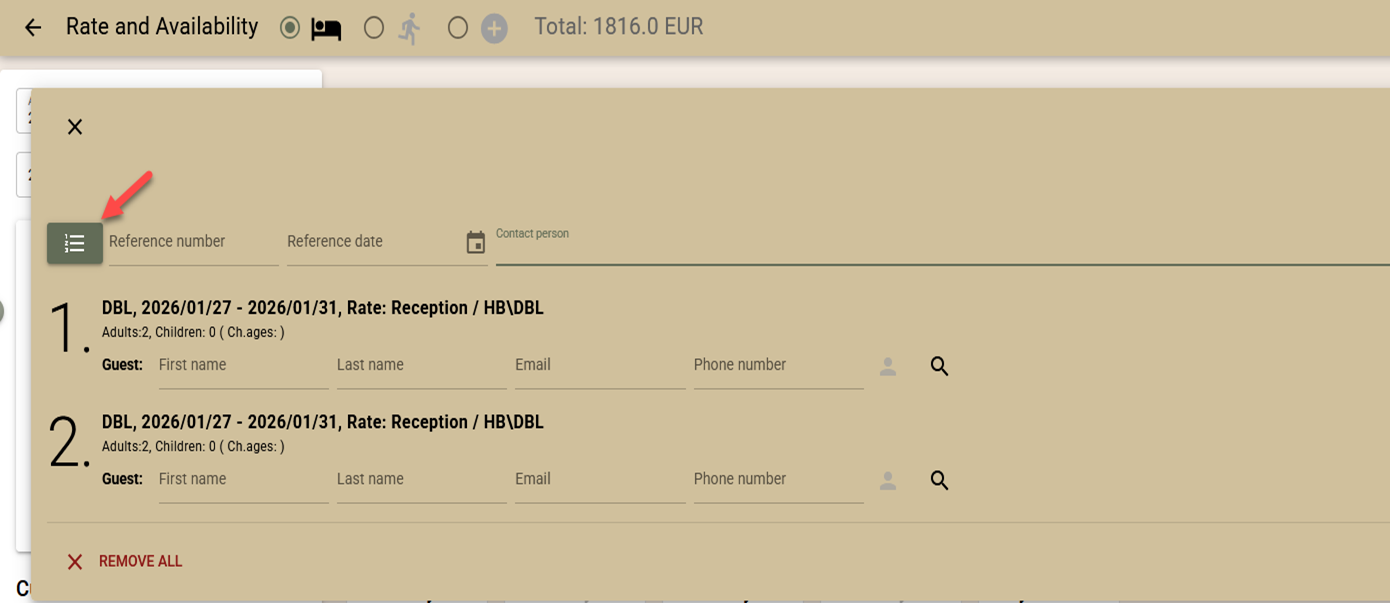
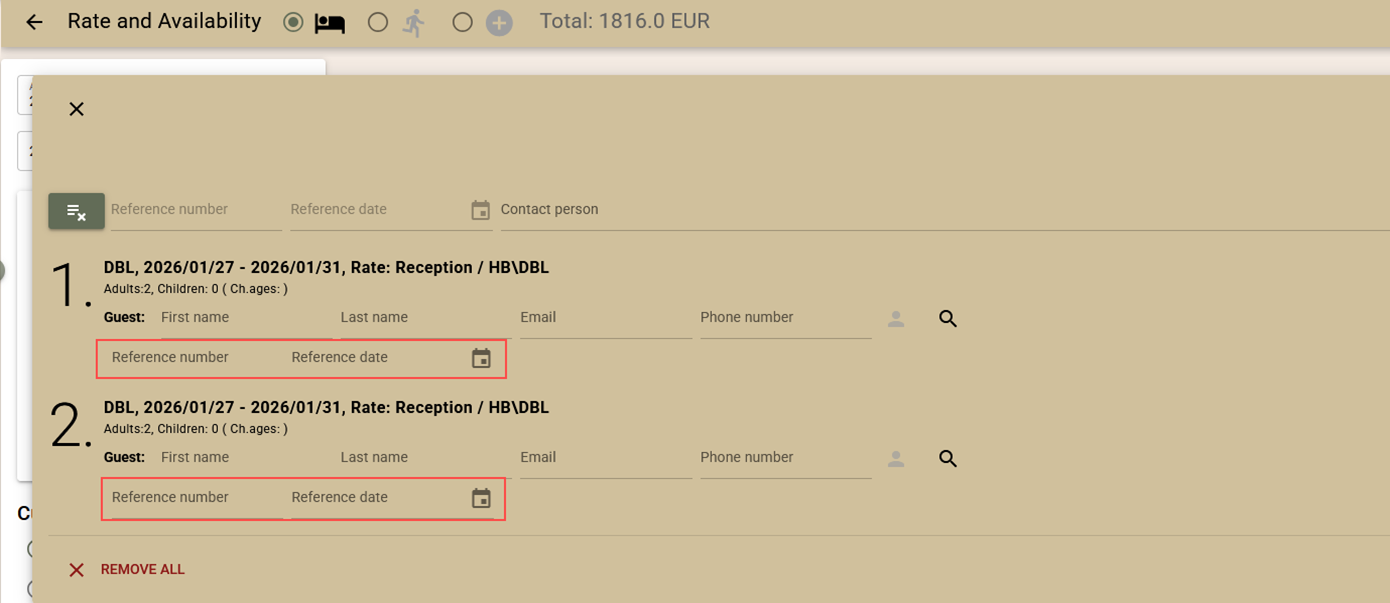
  • "Rate and Availability" screen (new) – reference date and individual references for each booking from the cart. In the "Rate and Availability" screen (new), new possibilities related to the reference data have been added:
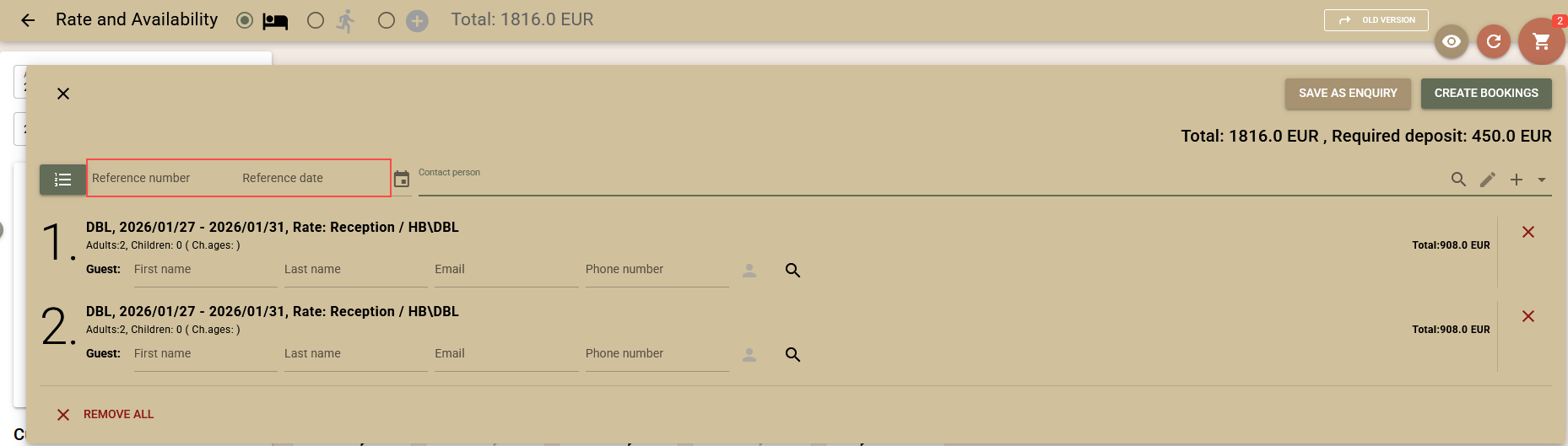
    • It is now possible to fill in a reference date, in addition to a reference number;

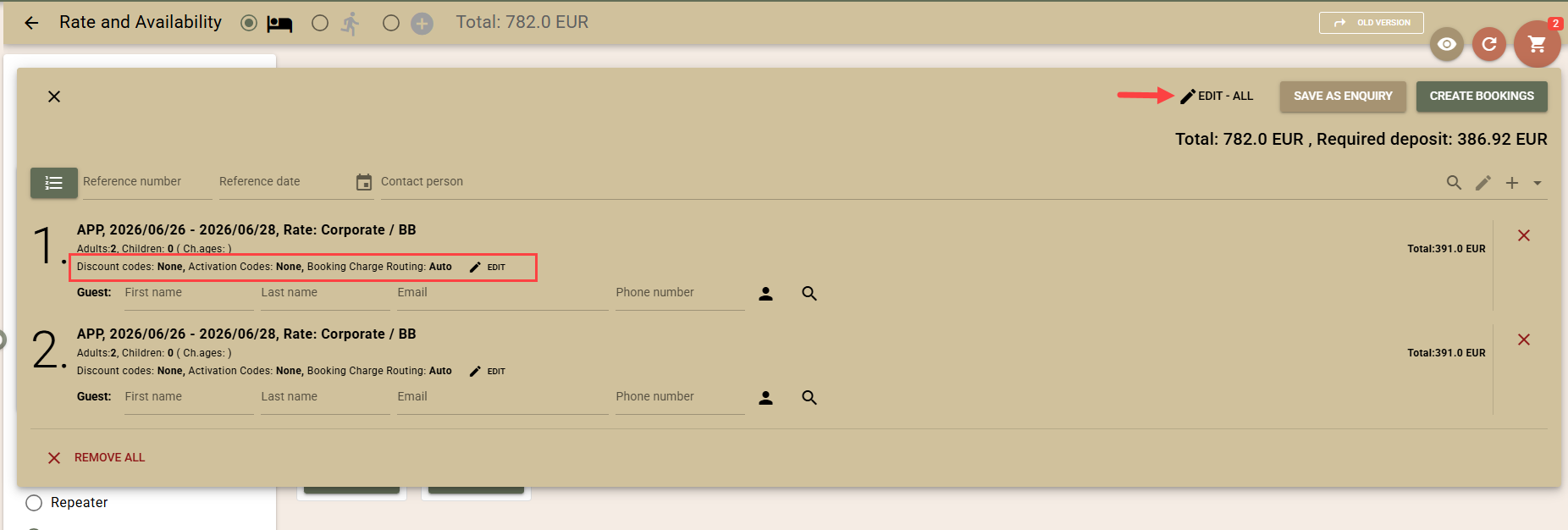
    • If there is more than one booking with different reference numbers, it is possible to enter different reference numbers and dates for each row(booking). To do this, use the button next to the reference number field at the top of the screen. This disables the common reference fields and adds the same fields to each row of the cart. By pressing the button again, you can return to the general input mode.

  • Housekeeping tasks – automatic generation. The ability to automatically generate housekeeping tasks at a pre-set time has been added. Keep in mind that automatic generation can be executed up to 15 minutes late compared to the set time. The setting is done from the menu Settings → Housekeeping → Automatically generate tasks.
    After setting a time for the next generation (for example, 06:00), the tasks will be generated automatically every day at the same time. To stop the automatic generation, the field must be cleared and saved.

Integrations

PEPPOL e-Invoicing (gateway: billit.eu)

  • The Purchase Order Number value from the closing folio is now exported as a Reference to PEPPOL. This field is often used by customers to validate the document.
  • Added the ability to send company contact person details – First name and Last name from the Contact Info section. This information helps large organisations identify the department from which the expense was made.
  • Folio remarks are now exported as Comments in the PEPPOL document. They often contain important information that needs to reach the customer.
  • In order to bring the appearance of PEPPOL documents as close as possible to those generated by Clock, print_text support has been added to charges when entered. If print_text is missing, the name of the charge is exported as before.
  • Added balance support for the sent folio. This allows the customer to easily see how much is still owed on the specific document if it has been partially paid.
  • Added the option to export the source of the charges. It is now possible to include the source of the charges in the PEPPOL document. The source most often contains details of the booking, including the period of stay and the main guest. The aim is to bring the appearance of documents exported to the PEPPOL network closer to the standard appearance of documents in Clock. The functionality must be explicitly enabled from App Connector → PEPPOL and e-Invoice connectivity with Billit.eu → Settings
  • Export of documents in compact view. Added the ability to export PEPPOL documents in a compact view. There is now a Compact modeoption in the interface settings, which works as follows:
    • Compact mode disabled – charges are sent in detail as before;
    • Compact mode enabled – charges are grouped analogously to the Compact view of folios:
      • grouping by tax % and print_text;
      • when print_text is missing, the text field is used;
      • since PEPPOL requires a quantity (qty) field, it is always submitted with a value of 1.

Localisations

Italian Invoice Export. The way VAT Payment Method information is exported (EsigibilitaIVA) has been changed. Until now, Split VAT Payment was only allowed for B2G documents (SDI number with 6 characters). As a result of regulatory changes, Split VAT Payment can now also be used by other companies with an SDI number of 7 characters, so this control has been removed. When using Split VAT Payment, the ImportoPagamento field (balance to pay) now takes into account the value excluding VAT, as the tax is paid directly by the customer to the state.

Clock Update (21 Jan 2026)

New Functionalities

Rate and Availability – Updated Screen

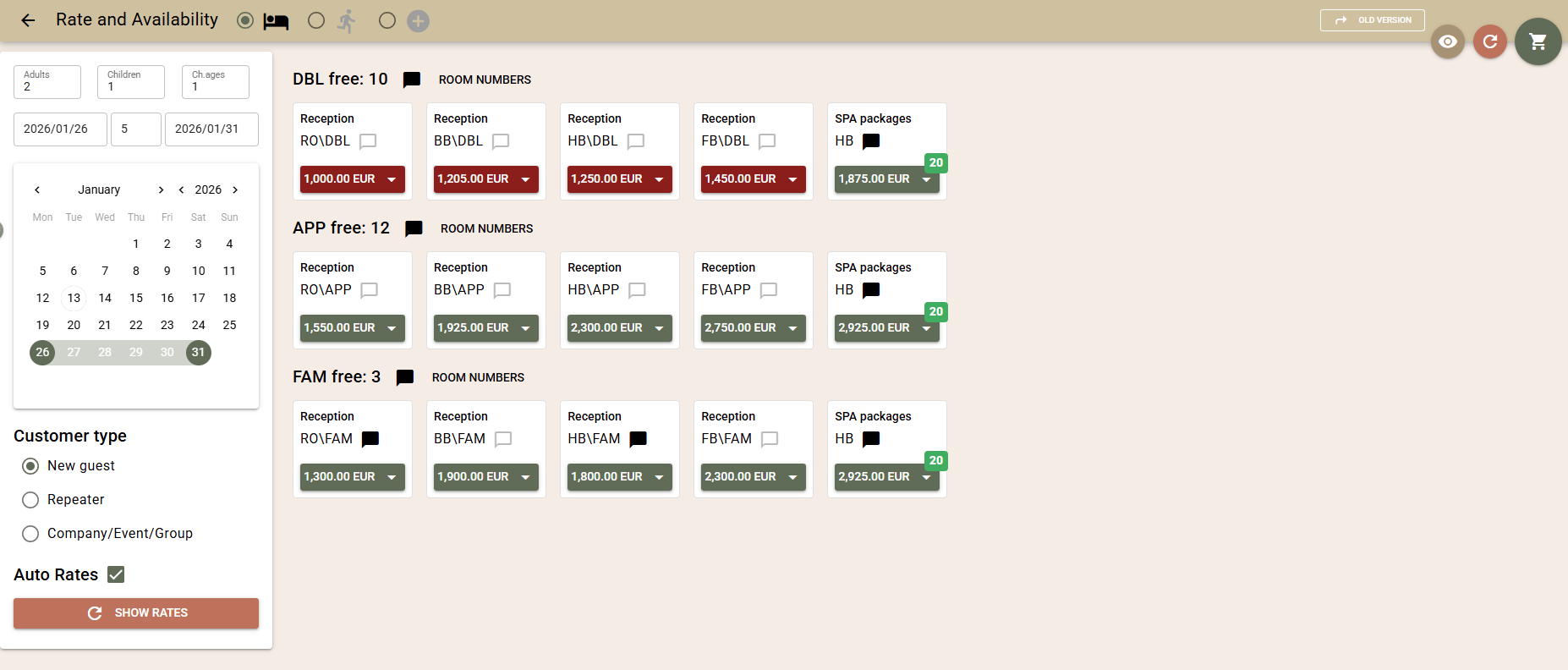
We've launched a new and significantly improved version of the "Rate and Availability" screen, making it easier to work with bookings and providing better visibility of prices, availability and related information.

Key improvements and new features:

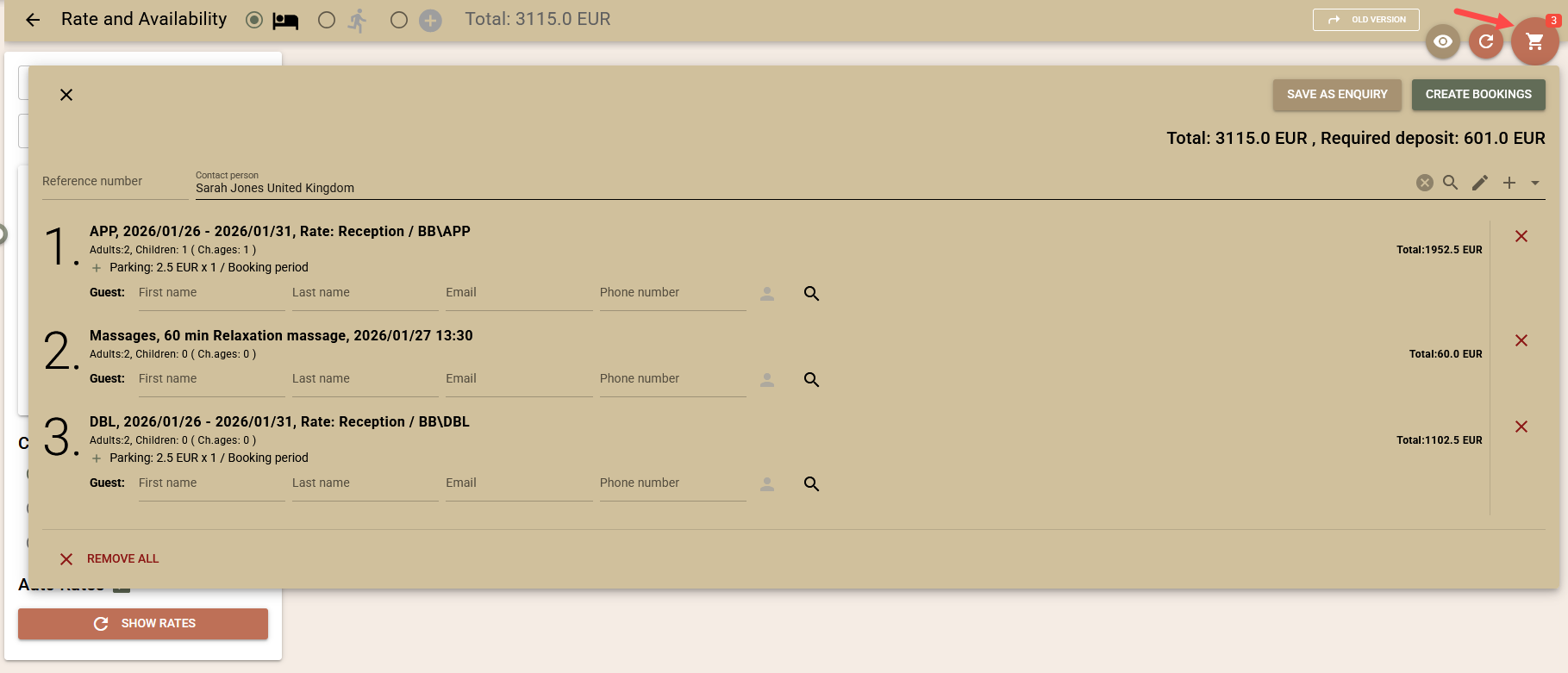
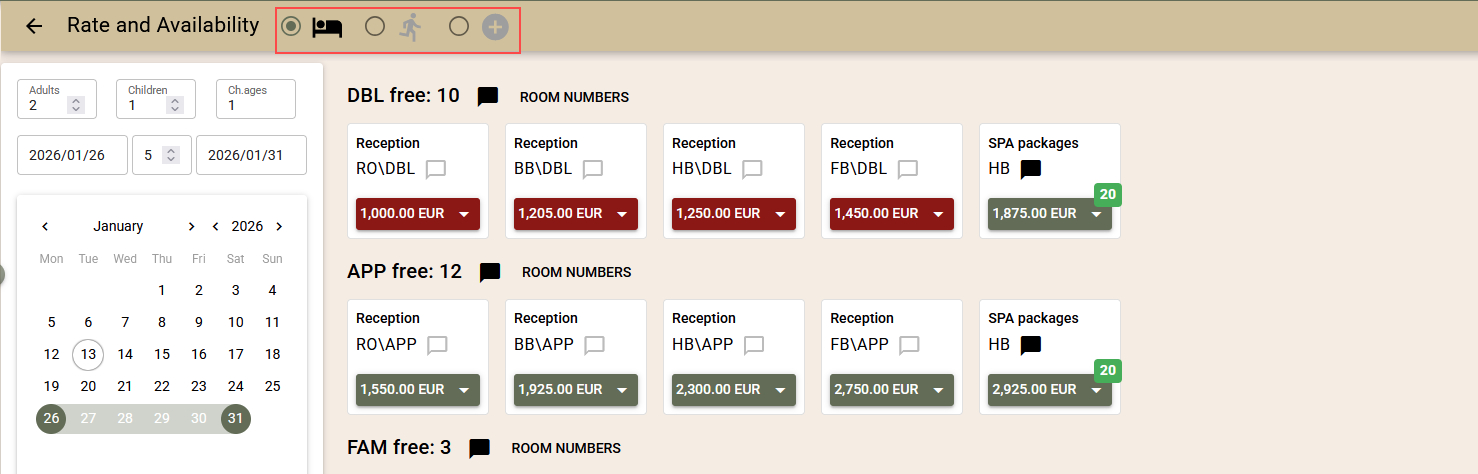
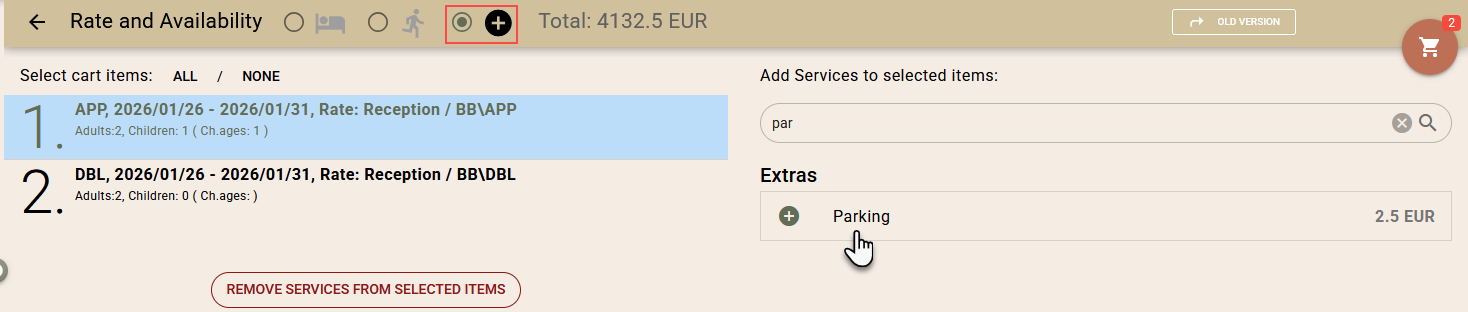
  • "Cart" – room bookings, activity bookings and total price;
  • Additional services for bookings;
  • Automatic or manual mode for rate selection;
  • Manual price;
  • Selection of Profile, Company, Event or Block and transfer of information to the booking;
  • Improved block booking, including optional blocks;
  • Selection of one or more room numbers;
  • Multiple information views and interactive filters;

Booking cart (rooms, activities, and services)

The screen now works with a cart that allows you to add:

  • room bookings with different numbers of guests, room types, rates, blocks and periods;
  • activity bookings;
  • additional services to rooms and activities.

The following is visible in the cart:

  • the price of each product;
  • the total amount;
  • the total amount of the required deposit.

The calculation includes all applicable elements – Tax regime, City Tax regime, Markups, Automatic charges to bookings related to room types, as well as added Additional services.

Once the cart is complete, you can:

  • create bookings directly;
  • or save it as a Booking Enquiry.

When saving as an enquiry, activity bookings are not supported and are excluded with a warning message.

From the radio buttons to the screen title, you can choose what you are booking: Rooms, Activities or Additional Services.

Activity Bookings

Bookings are supported for activities, introduced with the previous update, as the first part of the new "Rate and Availability" screen.

Manual Price

If you have the appropriate user rights, you can enter a manual price for a selected rate.

The system offers standard calculated daily prices, which can be edited.

The manual prices entered are correctly reflected in the cart and transferred to the enquiry or booking.

Additional Services for Bookings

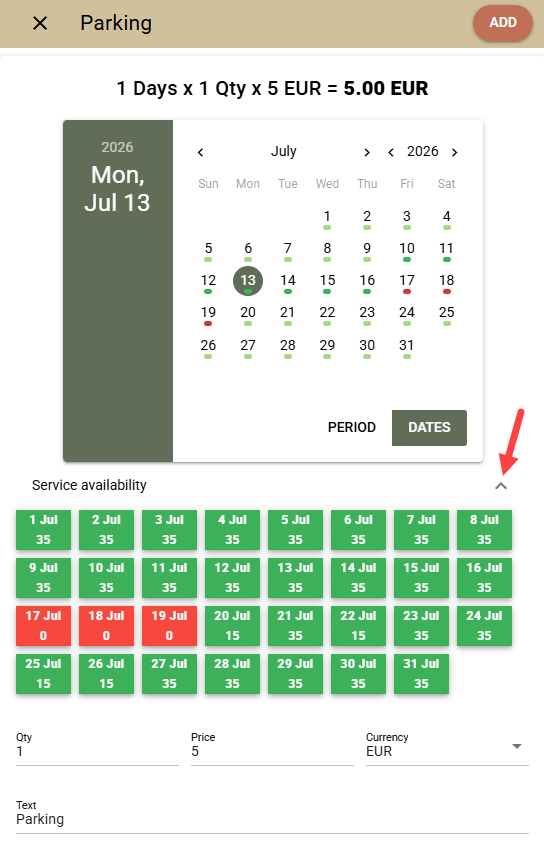
After adding rooms or activities to the cart, additional services (e.g. dinner, parking, cot) can be added even before the booking is created. When saving as an enquiry, the selected services are transferred to the final booking.

For services with limited daily capacity, the system shows:

  • availability by day;
  • visual indication of insufficient availability.

Additional services can be applied for:

  • the entire period;
  • the arrival date;
  • the departure date;
  • specifically selected dates.

All services are included in the total amount of the cart.

Automatic and Manual Rate Selection Mode

Automatic Mode

The system automatically selects appropriate rates according to the client type:

  • Individual / Returning guest – preferred rates;
  • Company / Event – rates from the Company agreement, if not available – preferred rates;
  • Block – the rate or manual price from the block, if not available – the Company agreement, then preferred rates.

Manual Mode

It is possible to select rates:

  • by rate plans;
  • by rate tags.

For both modes, searching is available, as well as saving the selected plans or tags for future use (locally for the station).

Selection of Profile, Company, Event or Block

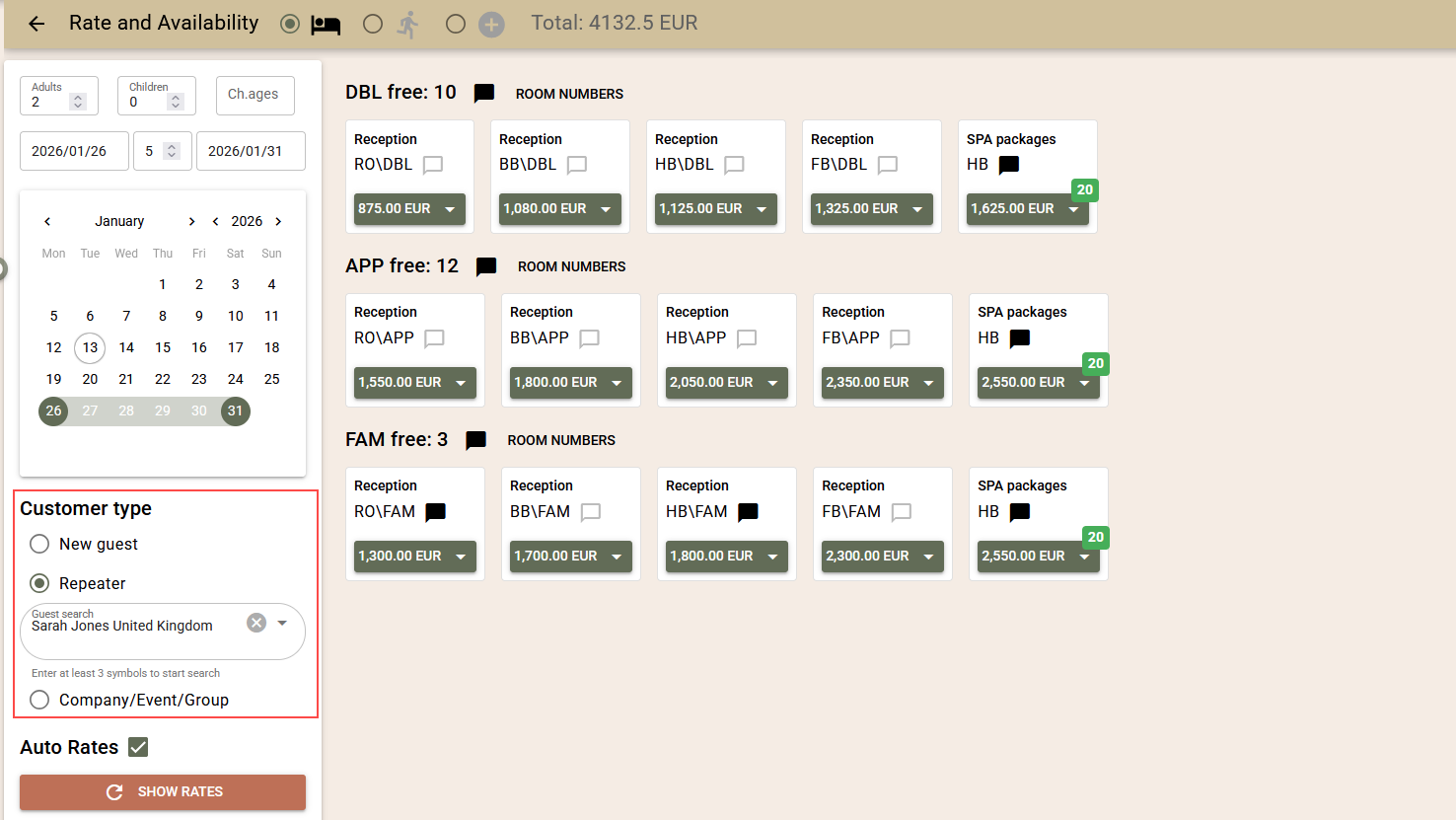
The client type can be selected in advance, which helps automatic rate selection and the transfer of information to bookings.

Supported:

  • selection of contact profiles as a guest, for Company / Event / Block;
  • choosing whether the returning guest is a contact person or a guest;
  • selection of an existing profile even for an individual guest;
  • pre-entering data for new guests.

Automatically transferred:

  • Guarantee policy and meals from the rate;
  • Reference number (manually entered or automatically generated);
  • Marketing segments (priority Event → Company → Agent → Rate);
  • Colour for the calendar and Client cost centre from the Event.

Improved Block Booking

  • Blocks are selected directly by period, Company and Event (without a code);
  • Optional blocks are supported;
  • Availability is the minimum value between the block and the hotel availability;
  • Blocks without pre-set rates or manual prices are supported.

Selection of Specific Room Numbers

In addition to room types, it is now possible to check and select specific available numbers before creating the booking or enquiry.

Views and Interactive Filters

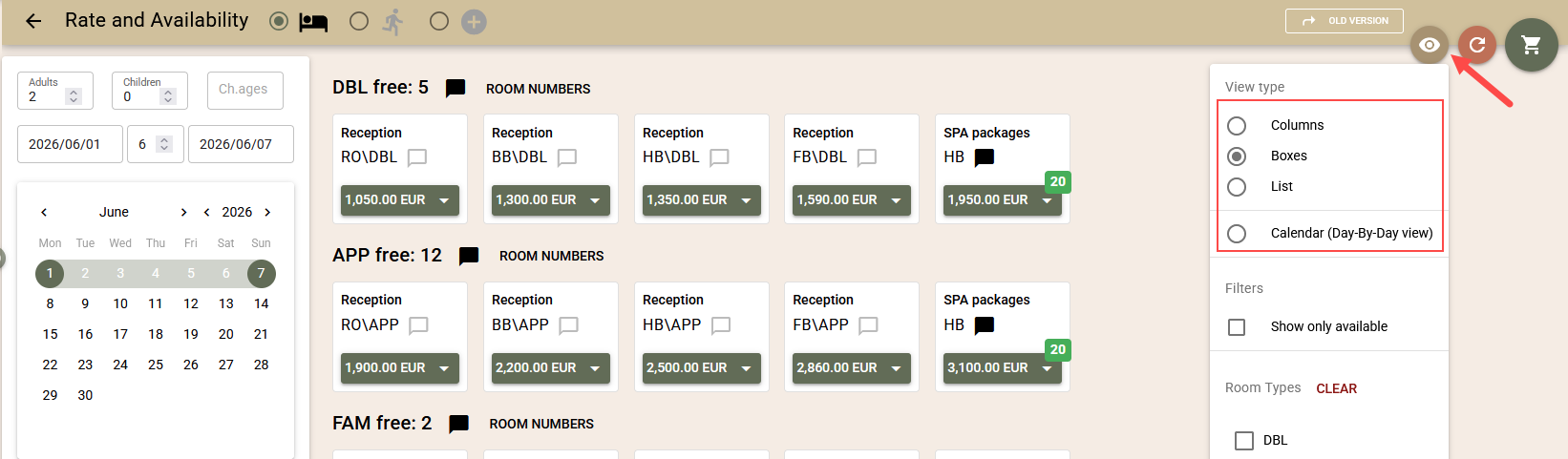
Several views are available:

  • List - each rate on a separate line;
  • Boxes - compact view;
  • Columns - suitable for unified rate names (RO, BB, HB, etc.);
  • Calendar - detailed overview by day.

The last selected view is saved for the device.

The filters for room types and "only available" work instantly, without reloading.

Additional Improvements

  • Descriptions for staff for room type, rate and guarantee policy;
  • Adding one or more room bookings with one click;
  • Visibility of activated restrictions;
  • Tracking the booking creation process and the ability to "Retry" in case of a removable error;
  • Significantly improved performance – up to 2 times for few rates and up to 4 times for many rates;
  • Support for limited capacity packages.

Detailed Instructions

For a detailed description of how to work with the new "Rate and Availability" screen, see the following articles:

"Rate and Availability" Screen: Creating Bookings

"Rate and Availability" Screen: Additional Services

"Rate and Availability" Screen: Advanced Features

Rules for Automatic booking charge routing

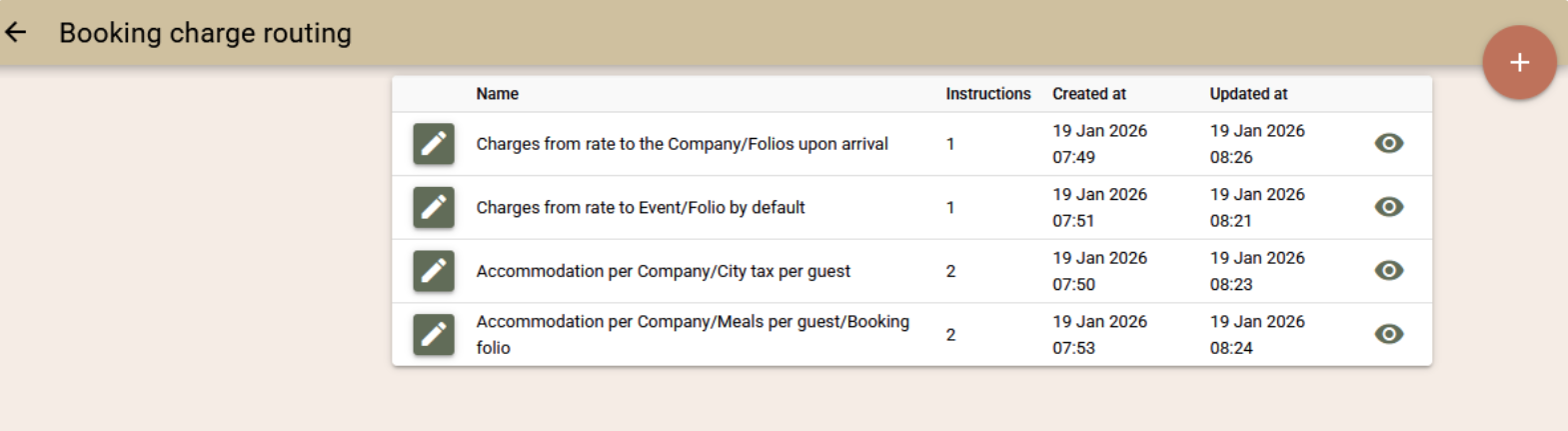
A new functionality has been added for automatic booking charge routing through predefined rules, which eliminates the need for manual transfers between folios.

What problems does it solve:

  • Removes manual processing of charges for corporate, group and event bookings;
  • Reduces errors in complex payment and invoicing agreements;
  • Facilitates the management of scenarios with different payers and deferred payments;

What it is:

  • Configurable set of rules for automatic charge routing;
  • Determines who pays a specific charge and in which folio it is reflected;
  • Applied automatically to all related bookings after a one-off setup.

What it allows:

  • Distribution of charges between Guest, Company, Agent or Event;
  • Routing of charges to specific folios at the time of charging;
  • Automatic split or grouping of invoices according to the agreements;

  • Support for on-site payment and deferred payment.

How it works:

  • Rules are created that determine who pays and in which folio the charges go;
  • The router is selected at the Company, Agent or Event level;
  • All related bookings use the router automatically, without the need for manual actions;


What charges are routed:

  • Automatic charges (rates, packages, daily charges, City Tax);
  • Manual charges per booking;
  • Transfers from POS to room.

Supported scenarios include:

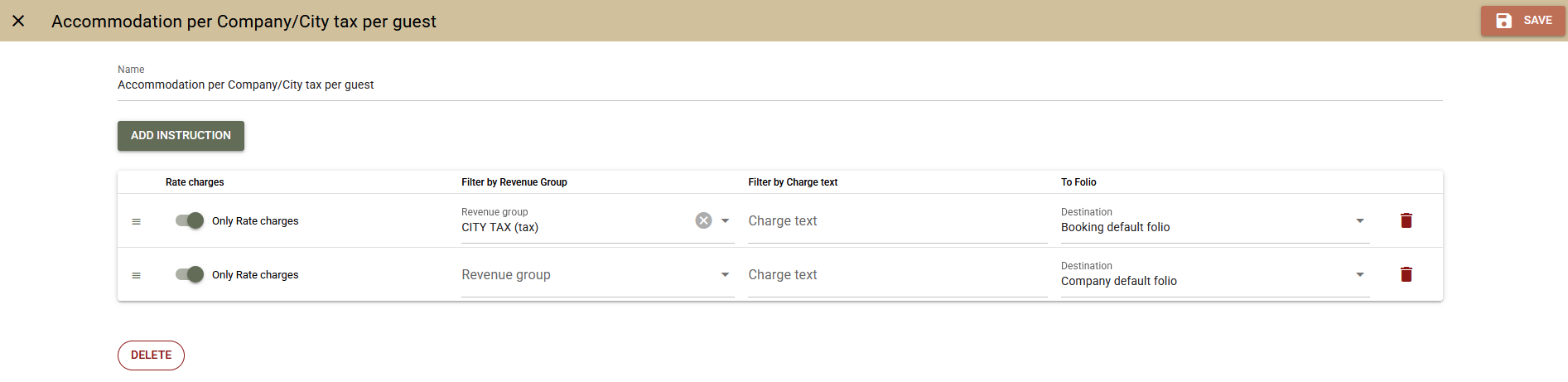
  • The company pays for the package, the guest – for the additional services;
  • The guest pays, but the invoice is in the name of the company;
  • Separating a package and additional services into different folios;
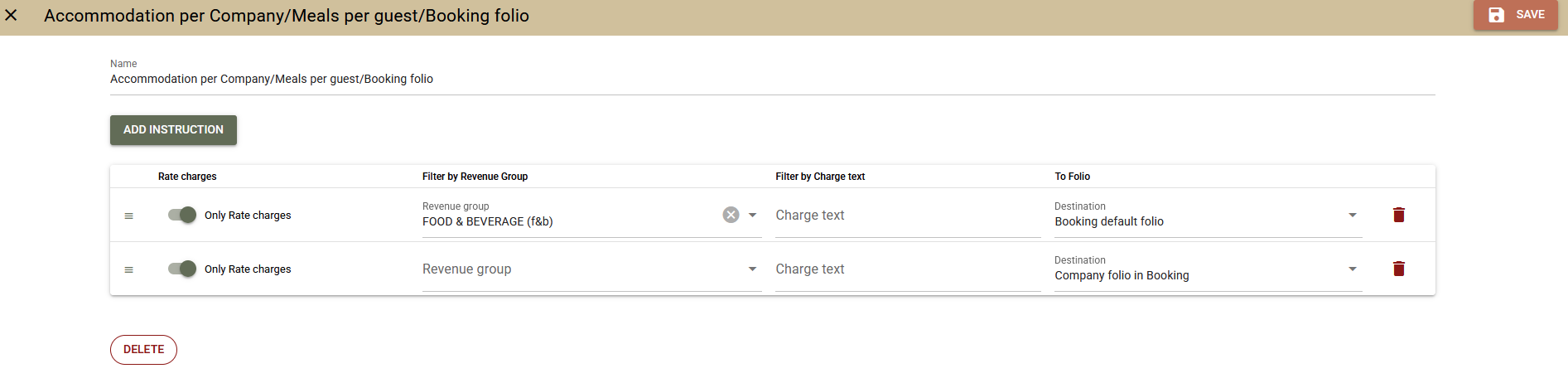
  • The company pays for the accommodation, but not for the meals, even when they are part of a package;
  • Many other combined scenarios with Event, Company, Agent and Guest.

Important:

  • Routing is applied only at the time of charging;
  • Already made charges are not moved automatically;
  • Charges added directly to a folio are not routed.

For more details on the settings, logic and use of the new functionality, see our detailed articles:

Rules for automatic routing of booking charges

Using Charge Routers

Improvements

Booking Enquiry

We have added new screens for Booking Enquiry – search and edit. These are accessible from the navigation (the "New" button) and from the new "Rate and Availability" screen. The existing functionality has been retained and enhanced with the following improvements:

  • Ability to add additional services to the room in the enquiry;
  • Ability to link the rooms in the enquiry to a Company, Agent or Event.

Additional services added to rooms via the new "Rate and Availability" screen are now also saved in the corresponding room of the enquiry. They are visible in the enquiry screen and are automatically transferred when a booking is created – both from the WBE and directly from the enquiry screen.

Similarly, the Company, Agent or Event selected in the "Rate and Availability" screen is saved to the room in the enquiry, displayed in the screen and transferred to the created booking.

These improvements make Booking Enquiries a more complete and convenient tool for working with both individual and corporate guests.

Other Improvements

  • Booking.com – increased number of mappings. If you are using both Booking.com and another channel manager, we have increased the number of rate mappings available. 100 separate mappings have been added, reserved specifically for Booking.com, so its settings are not limited by the mappings used for other channels and vice versa.
  • Activities – deleting time slots. It is now possible to delete a time slot for activities, even if it has been used in existing bookings. Deletion does not change existing bookings, their times or associated capacities, which remain active. This provides greater flexibility in managing and changing time slots.
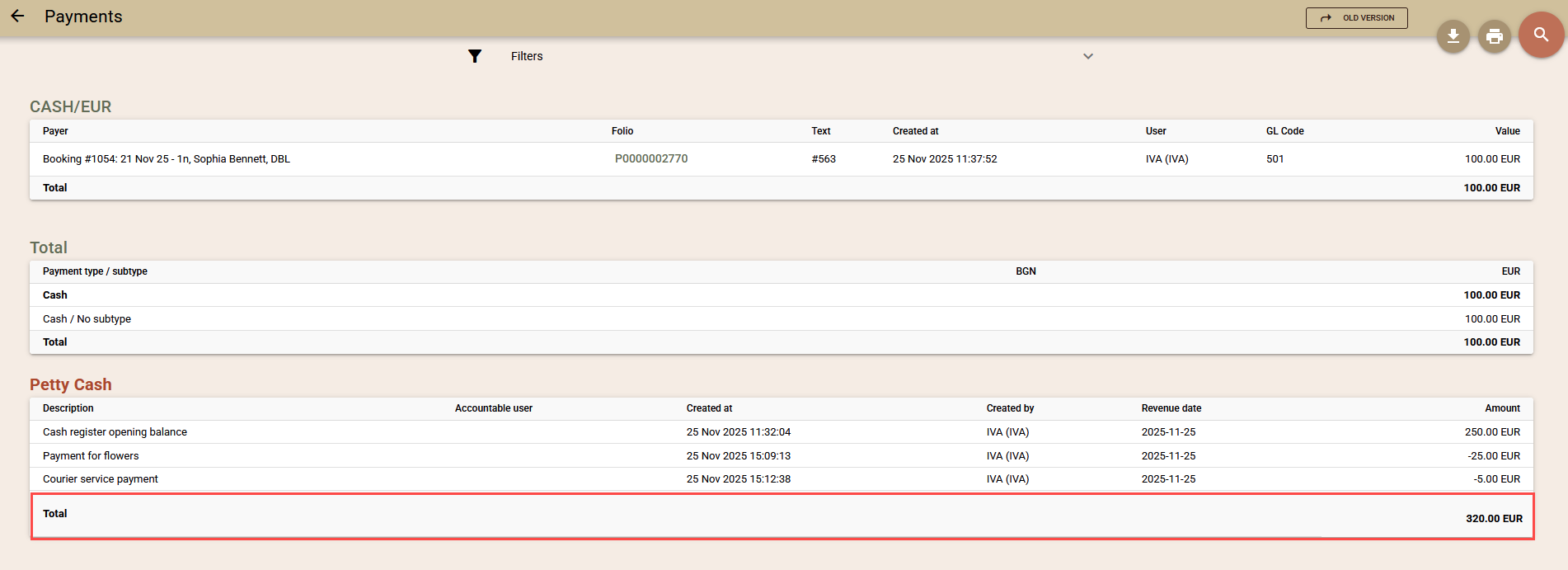
  • "Payments" Report – Petty Cash. A separate total for petty cash payments has been added to the report for clearer and more detailed reporting.
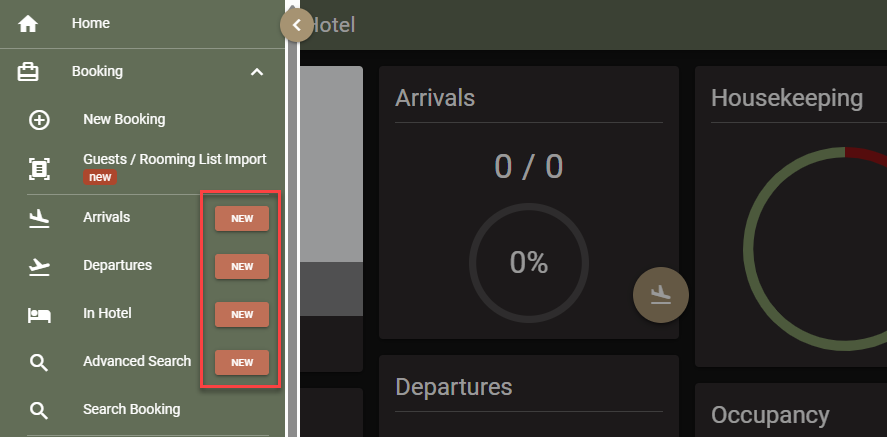
  • Switching to the new booking search screens. The new booking search screens are now active by default, including: Arrivals, In Hotel, Departures, Advanced Search.
  • Closings – support for longer periods.The user or day closing functionality is designed for daily reporting. In practice, however, there may be a longer period between two closings (for example, when closings have not been used for a long time or are being activated for the first time). In such cases, a large number of folios, charges and payments accumulate in the period, which may make it difficult or even block the generation of a report. The behaviour of closings has been improved so that the system can handle long periods:
    • Period from 1 to 7 days – the closing contains a full and detailed report, as before;
    • Period from 7 to 30 days – the closing contains a summary report with payment totals, without a detailed breakdown;
    • Period over 30 days – the closing contains no data and is considered the beginning of a new reporting period. The next closing will contain the full report;
    • Initial Closing – for new accounts, it is advisable to make an initial closing after setting up the system and before actual operation to start reporting correctly.
  • WBE link builder. Added the ability to create links to specific activities. This allows for better integration of WBE with your website – for example, the booking buttons on the site can lead directly to a selected activity instead of the general list of activities.
  • The starting work screen. Errors from Booking.com and SynXis are now displayed in the "Channel Managers" section of the start screen.

Fixes

  • Guest Portal – the room type in the details bar is now translated correctly;
  • Email Verification – corrected the incorrect message when there is a mismatch between the verified email and the email entered as username in custom SMTP
  • Printing Documents – printing cancelled documents no longer increases the printed number;
  • Surcharge in Folio – corrected the incorrect calculation for a specific combination of calculation method, discounts and available charges;
  • "Rate and Availability" screen: – corrected the reporting of free rooms when virtual room types are blocked;
  • Deposit Ledger – fixed an issue where a small unallocated amount remained when the advance and final folios had different currencies, due to currency differences;
  • Company Overview Screen – consumed and cancelled folios are no longer displayed in the list of deposit folios;
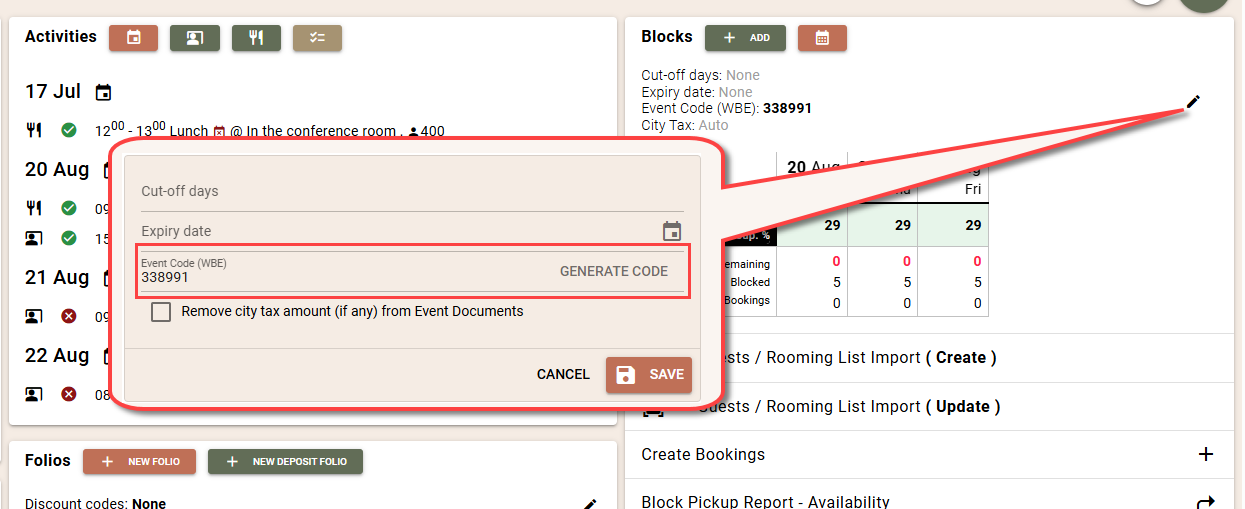
  • WBE – the Event Code entry screen now opens correctly in the selected language;
  • Booking Advanced Search – corrected the key card issue times, and the time zone is now correctly taken into account.

Integrations

  • Gastronovi
    • Mapping Optimisation - the process of creating and maintaining mappings between Gastronovi and Clock has been optimised;
    • Non-room booking support - support for Non-room bookings has been added. For easier recognition in the Gastronovi interface, these bookings are submitted with room "NON-ROOM booking".
  • PEPPOL e-Invoicing (gateway: billit.eu)
    • Added Client Data - the set of client data exported to PEPPOL has been expanded, and now includes: Address, City, ZIP Code, Country Code;
    • Improved Receiver ID Validation - the validation of the receiver identifier has been improved. Validation now works correctly even when using separators, for example: 123 456 789, 123.456.789;
    • Receiver ID from Company Custom Field - the ability to select the Receiver ID field from a Company Custom Field, and not just from the standard Company fields, has been added.
    • API Key Check on Activation - a check of the configured API Key has been added when saving settings with Active enabled. If the key is invalid, the system will return an error "StandardError: ApiKeyNotValid". The aim is to prevent the saving of an invalid API Key, which would prevent the sending of documents to the PEPPOL network.

Localisations

  • RO e-Factura
    • Export in Compact View - the ability to export documents in a compact view has been added. A new XML Generation option is available in the interface settings, which works as follows:
      • Compact mode disabled – charges are exported in detail, as before;
      • Compact mode enabled – charges are grouped analogously to the Compact view of the folios:
        • grouping by tax rate (tax %) and print_text;
        • if print_text is missing, the text field is used;
        • the quantity (qty) field is always submitted with a value of 1, as required by e-Factura;
    • Different InvoiceTypeCode for fiscalised documents - documents containing payments subject to fiscalisation are now exported to e-Factura with InvoiceTypeCode = 751 (instead of 380). We remind you to check the settings for fiscalised payments in Settings → All Settings → Romanian Fiscal Policy → Fiscal Payment Types.
  • Italian Invoice Export
    • Change in the content of the <RiferimentoTesto> element - the <RiferimentoTesto> field has a limit of 60 characters. With the previous method of filling in the field, it was possible for the booking reference number to exceed the allowed length. With this change, the content of the field is now exported in the following standardised format: Jul 31 - Aug 01 2025 / BOK.13456789 / APP, Daniel Wood, where:
      • BOK.13456789 is the reference number of the booking;
      • if a reference number is missing, the booking number is used (for example, Booking #362).

Clock Update (25 Nov 2025)

New Functionalities

Petty Cash

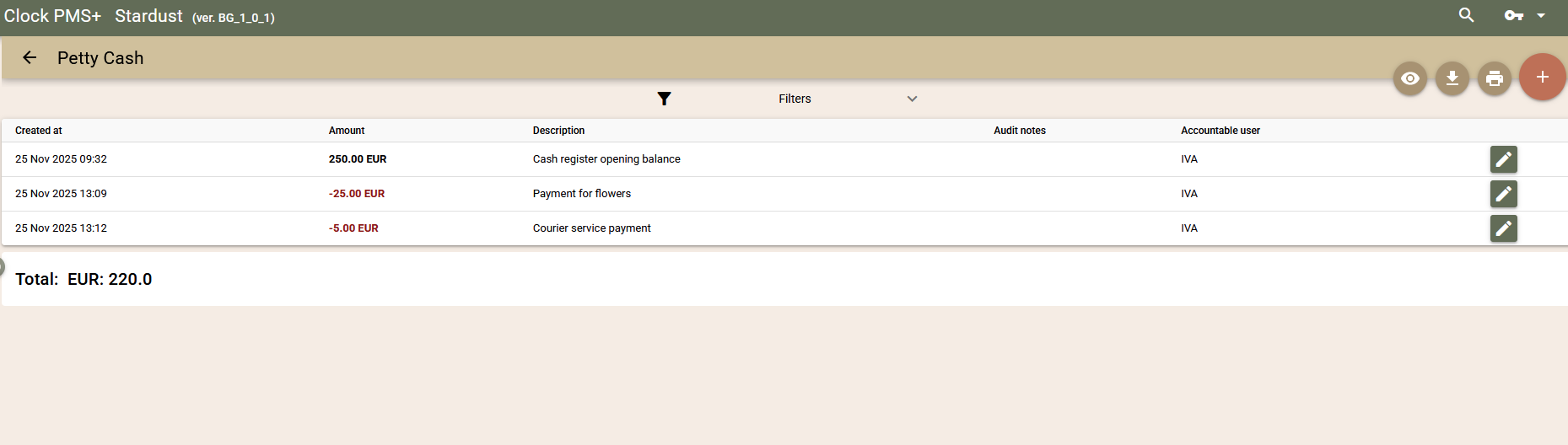
We have added a new functionality, through which you can track petty cash flows and the overall cash balance. Up until now, the system tracked cash flow related only to customer payments. Flows related to petty cash inflows and outflows were not directly tracked, and the workaround with payments in an external folio was unclear and created confusion. The new functionality is aimed at providing an explicit register for such movements. Here is a description:

  • To access the new function, from the navigation select  Other functionalities→Petty Cash;
  • Strict chronological order. Editing or deleting entries in the register is not allowed. All corrections should be registered with an opposite sign. The financial date of the operation provides clarity and comparability with all financial operations.
  • Two levels (user rights) of access.We have organised two levels of access – for users and auditors.
    • Petty Cash. With this right, you can register movement – inflow and outflow in your name.
    • Petty Cash Audit. This right allows you to register movement – inflow and outflow, both in your name and in the name of someone else. That is, if you are a cashier and hand over cash to another person, you can specify the other person as having received the funds. This way, the system will retain clear information for both users.
  • Description and note for the auditor. Each entry has a field for the operation description, which cannot be edited. To facilitate the auditing process, there is a separate field for a note to the entry, accessible only to the auditor, which can be filled in and edited if an auditor right is present. In it, the auditor can fill in notes related to issues or questions to assist them in the process.

  • Overall Balance. Entries from the cash register appear in the "Payments" report, taking into account the period and user filters. The entries are added at the end of the report, and a total sum per currency has also been added. The total sum includes cash payments on folios + the cash register.

  • Fiscal requirements. It is important to know that the cash register is not linked to fiscalisation. If your legislation requires fiscalisation of petty cash flows, then this module does not meet these requirements and we do not recommend using it.
  • POS. In addition to the PMS, you can also use the register in the POS. We have added a new button to the management screen, and the entries are included in the "Payments" report.

Improvements

Companies – new screens

We have completed work on the new Company screens, which are more compact, faster, and more convenient than the old ones, but overall, we have tried to maintain the old way of organisation and operation. Here are the changes:

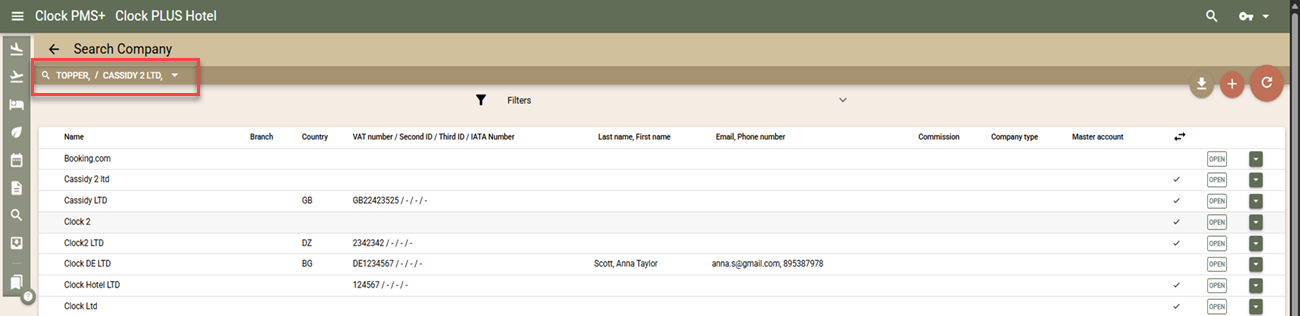
  • New Company search:
    • The search is in real-time, as you type the details of the company you are searching for (name, VAT number, contact information), and there is no need to start it.
    • Quick access to recently opened Companies. Similar to recently opened Events, a separate bar displays the companies most recently opened on this device. Select a company to open it. The full list of the last 20 used companies can be opened by clicking on the triangle icon at the end of the row.

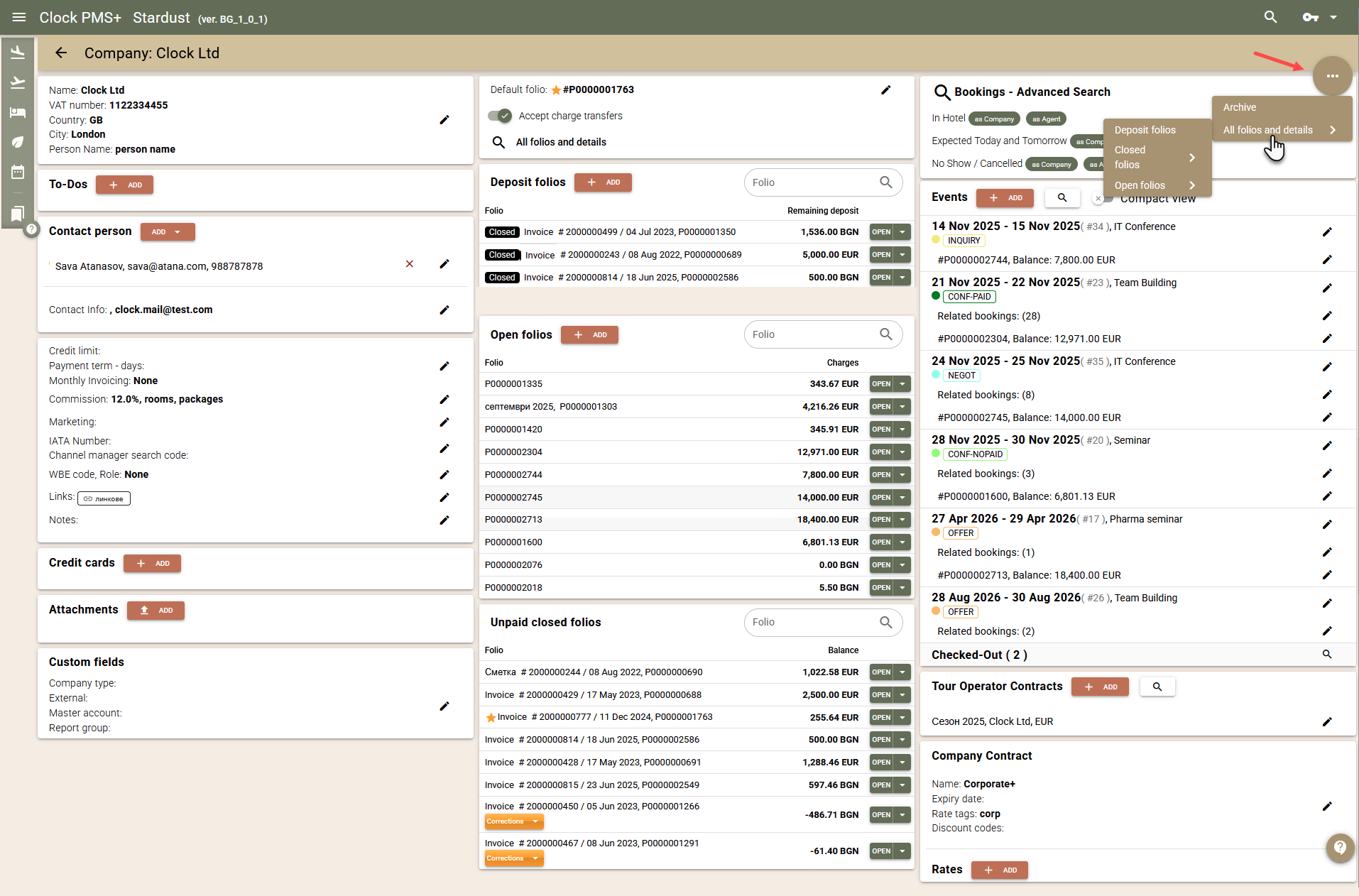
  • New Company screen:
    • In-place editing. Instead of opening a large form with all fields, we have made it possible to edit only the fields you wish to edit. Similar to the Events screen, click on the edit icon or on the data itself and edit only those.
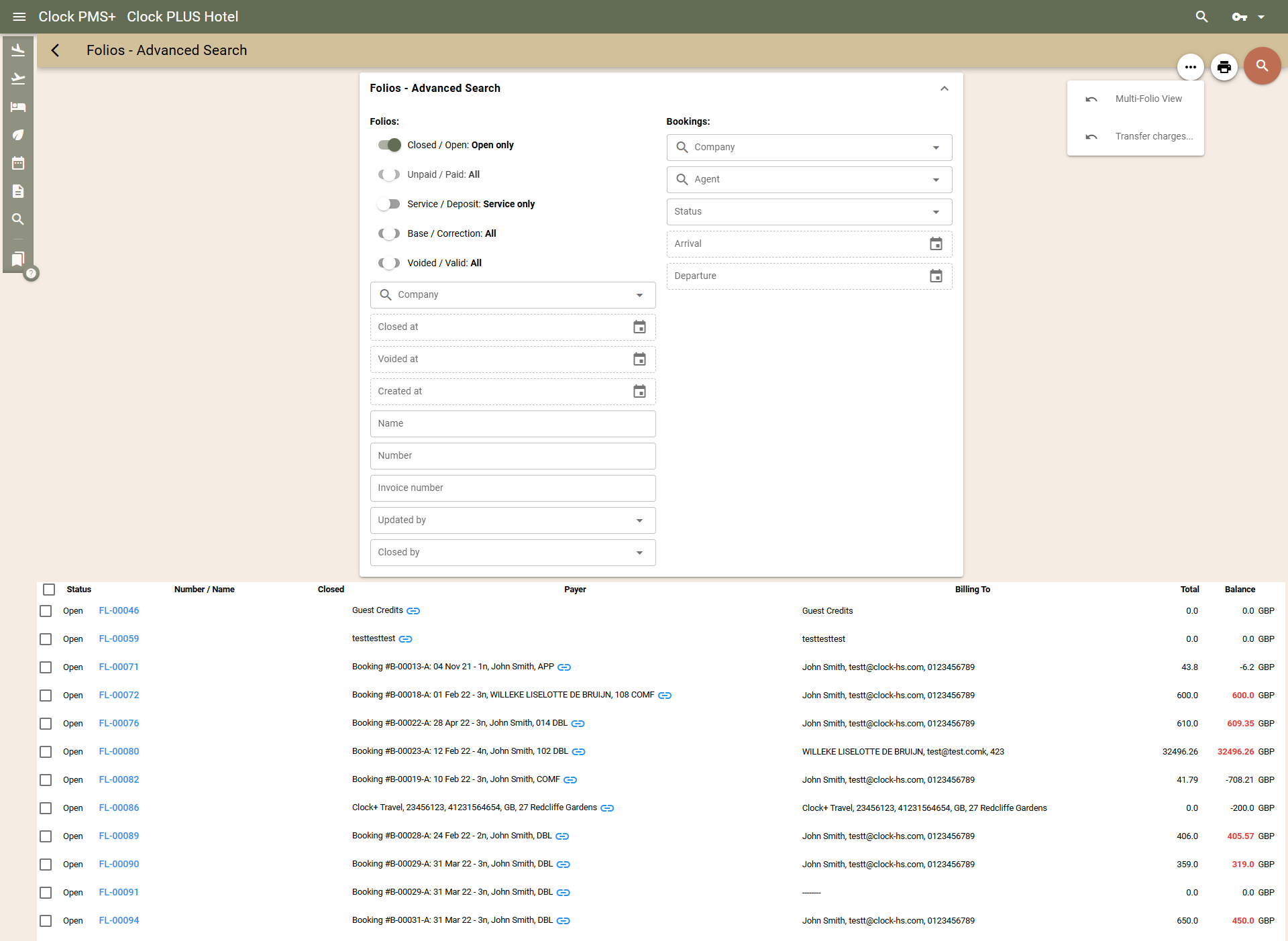
    • Folios. Similar to the old screen, you can see all operational folios in one place – unused advances, open folios, and closed unpaid folios. Through a link to the new "Folios - Advanced Search," you can find any folio related to this company, using even more criteria than before.
    • Quick folio functions. We have made quick functions for each folio accessible so that you can charge services or add payments without leaving the Company screen.
    • Events. We have improved the presentation of Events so you can focus on operational information. The focus is on current and upcoming Events, and others can be found via the link to the Events search. The list of Events also has an even more compact view, which you can enable with the button at the top.
    • Archiving. You can find the button in the dropdown menu of the options button at the top right.

  • New screen for company folios. We have added a link to the new "Folios - Advanced Search." This way, in addition to retaining quick searches (unpaid folios, folios of in-house or expected bookings, etc.), we provide the ability to use all filters in "Advanced Folio Search," as well as its new transfer functions. This allows you to process group accounts even faster.

POS – central item and price management

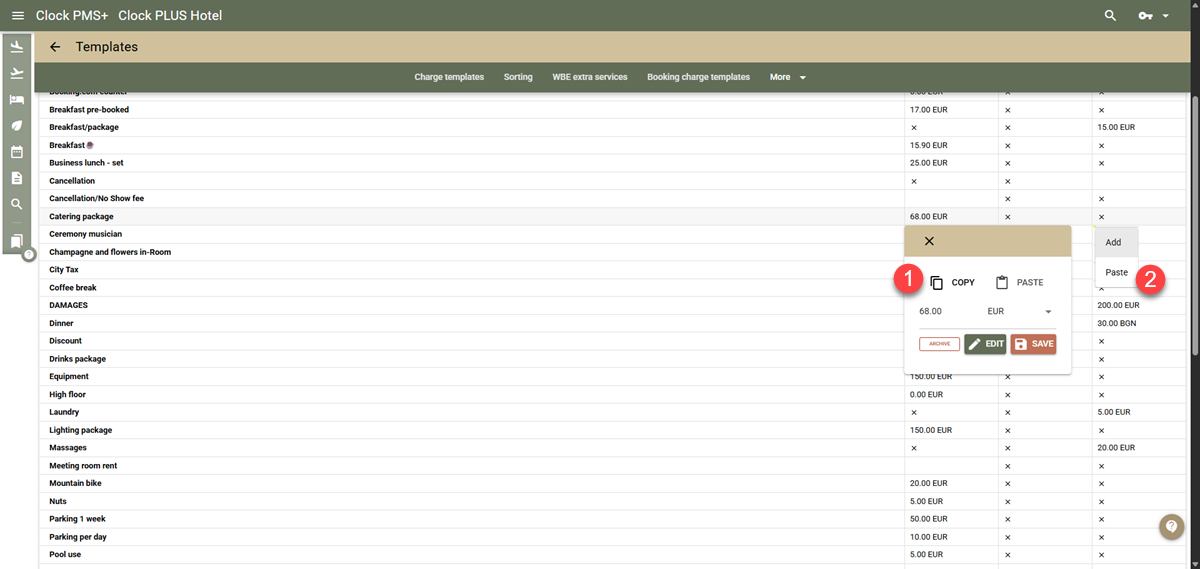
If you have multiple restaurants and need central management of items and prices within them – review this new functionality. For the PMS and hotel services, we have already added a similar function, and now you can use it for the POS as well. Here's a brief overview, if you haven't already familiarised yourself with it in the PMS:

  • Items are presented in a "matrix" across all accounts (restaurants).
  • You can easily review what items are offered in all your restaurants and at what prices.
  • Using Copy/Paste, you can quickly add the same item to all restaurants.
  • You can easily compare the prices of an item, and using the quick function, set a new price for all restaurants with one click.

To open the new screen, from the Management screen, open the new settings screen. In the "Menu" section, select "Items - all POS accounts."

Check-in kiosk – use booking Number and PIN login

The change is small, but it offers two key and important capabilities:

  • You can now use any tablets or devices as a check-in kiosk.
  • Customers have a backup login method if they cannot find their QR code or if it has been removed from the email (e.g., from emails via Booking.com).
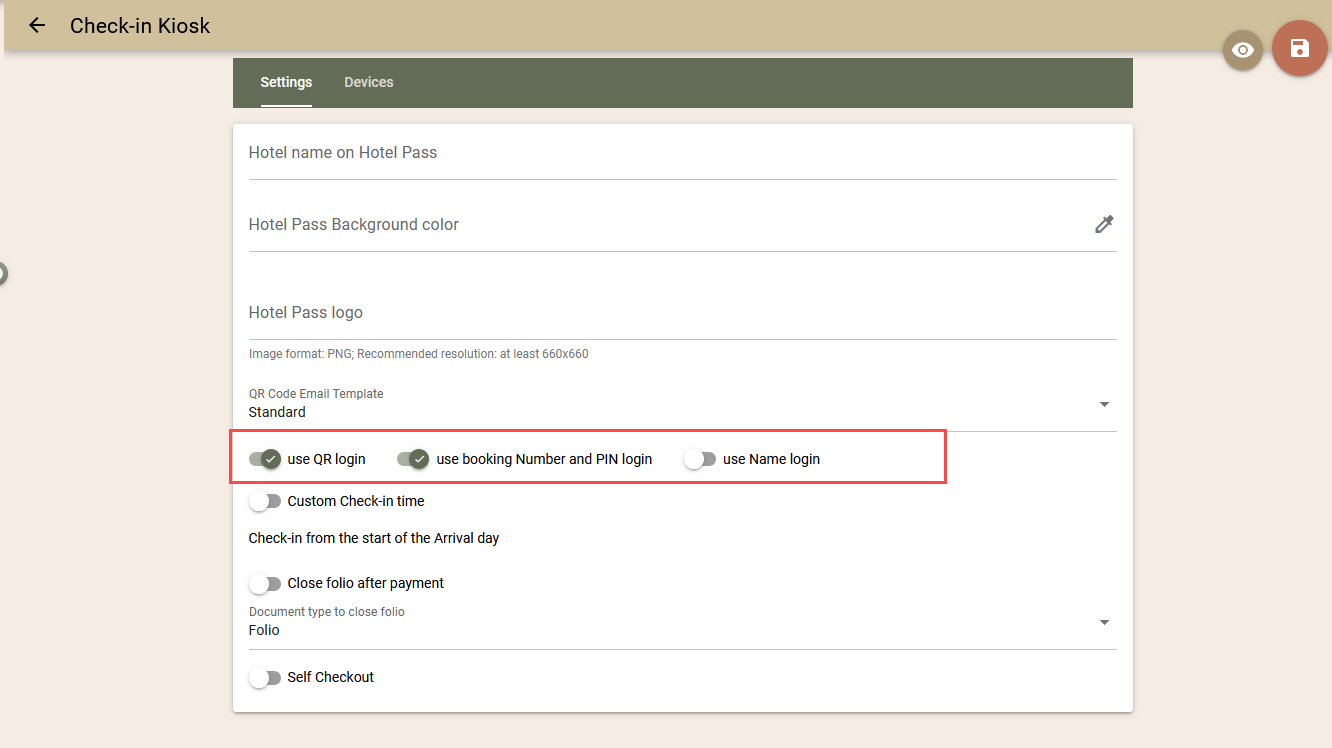
  • We have added two new settings to the check-in kiosk: "use QR login" and "use booking Number and PIN login". 

With the new settings, if you use our recommended standard tablets with a built-in QR reader, you can also choose "use booking Number and PIN login" as an alternative access method. This way, if the customer has not received or cannot find their QR code, they will be able to log in with their booking number and PIN. Make sure this information is clearly stated in the letters sent to the customer.

If you decide to use a different tablet model or device, you can disable the "login with QR code" option to avoid displaying unnecessary information on the kiosk and to make it clearer for the guest how to log in (via Booking Number and PIN).

Charge transfer – improvement

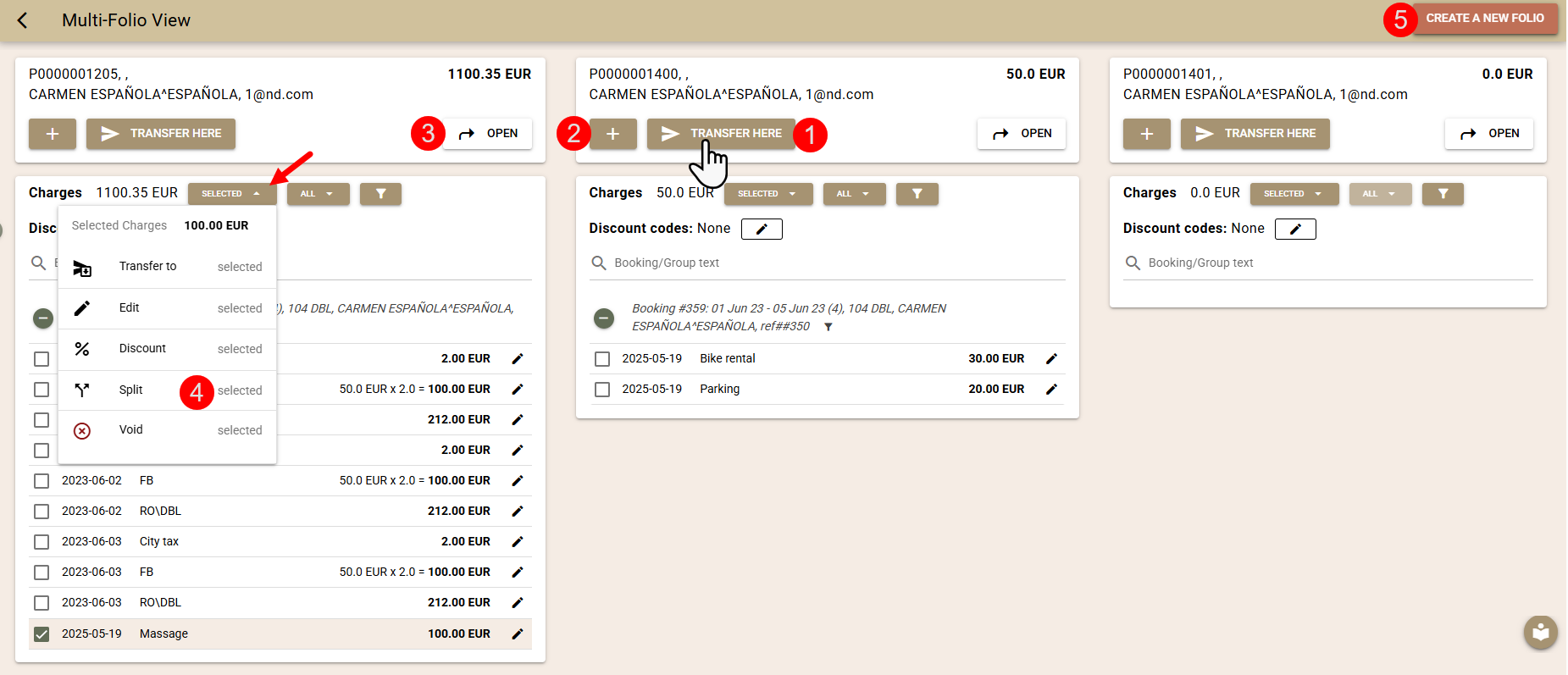
We have added a new, improved Charge Transfer functionto booking searches (arrivals, departures, In Hotel, advanced search), as well as to Folios - Advanced Search. With it, you can transfer charges from multiple folios to a single folio with a few clicks.

In the first case, this allows you to select the bookings themselves from the booking search screens, and in the second – to filter folios by various criteria and select them. The new function provides more control and quick options for selecting revenue groups and the type of charges you wish to transfer. You are already familiar with it from the folio screen, but now you will also be able to use it for mass functions – for multiple bookings or multiple selected folios.

  • From the booking search screens – select the ellipsis button (...) →Folios →Make Transfer (New). Then click "Transfer All Charges Here" for the folio you wish to transfer to. A screen will appear where you can choose whether you want all charges to be transferred or a specific type – you can use the quick options: All, Packages, No City Tax, Room only, Extras, or select specific revenue groups.

  • From the Folios - Advanced Search screen – filter folios by the desired criteria, select the folios, click the ellipsis button (...) and select "Charge transfer". Select the options on the screen and confirm. Alternatively, from the ellipsis button (...) you can select "Fast Transfer Mode". This will display a "Transfer all charges here" button, which will open the charge transfer screen.


Other improvements

  • Activity bookings are now created with the same arrival and departure date – i.e., with a stay of 0 nights. This is much clearer for this type of booking. If you use non-room bookings for other purposes, please note the following change in booking behaviour. Until now, for a non-room booking with zero nights, nothing was automatically charged. After the change, for non-room bookings with a zero period, services are automatically charged if they have a selected rate or "Daily charges" added. The charges are the same as for 1 night.
  • Activity bookings – confirmation letter. For Activity bookings, we have prepared a new confirmation letter that corresponds to the nature of these bookings. Please note that for these bookings, there is no possibility for custom templates. The standard confirmation letter has the following customisation options: logo, header, and footer. Additionally, the descriptive text of the guarantee policy is also included.
  • Booking.COM – the 'Waived cancellation fees' setting is now included in the channel setting change log.
  • SiteMinder – payment import. If the first message contains information about a payment made, the system will add it to the guest's folio. If such information arrives in subsequent XMLs, the system will not create a payment but will generate a To-Do. This functionality is disabled by default. Contact our support team if you would like it enabled.
  • Availpro – for this channel, we now import payments with the first message. We have added a To-Do if we receive a payment with an update message. The To-Do also contains the payment amount.
  • In Booking enquiry templates, we have added a new parameter (booking_offer.guest), so you can add other guest details, such as country, address, etc. Here's what data you can add to the template: , , , , , as well as all other guest fields.
  • POS – more new settings screens. To the new settings screen in the POS, we have added more new screens for the following settings: Menu groups, Items, Kitchens and Printers, Import from CSV file, Datecs operations, Folio Print Templates.
  • POS – in the new "Billing info" screen, we have also added the fields: State, City, Postcode.

Fixes

  • Rates and Availability – when a company was selected, rates that were in the company's contract but archived were shown.
  • Company contracts – we fixed an issue where the check for duplicate contract names was not working.
  • The new screen for RoomCloud export logs – we fixed two issues related to the room type filter and the sent updates screen.
  • RoomCloud – pauses in phone numbers were automatically removed by the system, which led to the conflict detection system being activated and the booking not being imported.
  • In some of the To-Dos created by the channel managers, the booking number was missing.
  • The new screen "Booking enquiry - template" – changing the editor was not working.
  • POS – "Covers" report, when the report was run with a "By days" filter, the sorting of dates was incorrect.
  • POS – daily closing delay. In certain situations, the daily closing was delayed or even failed to complete.

Localisations:

  • German FIscalisation (Fiskaly) .The configuration screen for Fiskaly has been fully redesigned. It now offers a more intuitive and user-friendly interface, making it easier to complete all required fiscalisation settings and verify the status of your Fiskaly connection.
  • Romania e-Factura. We have improved the export logic for documents already fiscalised through a cash register (bon fiscal / AMEF) to prevent double counting of VAT and revenues.

    When a folio has already been documented via a fiscal receipt, the invoice sent to RO e-Factura will now use:

    InvoiceTypeCode: 751 – “Invoice for accounting purposes”

    (Romanian: „factură informativă în scopuri contabile”)

    This ensures that the invoice is submitted to the RO e-Factura system as an informational accounting document, rather than as a new taxable invoice, aligning with Romanian e-Factura compliance requirements.

Integrations

  • Gastronovi POS. We have fixed an issue that prevented the interface configuration screen from loading when an invalid or outdated connection token had been saved.

    With this update, all tokens are now always displayed, allowing you to view, identify, and manage incorrect or expired tokens directly from the interface without blocking access to the configuration page.

  • Clock API webhooks. A new webhook event has been added: folio_void.

    This event notifies subscribed systems whenever a folio is voided. It also includes a clear indication of whether the voided folio was previously open or closed, enabling more precise downstream handling.

    More information is available in the corresponding section of the API documentation.

Clock Update (27 Oct 2025)

Activity Bookings

Clock presents a beta version of its new activity management and booking module—a modern and flexible solution that helps hotels and resorts expand their services beyond accommodation.

With it, you can easily offer, manage, and sell experiences such as yoga sessions, spa therapies, tastings, transfers, or excursions—anything your guests can experience and remember.

Hotels with all-inclusive, performance-based contracts receive the module as part of their package. For other hotels, the module can be tested and used free of charge during its beta version. 


The Activities module in Clock allows you to offer and manage additional services and experiences with fixed time slots, limited capacity, and clear organisation. 

We will look in detail at how the module works and create an example activity with several options, time slots and shared capacity. The settings are divided into the following sections: Activities, Options for each Activity, Time slots for each Option, Rates, Work schedules. 

To set up the Activities, Options and Time slots, select Settings > Activities > Activities.

Activity

This is a specific experience or service that you want to present to guests, such as Wine Tour, Yoga Class, Boat Trip, Massage, Cooking Class

Each activity has:

  • Name, Description and Photos.
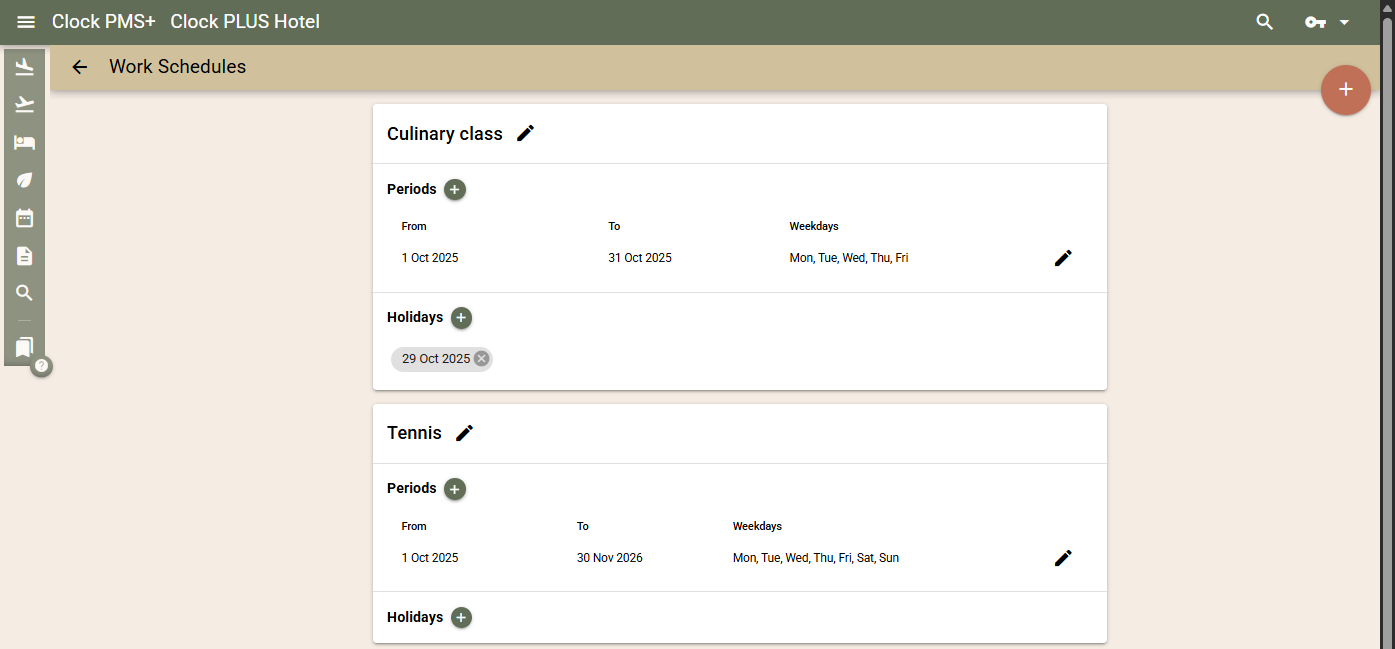
  • Work schedule. It defines the periods of the year and the working days of the week within each period, as well as the start and end time. It also defines non-working public holidays. It can be shared between Activities. 
  • Min and max guests per booking;
  • Whether children are allowed or not 
  • What is the Capacity that is tracked - whether it decreases with each booking or per guest.

Option 

Each activity can have one or more options. Each option has:

  • Name 
  • Rate. The rate is responsible for pricing and can be shared between different options and Activities. 
  • Charge template. The charge data - tax, revenue group and category, custom fields. The text, quantity, price and currency are automatically generated. For this reason, you can use one charge template for different Activities, as long as the main fields - tax, revenue group and category, and custom fields are the same.
  • Time slot - the time slots are defined for each option. This is the final element that the guest selects and books.

Important: Each booking is for one time slot only and cannot occupy two or more time slots.

Each Time slot has:

  • Start time
  • Capacity counter - this is the counter by which the capacity is determined. Booking a time slot creates a charge with this counter. In turn, the charge reduces the value of the counter for the specific date. Ultimately, the charges and their counters manage the availability of time slots. The counter can be the same for different time slots and between different options and activities. In this way, the counter will manage the capacity for all time slots for which it is selected. 

Easy setup of time slots: 

For certain activities, you may have a large number of time slots. For example, in golf, the standard time slot is 10 minutes. This means that you can have about 50 time slots per day. And if you have several options for a similar activity, this can lead to hundreds of time slots. For the quick configuration of such cases, we have provided the following tools:

  • Automatic generation of time slots - specify the start time, repeat interval, and end time. Also, specify the name for the capacity counters to be created, as well as the capacity itself. The system will generate the specified number of time slots, as well as the necessary capacity counters - one counter for each time slot.
  • Copy/Paste. This feature can be useful if two or more options or activities have shared capacity - for example, you have one tourist guide, but you offer two different activities or two different options. When copying/pasting, the time slots are transferred directly, i.e., they retain the assigned capacity counter. When pasting, you have the option to choose whether old time slots should be deleted and also to exclude some of the time slots you do not wish to transfer.

Rates 

The rates you create can serve one or many options. This "sharing" allows for easier price management - if the given products (options) have identical prices and therefore the same rate, when changing the price you will only need to edit one rate.

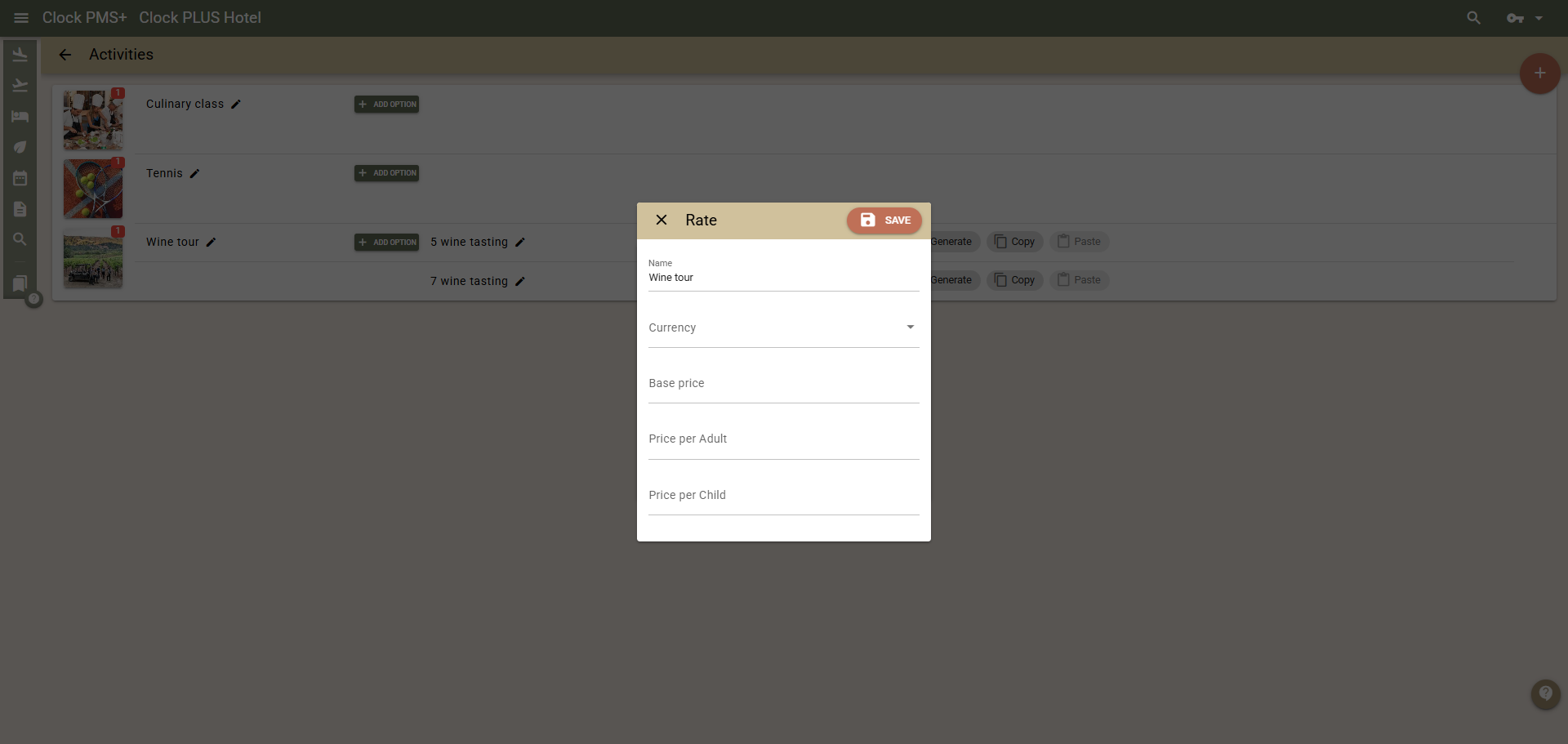
To edit the Rates, select Settings > Activities > Rates. For each rate, you can set: a base price, a price per adult, a price per child. The price per adult/child is multiplied by the number of guests and added to the base price. For example, if your rate is: Base price 50, price per adult: 20, price per child: 10, then for an Activity booking for 2 adults and 1 child, the price will be = 50 (base) + 40 (20 multiplied by 2 adults) + 10 (1 child) = 100. If you do not have a base price or a price per guest, enter 0 in the corresponding field. 

When charging for an Activity service that has capacity per guest, there is a peculiarity related to rounding. Since the charge must have a quantity corresponding to the number of guests, the price of the charge needs to be averaged. Let's look at the example above, where the price for 2+1 is 100. In this example, if the activity has capacity per guest, a service will be charged with a quantity of 3 (total number of guests) and a price of 33.33. That is, the total final price will be 99.99, not 100. Due to this rounding peculiarity, the price that the customer will see when booking and subsequently in the folio will be 99.99.

Work schedule 

Work schedules can be shared between Activities. This means that once you create a work schedule, you can select it for many activities. Thus, when editing a specific work schedule, the changes are reflected for all activities for which that work schedule is selected. A work schedule can have multiple periods in which you can select the start and end time slot for the Activity, as well as the working days of the week. Through different periods and start and end times, you can precisely change the available time slots so that they follow the daylight hours. In this way, you can extract the maximum number of bookings from each season. 

The start and end time are treated as "inclusive", i.e., these are the earliest and latest possible slots. Here is an example:

  • Let's assume that for a specific Activity, you have defined the following time slots: 08:00, 09:00, 16:00, 17:00, 18:00 
  • You create a period (e.g., summer months) in which you enter 08:00 - 18:00 for the start and end time. This will leave the above time slots for sale.
  • You also add a period (e.g., winter months) with time slots 09:00 - 17:00. This will leave 09:00, 16:00 and 17:00 for sale.

To quickly exclude a given day, for example a holiday, entirely from sales, you can add it to the "Holidays" section for the respective work schedule.

Setup Examples 

Example 1 - Wine Tour

Your hotel offers the following Wine Tours: "5 wines" or "7 wines + premium wine", both having different prices. Groups are up to 10 people, and within these 10 people, different guests can book their spots, and each booking can be for a different option. Each tourist is served 5 or 7 wines depending on what they have chosen. The visit time slots are 11:00, 13:30, 15:30. This option is sold both at the reception and through the WBE.

Settings:

  • Create an Activity "Wine Tour". 
  • Create a work schedule and select the working days of the week, 
  • Enter minimum guests 1 and maximum 10. 
  • Leave "Allow children" blank 
  • Select "Capacity per guest"
  • Add the option "5 wines" to it 
  • Add a new rate "Wine Tour - 5 wines". Fill in the price per adult in it. 
  • Create a charge template "Wine Tour" and select it here. 
  • Add the option "7 wines + premium wine" 
  • Add a new rate "Wine Tour - 7 wines". Fill in the price per adult in it. 
  • Select the charge template "Wine Tour". 
  • Add the time slots for "5 wines". 
  • Fill in the time slot: 11:00 
  • In the Capacity Counter field - click the "+" button. The system will suggest a name for the counter, composed of the name of the Activity, Option and Time slot. Enter capacity: 10. Since you have selected "Capacity per guest" in the Activity, this means that the capacity is 10 people. This allows bookings for different numbers of guests to be accepted until the capacity is filled. Save.
  • Repeat the steps for 13:30 and 15:30
  • Copy the time slots from "5 wines" and paste them into "7 wines + premium wine". This will transfer the same capacity counters.
  • After completing the configuration, re-edit the "Wine Tour" Activity options and select the checkbox that it is sold through the WBE. 
  • Also, don't forget to set up the remaining fields and the tax for the newly created "Wine Tour" template. See more examples of Activities below.

Example 2: Tennis Court

The hotel has 4 tennis courts that guests can book. Bookings are for 1 hour each, with courts operating all days of the week from 7 AM to 6 PM. They offer 3 types of services at different prices - court rental, court + rackets rental, court + rackets + 4 balls rental. 

  • Create an Activity "Tennis Court". Work schedule - all days of the week, 7 AM - 6 PM; minimum guests 2, maximum 4; children are allowed; Capacity is NOT per guest. 
  • Add three options for the three types of services, setting a separate rate for each. In the base price, set the court rental price. In the rate for "court + rackets rental" - in the base price, set the court rental price, and in the prices per guest and child, enter the price for renting 1 racket. In the rate "court + rackets + 4 balls rental", in the base price, set the price for court rental and 4 balls and again in the prices per adult and child, set the price for renting a racket. 
  • In the first option, add the time slots. 
    • Use "Generate": Start time 07:00, End time: 18:00, 
    • Repeat interval: 60 min. 
    • Prefix for the capacity pools that will be automatically created - since the capacity pools will be the same for all options, edit the name so that it only contains "Tennis Court". 
    • Capacity: 4 - corresponds to the number of tennis courts. 
  • Copy the created time slots from the first option and paste them into the other two. This will then transfer the same capacity counters, meaning that booking one time slot for any option will also deduct from the time slots of the other options. 

Example 3: Massages/Hydromassages with fixed time slots

The module is not intended for services that are freely booked by hourly schedule, where bookings can have different durations and the aim is to maximise schedule occupancy. However, there are situations where similar services can also be sold on the principle of fixed time slots. For example, if you offer services in the SPA that have a relatively similar duration, you could set up time slots, e.g., on the hour or half-hour, and offer different services (options). The disadvantage is that if you use 1-hour time slot, even if a service is 30 or 40 minutes, the entire time slot is occupied. The greater the difference in the durations of the options provided by one specialist, the greater the loss of time in the fixed time slot model. 

Here is an example setup. For instance, if you offer manual massages and a hydro-massage bath, you can approach it as follows:

  • Create two Activities: "Massages" and "Hydromassages". Min/Max guests: 1. 
  • As different options, add the different types of massages and baths, setting different prices for each option. 
  • For massages, set the time slots to 1 hour, and as capacity, set the number of masseurs you have. Copy the time slots between the different options to share one capacity (to use the same capacity counters) 
  • For Hydro-massage baths, set the time slots to 30 minutes, and as capacity, set the number of Baths. Again, copy the time slots between the different options to share capacity.

Booking

Guests can book Activities through the WBE, and reception through the new "Activities - Availability" screen. This creates bookings without a room, which you can see on the Arrivals, Departures, and In Hotel screens. Find more details below. 

Here's how a guest's booking is reflected in the system:

  • Booking each Activity creates a new, separate booking for it with guest contact information.
  • The booking is marked as a booking without a room. 
  • The service usage date is in the Arrival field. 
  • The service usage time is in the "Arrival Time" field. 
  • The service itself is added as a daily charge to the booking with the tariff price calculated by the Activity.
  • The consumption of the time slot's capacity is carried out by the created charge, its capacity counter and its service date. 

The recommended approach when changing the date or time of a booking is by cancelling the old booking and creating a new one through the "Activities - Availability" screen. If for some reason you cannot or do not wish to cancel the old booking, you can manually change the date and time by: 

  • In the booking itself, you edit the arrival date and time.
  • In the charge, you edit the service date and the capacity counter corresponding to the new time slot.

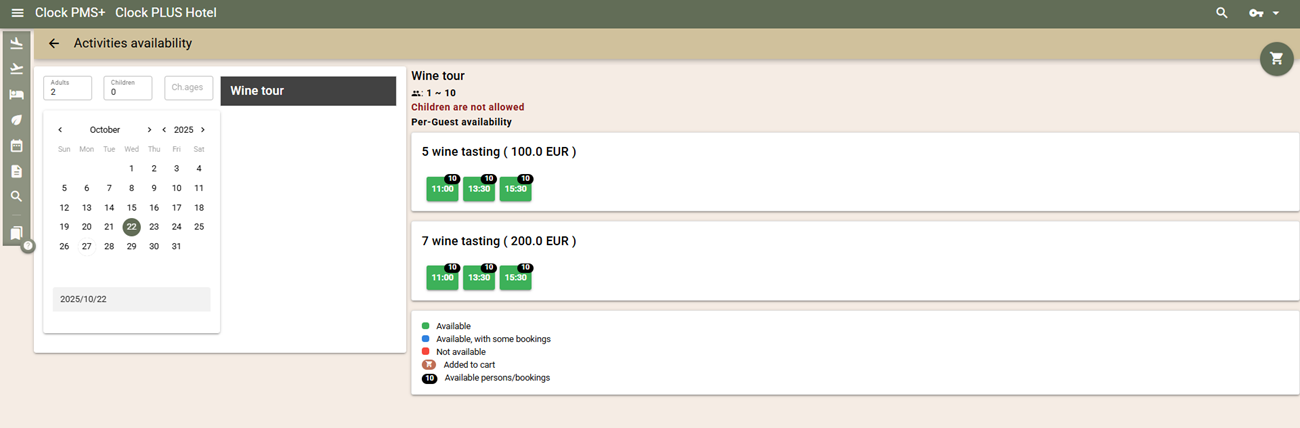
New "Activities - Availability" screen

Open the new screen from "Availability" > "Activities - Availability".

  • Fill in the number of adults and children 
  • Select a date. 
  • Select an Activity. 
  • You will see the available and occupied time slots (coloured). In the upper corner of each time slot, you can also see the remaining capacity. 
  • Click the time slot to add it to the cart. This selects the time slot, but you do not yet have a booking. 
  • You can add more time slots for other Activities in the same way. 
  • Open the cart from the top right corner of the screen. There you will see the price of each booking, as well as the total amount. From there, you can also remove added lines. 
  • When you wish to complete and create the bookings, fill in the guest's name, email or phone and select "Create". 
  • On the next page, you can see the status and creation of the bookings. After creation, you can open all created bookings in Advanced Search. 

WBE

In the WBE, you can book Activities independently of rooms or along with them. The bookings for Activities themselves are not linked to room bookings. This provides maximum flexibility in selling Activities. 

The processes for booking a room and an Activity are different and go through different steps, with the final page being the same - where bookings for all added rooms and Activities are completed.

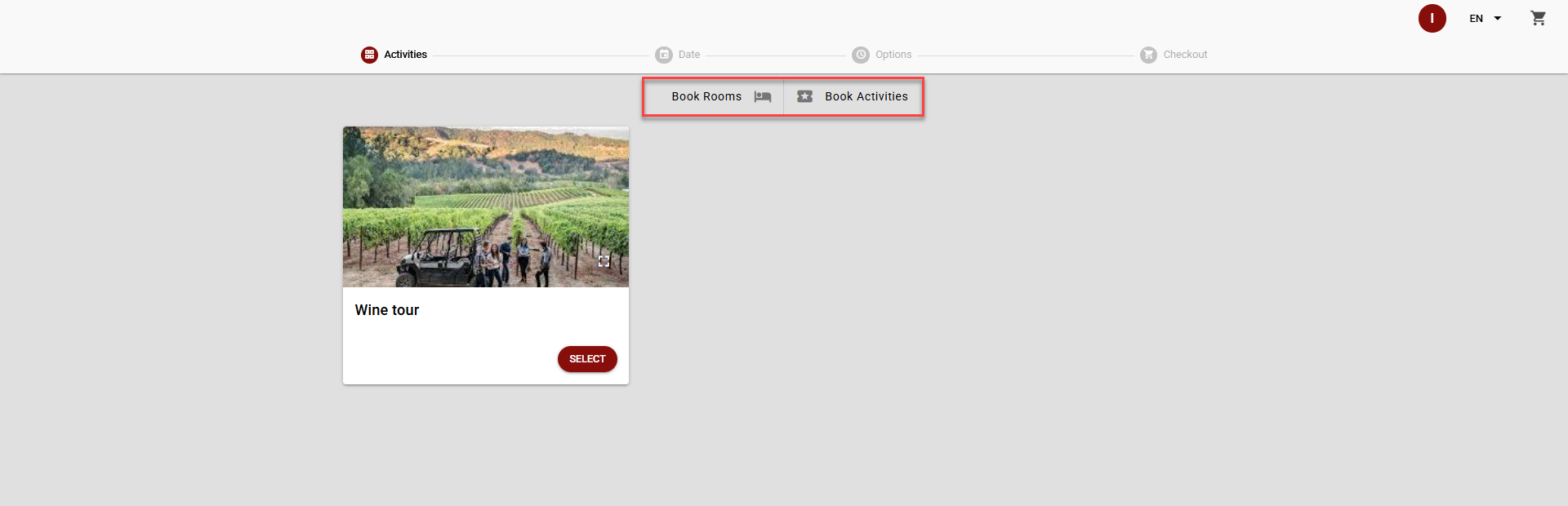
The WBE now also has new entry points. This means that depending on the integration or the link the guest receives, one of the following pages can be opened: 

  • Calendar (the old home page) from which room booking begins. 
  • Selection. This is a new simple and clear screen where the guest has to choose what they want to book: Rooms or Activities. 
  • Activities. The Activities screen opens directly. 

You can choose to use the universal entry point "Selection" everywhere or opt for a more specialised approach - on pages describing room types, have a link to the "Calendar", and on pages describing Activities - a link to "Activities". 

Either way, on the internal pages, the guest can switch between the rooms page and the Activities page, and thus book either one of the two or both together. The switch is made via two new buttons just above the date change button. Besides being convenient for the guest, this also provides an opportunity for an upgrade. 

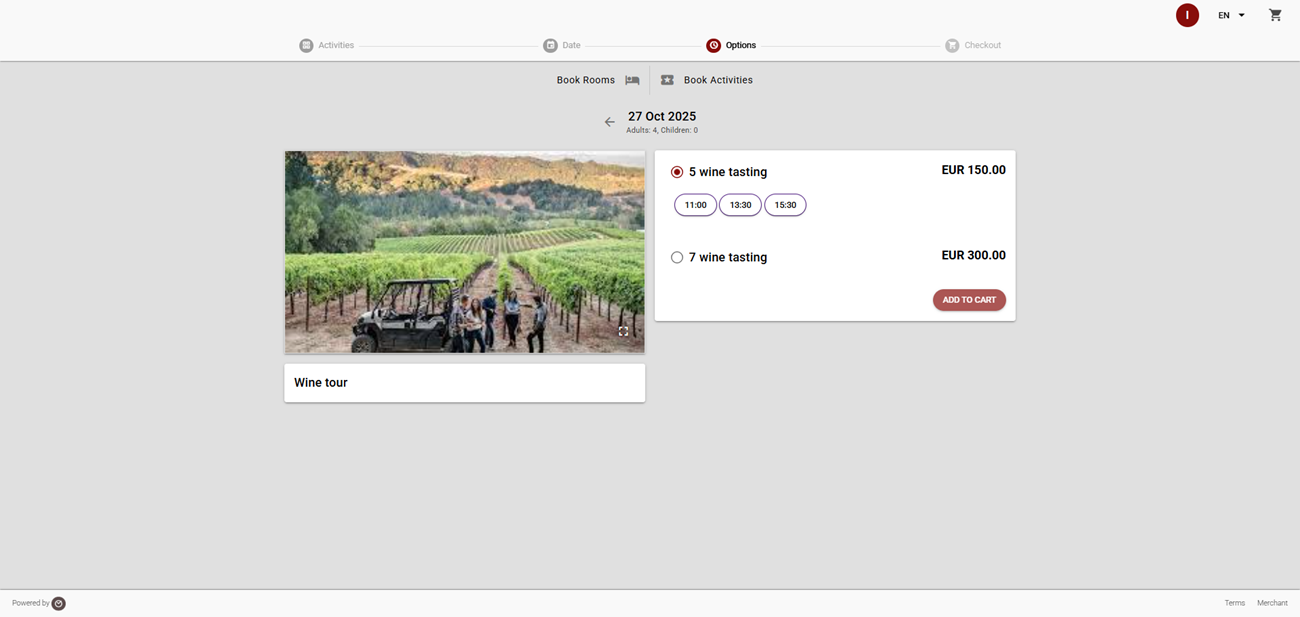
Booking an Activity goes through the following steps:

  • Activity Selection. The guest sees photos and descriptions for each Activity. 
  • Date and number of guests selection 
  • Options and available Time slots. The guest sees the different options and their prices, as well as the available time slots. Selects a time slot and adds it to the cart. 
  • Final page. From here, the guest can complete their booking or add more Activities or Rooms beforehand.

Guarantee Policy 

Bookings for Activities are made with the default Guarantee Policy selected in the WBE settings. The Guarantee Policy determines the deposit amount, the method of guarantee, and the cancellation policy. 

Arrivals and Bookings - Advanced Search Screens

Bookings for Activities can be viewed on the booking search screens - Arrivals and Advanced Search. In Arrivals, Departures, and In Hotel, we have provided a new filter with which you can filter bookings by type: All, Room bookings, Non-room bookings, Activity bookings. Thus, if Activity bookings are served at a different reception, it can be chosen for each of them which bookings to see: the hotel reception - room bookings, the Activities reception - Activity bookings. The setting is remembered for the station and is automatically selected the next time the screen is opened.

Visually, you can also easily distinguish Activity bookings: In the Room column, you will see the name of the Activity for which the booking is, it also has an icon and is coloured differently. 

In the Bookings - Advanced Search, you can find similar bookings using the existing Booking Type filter: Non-room bookings.

Other Improvements

  • Activity Calendar - similar to the room calendar, you can now view and manage special days that you can colour differently. In the same way as in the room calendar - click on the date row to set or remove a colour. Keep in mind that the list of special days is common between the room calendar and activity calendars - i.e. whatever you choose in one calendar, you will see in the other. 
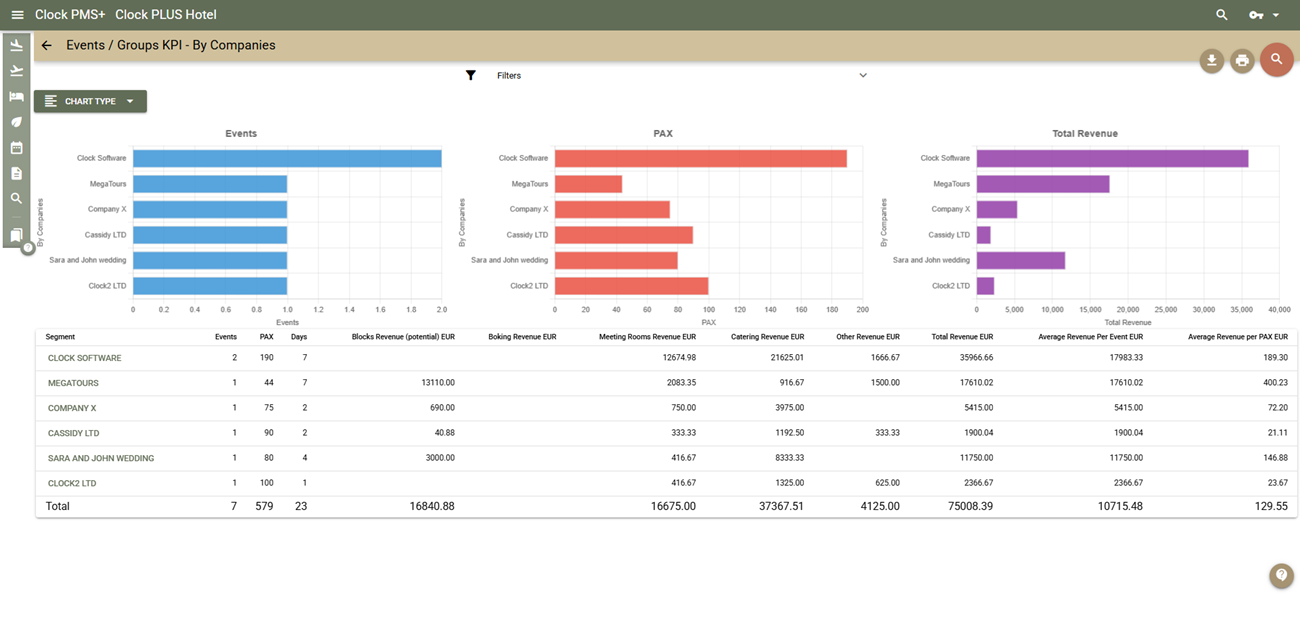
  • Event Reports / KPI Groups  - in the Other Revenue column, we have added the sum of charges from two more categories: 1. Charges transferred from the POS to the Event folios. 2. Charges from bookings or other sources and different from rooms and meals. 
  • Events - Activity search
    • We improved the Activity Type filter. You can now select several positions and thus get several different selected activity types in one report. 
    • New grouping - by Activity Type. Grouping in combination with filtering makes the list more readable and clearer.
    • When grouping by date, we also added the day of the week 
    • Event Code (WBE). We improved the screen for entering the event code and selecting a block to make it clearer for your guests. The selected event and block, as well as the process for changing or removing the code, are shown more clearly. 
  • For all channel managers, we added an additional check when importing bookings. Changes and cancellations are imported only if the booking has a "Expected" status. If the booking already has "Checked-in", "Checked-out" or "Cancelled" status, no changes are imported. In the Inbox, such changes appear with a 'Processed' status, and tasks are created for the bookings. 
  • Booking.com- we improved the import of existing, expected bookings (reservation summary). Upon initial launch of Booking.com, the system can import existing, expected bookings through a special procedure performed by Clock's service team. In certain situations, which are beyond our control, Booking.com may provide only partial information for expected bookings, although in other situations it provides full information. In our opinion, Booking.com does not send full information for past bookings in situations where the hotel has not used a PMS connection before. On our side, we have implemented both protocols so that you receive as much information as possible. When using the "Import" function, we try to get full information for the bookings. If full information is not received from Booking.com through this function, you can use the new "Import by summaries" function, where bookings will be imported, but with partial information. Partial information means that Booking:
    • does not send information for all guests per booking, as well as contact details. Only the names of one main guest are present. 
    • does not send additional services, their prices, or information on included taxes and fees 
    • does not send remarks, client requests, and other descriptions 
    • does not send credit card details 
    • sends information about companies and commissions 
  • We changed the list of countries and the behaviour of the custom list. Before the change, what you entered in the customised list replaced the full list. So, to add one country, you had to fill in all - i.e., fill in the entire list. After the change, in the custom list, you can add only the countries you wish to add or replace their names. The full list is "merged" with the customised list and is thus presented for selection. The customised list has priority and replaces the codes if they exist in the full list. Additionally, the selected "preferred" countries now appear at the top of the list in all places where there is a country select.
  • By default, the Guest data retention period now has a default value of 120 months. 
  • Housekeeping tasks - archive - now also shows completed tasks for common areas. 
  • Adyen - we added the payment methods Alipay and WeChat. 
  • We removed the limit on the number of components that make up the virtual room. Previously, the limit was up to 10, but there are properties that need more components for one virtual room. 

Fixes:

  • Activities Calendar. We resolved an issue where the calendar did not work if it included a day with a change in daylight saving time (summer-winter). 
  • Room features - icons whose name contained a number could not be added - for example, sticky_note_2 
  • Rooming list - bookings were not created if they were linked to an Event and a "default transfer folio" was selected in it.

Clock Update (24 Sep 2025)

New Functionalities

Event Code – reserving multiple blocks in WBE with a single code

Using the existing block codes, guests can reserve rooms from a specific block independently via the Web Booking Engine (WBE). When an event contains several blocks, until now it was necessary to use several different block codes. This led to complications and difficulties in communication with clients. We therefore made a change that simultaneously expands functionality and preserves the previous way of working.

Example of the new functionality:

We have an event in which four blocks are created:

  • DBL for 1 guest named "Single Use"
  • DBL for 2 guests named "Double Use"
  • TRPL – rooms for three guests
  • 1 DBL room for the organizer which is free of charge

Since we keep the old functionality, of course you can assign a separate code for each block and provide 4 different codes to the organizer.

Or:

With the new functionality you can add one common code to the event itself. Using this single code, guests will be able to reserve all the blocks. In our example, however, we have a block for the organizer that must not be accessible to all guests because it is free. Therefore we introduce a separate block code only for that block.

What happens in this case?

  • The event code can be used to reserve the three blocks for which no individual block code has been assigned.
  • The fourth block (for the organizer) will be accessible only via its specific code.

This way we preserve the flexibility of individual codes and add the convenience of the event-wide code.

Reservation through WBE

When the guest enters the event code on the WBE start page, a dialog will appear in which to choose which of the blocks they want to reserve. If they want to make a second reservation for another block, they again select the event code field and specify the desired block.

By default the event code field is not shown in WBE. If you want to use it, activate it from the settings: WBE settings → WBE rates → Show Event Code.

Adding the event code in documents and emails

For use in documents and emails related to the event, the new code can be added to templates via the parameter:

Folios – Advanced search

We added a new screen that allows you to find folios by multiple criteria, and also to perform transfers from multiple folios to another folio with a single click.

You can use various filters to find exactly the folios you are looking for or want to review:

  • By folio criteria: folio status and type, creation/closing/cancellation periods, users, etc.
  • By related reservation criteria: company/agent of the reservation, status, arrival and departure.

Besides being a tool for finding and viewing folios, the new search can help you significantly in situations where you need to transfer charges. For example, you can find all open folios of reservations from Company X arriving between May 1 and 4, select them and transfer them to a new company folio with a few clicks.

New quick options for transfer

We also added a new functionality – a quick selection of what you want to transfer. The available options are:

  • All – all charges in the selected folios;
  • Packages – only charges generated by rate posting;
  • No City Tax – rate charges excluding city taxes;
  • Room Only – rate charges limited to revenue groups "Rooms" and "Packages";
  • Extras – manually added charges as well as POS transfers;
  • Custom – option to select which revenue groups will be transferred.

Multi-column view of folios from different reservations

Another new feature is the ability to open multiple folios in multi-column view even if they are from different reservations. Until now this view was available only for folios from the same reservation.

You can now select up to 10 folios from different reservations and open them simultaneously. There you will have access to all tools such as Split, Edit, Transfer, etc. – which greatly facilitates the distribution of charges between different folios or reservations.

To find the folios you want, use filters such as reservation status (for example "Checked-in") and arrival/departure dates.

The new advanced folio search is added to the navigation menu – in the "Other functionalities" section.

Centralized management of charge templates

We added a new tool that will help hotel chains manage the prices of additional services much more easily across all hotels in the group. On one screen you can see a combination of all your hotels and all services. In a convenient cross-tab you will quickly notice which services are available in which hotel and at what price – and also where they are missing. This screen is extremely useful both during initial configuration of hotels and during subsequent operational price changes.

Here are details about the new functionality:

  • To open the screen, select Settings → Charge Templates – All PMS Accounts from the Charges & Taxes section. You can also open it from the Charge Templates screen using the button More… → All Accounts.
  • Displayed as a cross-tab: vertically – charge templates; horizontally – hotels. In the top-left corner there is a quick search field for the template name.
  • Each cell shows whether a template with that name exists in the hotel (you see its price) or does not exist – in that case an "X" is shown.
  • You have the option for quick price editing directly in the cell.
  • You can edit or create a template with all its data via the Edit button, which opens a full editor with all fields.
  • You can also use Copy/Paste to create the same template in all hotels.
  • If the template does not exist at all in the table, you can add a new row with the "+" button. Then you create the template in one of the hotels and then copy and quickly spread it across all the others.

Attention for templates with Capacity Counter, Meal Plan or Housekeeping template

For more complex configured templates that use a Capacity Counter, Meal Plan or Housekeeping template, you must be more careful when copying. The reason is that these elements are defined separately for each account, and when pasting the system attempts to find a matching element by name in the target account.

Example: If you copy a template with a meal called "Breakfast" and paste it into another hotel, the system will look for a meal plan with the same name in that account. If it does not find it, you will see a red message under the respective field that no match was found.

Tip: Keep uniform names of these elements between hotels – this will make the copy process much easier and smoother.

Improvements

  • Reservation notes in the Room Calendar: In the reservation details pop-up that appears automatically when you hover over a reservation, you can now see all notes added to the reservation. This includes: Guest Requests, Housekeeping Notes, Meal Notes and Notes.
  • Folio screen – easy transfer of nights excluding tourist tax and other common cases:We added the ability to transfer charges much more easily in a number of common situations. With one click you can choose ready (preset) options or use your own filters. To use the new functionality:
    1. Open the folio you want to transfer from;
    2. Select All → Transfer to;
    3. At the top of the screen you will see a new section with selection options. By default "All" is selected, which corresponds to the previous behavior. Hover over the other options to see their descriptions. The options are the same as described above for transfer via Folios – Advanced Search.
  • Events Activity Calendar – capacity services: You can now visualize services with limited capacity (i.e. those with a selected Capacity Counter) and their availability for each day in the Activities Calendar. For example, if you offer parking spaces and have defined a counter for that service, you will be able to see directly in the calendar how many free spaces you have for each day. We remind you that the same functionality had already been added to the Room Calendar. How to enable this visualization:
    1. Open the Activity Calendar;
    2. Select the settings icon (gear) in the top-right corner;
    3. Choose "Capacity Services";
    4. Select which services you want to be visible and confirm the selection.
  • Daily availability information will appear at the bottom of the calendar.

  • Capacity Counters – types & grouping:When using multiple Capacity Counters for different purposes, there was a need to group them. You can now assign a group to each counter. This is done in the edit screen where you can choose from predefined groups or enter your own name. After you assign groups, in the screens for changing daily capacity or during a bulk update you will be able to:
    • filter by groups;
    • see a clearer grouping of counters according to their functionality.
  • Booking.com – commission import: If you use the direct interface with Booking.com, you can now take advantage of a new functionality – importing the commission calculated by Booking and sent with each reservation. This facilitates tracking and analysis of commissions. To enable it, go to the Booking.com interface settings screen and enable the option "Process received commission data".
  • Booking.com: A new column has been added to the rate map: Waived cancellation fees, for easier viewing and tracking.
  • Issuing keys (codes) for access via Online check-in: The purpose of this functionality is to simplify the work of hotels without a reception or with limited reception hours that use electronic locks with codes.
  • Why code locks?

    If the hotel uses code locks, there is no need to issue a physical card to the guest. That is, if the guest receives the access code in advance, they do not need to be met by an employee. In this case the hotel does not need a kiosk, whose primary function is issuing cards. Issuing a key code can be initiated directly from online check-in.

    You can use this functionality if:

    • Codes can be sent automatically by email through the integrated access control system.
    • It is not necessary to explicitly send the code if the Guest Portal PIN has already been sent (or can be resent by a separate email on the day of arrival). This applies to systems that use the PIN as an access code.
    • The access control system must support issuing codes for future dates.
  • For additional information and activation of the functionality, please contact our support team.

  • Event Meeting room utilization Report: For multi-room reservations, the PAX value is now distributed evenly among the halls to avoid inaccuracies in average values. This method provides a more balanced calculation. For maximum accuracy, create separate reservations for each room with the exact number of guests.
  • POS receipt printing: Publisher company data has been added at the bottom of the printout and a copy number for better traceability.
  • Company data – third identifier: In connection with specific legal requirements (e.g., France), a third field for company identifier has been added. We recommend using it instead of adding the data in the "Additional Billing Info" field.
  • Interface update:The replacement of the old user interface continues. The following screens have been updated:
    • PMS: key card settings, door codes for standalone PIN keypads, and telephone calls (including reports in the Control section).
    • POS: new settings screens and report screens (now with search capability). The old screens remain active. The new ones are accessible via Settings → New and Reports → New.

Fixes

  • Reservations – Advanced Search – Excel export: a row with the total amount (Total) that had been missing has been added. Column names have been changed – full names are now used instead of abbreviations.
  • Rounding of quantities in folios: previously, quantities with up to 4 decimal places were allowed, which had no practical value but created difficulties in rounding, fiscalization, and exports. From now on a maximum of 3 decimal places is allowed.
  • SmartHotel – "Sync" tab: a problem where downloading files did not work and an error occurred has been fixed.
  • WBE – Out of season: for out-of-season periods, the first date of the period was disabled for selection even though departure was allowed on that date. The problem has been fixed.
  • SiteMinder and OTA channels: in cases where a cancellation was sent immediately after the reservation was created, channels sometimes sent both messages (create and cancel) simultaneously and in reverse order. This caused wrong import of the reservation as valid even though it had been canceled. Additional checks have been added – if a reservation is once canceled, subsequent messages will not be accepted, so the problematic situation can no longer occur.
  • Company, Guest and Deposit ledgers: a problem was fixed where reports did not show data for the first date from the beginning of operations if there was no opening balance on that date.

Integrations

New functionalities

  • API – notification on guest data change: A new notification has been added which is triggered automatically every time guest data is edited for a reservation with active status (expected or checked-in). More information can be found in the Message Channels (Webhooks) section of the API documentation.
  • AppConnector – upcoming integrations: AppConnector now provides information about new integrations that are in development. With this functionality you can not only see what is coming, but also apply to be a pilot client and be among the first to try it. The list of upcoming integrations will be gradually supplemented over the coming days.

Improvements

  • Salto KS – RFID key issuing: When an RFID tag is not read during key issuance, the system now displays a clear error message.
  • Salto KS – access to common areas: Guests now receive access not only to the doors configured for their reservation but also to all "common doors" defined in the room settings.

Fixes

  • Google BigQuery Export / Private Analytics: synchronization issues when exporting data to Google locations outside the USA have been fixed.
  • German Fiscalization (DSFinV-K): the statuses of daily closure exports were not updating correctly. The problem has been fixed.
  • Romania eFactura: an incorrect calculation of discounts in sums by tax groups that resulted in invalid documents has been fixed. Correct values are now applied for successful invoice submissions.

Clock Update (29 Jul 2025)

New Functionalities

Currency Conversion of Rates

We have added a new function, "Change Currency and Prices", which allows for easy currency conversion of existing rates. The system automatically recalculates the values at all levels within the rate based on the specified exchange rates. The function is accessible via the "Rates Management" screen, by clicking the "..." button located in the top right corner.

Here's how the new functionality works:

  • Selected rates are reviewed, and for each rate whose currency differs from the submitted one, the values are converted at the following levels:
    • Guest offsets in the Rate - only those that are for a fixed value (percentage-based ones are retained);
    • Guest levels in the Rate - the "Price" field is updated if it is populated;
    • Seasons - both fields, "Price" and "Weekend Price", are updated if they have values. Percentage-based derived rates are skipped.
    • Guest offsets in the Season - same as in the rate;
    • Guest levels in the Season same as in the rate; 
    • Days - if a price exists, it is converted. Percentage-based derived rates are skipped.
  • The currency of the rate itself is changed.

How to use the new function:

  • In the "Rates Management" screen, load the rates you wish to convert;
  • Select the rates in the list and choose the "..." button, then "Change Currency and Prices";
  • Select the new currency and confirm;

Wait for the system to complete the rate conversion, then check the resulting prices.

Improvements

Room Calendar

Capacity Services

Quickly check the availability of parking spaces, rental bicycles, extra beds, and any capacity services. If you have services set up that are limited by a specific daily capacity (Capacity Counters), you can now choose to view them directly in the Room Calendar. Previously, this information was available in a separate report, "Charge Template Availability Report," but by adding it to the Room Calendar, it is now much more accessible and user-friendly. 

To select which capacity services to view in the Room Calendar:

  • Open the filters and select "Capacity Services";
  • Select the services and confirm.

You can save your selected filters on the screen by clicking the "Save as default" button, so you won't have to select them every time. 

The list of selected capacity services will appear at the bottom of the calendar, after all rooms. For each service and day, you will see the availability, and if you hover your mouse over it, you will also see the base capacity and quantities sold. Furthermore, the day will be coloured red if there are no availabilities, making it easy to spot. 

If you are not yet using Capacity Services, we would like to remind you that by setting daily capacities, you can regulate the sale of certain services and rate packages. You can easily manage scenarios such as the sale of parking spaces, bicycles or other rental equipment, folding beds, cots, or even snacks if they have a limited capacity for each day. Please contact our customer service department if you need assistance with the setup.

Quick Guest Info

We have also added very important guest information to the Room Calendar. The following "quick" information has been added to bookings:

  • Returning guest icon. If a guest has one or more valid and checked-out bookings, we display a returning guest icon - a star for them. You can also see the number of their previous visits in the quick booking information. For hotel chains, we would like to point out that visits to all hotels in the chain are taken into account.
  • Group/Family Booking Icon. If a booking has associated bookings, there is now an icon in the Room Calendar to help you easily identify it. 
  • Upgraded Bookings Icon. You will easily recognise which bookings are upgraded through the indicator with an upward arrow icon. We remind you that an upgraded booking is one whose rate is not for the room type the guest is staying in. Easy access to this information will help you with both quick audits and potential room reallocations.

More Useful Improvements:

  • Two-Day View for Arrivals/Departures. The Room Calendar is a great tool, but sometimes the 31-day view is not optimal. When using the calendar for arrivals or departures, you need to see the guest's full name. Therefore, we have added a new, two-day view, which provides enough space to see departures and arrivals with guests' full names.
  • Search Bookings by Guest Names. To make it even easier to serve guests from the Room Calendar, we have also added the ability to search for bookings by Guest Name, phone number, or email. Enter the details in the field at the top of the screen, and the found bookings will be highlighted for quick and easy identification among all others.

Booking.com 

We have added two new features to our direct interface with Booking.com:

  • Download Future Bookings. When transferring your Booking.com account to Clock, it is now possible to download all expected bookings into Clock. Downloaded bookings are displayed in the standard way – in the inbox. Unfortunately, with this download method, Booking.com does not provide the ability to download credit card details. Credit card details are transmitted only once – during the initial download, and are not accessible thereafter. To download future bookings, please contact customer service.
  • Report Invalid Cards and Failed Payments. We have expanded the automatic reporting of invalid credit cards to Booking.com. Currently, when a card is imported, it undergoes a verification process (). If tokenisation fails, the card is reported as invalid. Even if the card is valid, this does not mean it has sufficient funds. Therefore, we have added another automatic function – if, during automatic advance payments (Payment Autopilot) or manually initiated payments, it is found that payment on a customer card received from Booking.com cannot be processed, we send a report for an invalid card again.

Events

Event Activities

We have added several interesting improvements that make the report even more useful:

  • Group by Dates. Previously, activities were grouped into two categories – Meeting Room bookings and Catering. However, this did not provide a clear view for the day. With the new parameter "Group results by dates," activities are in a single list, grouped by days and sorted by start time. This view is very convenient for seeing the hotel's overall workload chronologically.

  • New Column - Assigned to User. You can now easily see which employee is responsible for a specific activity in the report and quickly contact them.
  • New Column - Sales Stage. You can quickly see if an activity is optional, confirmed, paid, etc.

The above changes apply to both the Compact and Detailed views of the report.

Events – Block Pricing With/Without City Tax

If your market practice is to provide prices for rooms without including the City Tax in BEOs, this setting may be of interest to you. The new setting is located in the Event – Blocks section. If you enable it, the block price in the BEO will not include the City Tax, even if the rate has one defined. At the same time, if you make a booking based on this Block, the bookings' charges will include the City Tax, thus ensuring you do not miss collecting it. The option to exclude City Tax from the BEO works for rates defined with the City Tax mode "Extra, Separate charge".

Lost Business

To the block reports: KPI Reports, Event Room Occupancy and Top Companies by Revenue, we have added a new option "Lost Business". If selected, the report will analyse only cancelled Events and their cancelled charges. This way, for example, you can see which companies have the most cancellations, explore lost revenue by different marketing segments, or even by rooms.

Event Room Occupancy and Composite Event Rooms

If you have composite event rooms, this change may be of interest to you. The reporting of composite rooms and their components in statistics is a significant challenge. What should be reported in the statistics – the component areas or the composite room sold? How should revenue be allocated among the rooms? To address these questions, we have added two operating modes for the report. That is, you can view the data from two perspectives:

  • Real Areas - the report shows only the base areas, without the composite rooms. This means a booking for a composite room is counted as a booking for individual base areas. The booking's revenue is allocated proportionally to each of the base rooms, depending on their area. This view provides the most accurate analysis regarding the area as real estate and, consequently, the return on investment for a given area.
  • As Booked/Sold - the report shows the rooms that have been sold/booked – whether they are base or composite rooms. This means if you sold/booked a composite room, you will see a composite room in the report; if it's a base room, you will see a base room. This view will help you understand how and in what combinations you sell your spaces – in other words, what your clients are looking for most.
  • There is also a change in the analysis of bookings for multiple rooms (a single booking where multiple event rooms are selected). Previously, if a booking was for two rooms, the revenue was divided equally, but with this change, the revenue allocation to each room is proportional to its area.

To receive accurate report results, please ensure that all rooms have their areas filled in.

Other

  • Guest Profiles - clear information for Returning Guests. To quickly identify returning guests, we have added a new icon (a star) to bookings in the most important lists: Arrivals, Departures, In Hotel, as well as in the Room Calendar. A returning guest is considered a profile that already has valid and checked-out bookings.
  • Credit Card Payments in Guest Portal and Online Check-in - you can now disable the use of tokenised cards. What is the new setting for? Although payments with tokenised cards are very convenient and popular with guests, in certain situations, they can carry a higher financial risk. The higher risk comes from the fact that these payments do not go through 3DS confirmation. Therefore, what makes them convenient also makes them riskier. The risk arises in case of potential refund claims from guests. Such claims are more easily satisfied if the payment did not go through 3DS. If you have encountered such cases and believe the risk outweighs the benefits, you can disable tokenised card payments in both locations. In this case, the system will always require the full card details to be entered, followed by 3DS verification if required by the bank. Find the new setting "Request a new credit card upon payment", in the settings for Online Check-in and Guest Portal.
  • Charges – Additional Field Check - the report is now also available for Clock POS, through the new report screen. We have added the ability to search for charges with empty fields, without a filled-in value.
  • The log of fiscal operations now includes the Username of the user who performed the operation.
  • Via the Departures screen, as well as the mass function "Client Folios Print Preview", the new print view of folios will now open.

Fixes

  • Synxis - in certain situations during the import of group bookings where the same profile is used as the main guest, conflicts arose and not all bookings from the group were created.
  • We have improved the logic for processing monthly invoicing to avoid the possibility of duplication with credit card payments.
  • Company Contracts - when editing and potentially duplicating a contract name, there was a possibility that rate tags and discount codes would not be saved.

Localizations

Romania

  • RO e-Factura - The issued documents to customers outside Romania are not processed by ANAF; thus, they are now excluded from e-Factura export to prevent errors and unnecessary document volume.

Clock Update (03 Jul 2025)

Booking.com - Direct Interface

We are pleased to inform you that we have successfully completed the certification and testing of our new two-way direct interface with Booking.com – our most key partner in the OTA space. The new interface offers more functionalities, faster synchronisation and easier setup. Here are some of its most distinguishing advantages:

Support for all pricing models

The new interface supports all pricing models offered by Booking.com. This means that for one rate on Booking.com, you can send various pricing options – the pricing model configuration:

  • Standard Rate;
  • Single Occupancy Rate;
  • Occupancy-based pricing;

This flexibility can effectively lead to a reduction of two or more times in the number of supported and mapped rates.

Support for all restrictions

You can take advantage of all the rate management options that Booking.com offers, including:

  • STOP, Closed for Arrival, Closed for Departure;
  • Min stay, Min Stay on Arrival;
  • Max stay, Max Stay on Departure;
  • Min days before arrival, Max days before arrival .

Automatic Marking of No-Show Bookings

The new interface automates the process of notifying Booking.com of no-show bookings. It is sufficient to mark the booking as No-Show or Cancelled in Clock PMS, and the system will automatically send the corresponding update to Booking.com. You save time and eliminate the risk of commission charges for missed actions.

Important: According to Booking.com's policies, the booking must be marked as No-Show on the day after arrival, but no later than two days after the departure date.

Automatic Credit Card Validity Check

If you use the integrated payment service in Clock PMS, the system automatically checks the card when it is created. The card is tokenised and validated automatically. If an invalid card is detected, Clock PMS sends this information directly to Booking.com. Booking.com will, in turn, notify the guest and request a new credit card.

Significantly Faster Synchronisation

Thanks to the direct integration with Booking.com's servers, the new interface eliminates intermediaries that could slow down communication.

A synchronisation cycle for availability and rates every 5 minutes is supported, meaning that most updates will reach Booking.com within an average of 2.5 minutes.

Bookings are downloaded at 2-minute intervals, ensuring almost immediate updating of occupancy information.

Faster and Simpler Configuration

With direct integration, the process of connecting with Booking.com is significantly easier and faster. Without using a channel manager, no prior creation and mapping of products in a third-party system is required.

The entire configuration and connection process can be completed within 5 minutes.

Support for Booking.com's City Tax Model

The new interface fully supports Booking.com's City Tax calculation model.

In Clock PMS, the City Tax, which is a percentage of the overnight stay, is calculated per day (daily rate), while on Booking.com it is based on the total value of the overnight stays. This is a prerequisite for discrepancies in the tax amounts calculated by both systems. With the direct connection, you can now choose whether to import the City Tax as calculated by Booking.com and ensure full compliance between both parties. This guarantees that the total booking amount in Clock PMS matches exactly with that on Booking.com. It further facilitates automatic payment processing by preventing errors in virtual card transactions, where a difference of a few cents can lead to a failed payment.

KPI and Analyses for Events and Groups

In order to analyse the performance of this aspect of your business, we have added 12 new reports.

  • Events / Groups KPI Reports. The new KPI reports examine numerous important and specific key performance indicators for business activity and allow for various data slicing and analysis. In addition to Net or Gross Revenue, the reports also calculate indicators such as Total Area of Rented Rooms and Average Revenue per Unit Area, Total Guests Using the Rooms and Average Revenue per Guest, Average Booking Duration for a Room, etc. These indicators can be viewed in various segments: By Day, by Month, by Company, by Event, by Marketing Indicators (Source, Segment, Channel), by Pipeline Statuses, by Agent or Summarised.
  • You can select the columns to be displayed, making the report more compact and convenient for printing or exporting to PDF format. Changing visible/hidden columns happens in real-time without regenerating the report.
  • You can add or remove any of the key indicators as a chart to the report (select Charts), as well as change the type of charts to be most user-friendly for information perception. You can also choose to visualise the indicators in one chart to compare trends. Changes to the chart view are made from the "Chart Types" button after loading the report data. Changes to the chart view are in real-time and do not reload the data. You can safely experiment with different visual options to find the most suitable form for analysis.

  • Meeting Room Utilisation - provides information on how much each room has been used, the revenue generated from it, the total sold area, and the average indicators. Charts have been added to the report, which you can hide if desired.

  • Events / Groups - Top Performing Companies - through this report, you will easily find out which companies are the largest revenue generators in the field of Events and Groups, as well as average indicators for each company.

The new reports, along with some of the older ones, have been organised into a new section in the report list – "Events / Groups".

Improvements

Discounts (Discount Codes)

We have added more options to Discounts so that you can fully implement them in your pricing policy and get another pricing tool.

We remind you that with the previous update, we introduced the ability for discount codes to be set up within Companies (Corporate Contracts) and applied automatically to their folios. With this update, we are adding the following capabilities:

  • Discount Codes in Bookings - they are transferred to the booking folios upon their creation and will activate the corresponding discounts.

  • Discount Codes can now also be entered in Guest / Rooming Lists – this allows an entire group of bookings to easily receive a discount upon creation.

  • Discount Codes in Events/Groups - they apply discounts to the Event/Group folios.

  • New option for Discounts – to be calculated by days. You can now choose how discounts are calculated per folio:
    • Overall for the entire folio – a simpler option with fewer lines;
    • By days – this way, they do not distort the average revenue per night for each of the days.

  • Screen Multi-Hotel Management of Discounts and Copying Options. To effectively manage discounts across your entire chain of hotels (and now restaurants), we have added a new screen to provide a clear overview of all accounts simultaneously. Through it, you can easily identify setup issues, as well as easily distribute a discount by copying it to all hotels. To open the new screen, in the Discount setup screen, select "All Accounts", next to the screen title.

Important: Please note that if you set up a discount in a POS account, it will be activated with the same logic as in PMS accounts. That is, if you set up the discount in a Company and it covers the revenue groups from the POS system, the discount will be automatically activated for the accounts of that Company in the POS account. Subsequently, we plan to further expand the functionality of discounts in the POS system.

  • Discounts no longer require a charge template. If none is specified, the general discount template set in Charges & Taxes -> Discount - Template will be used. This significantly simplifies multi-hotel setup because when copying Discounts between hotels, you will not need to select anything extra.
  • Changing the configuration of an existing discount no longer automatically leads to a recalculation of all open folios where this discount has been used. The previous behaviour often led to mass, unexpected changes in folio values, causing confusion. Now, the discount percentage in a folio is locked at the moment of its creation. If you change the configuration of a discount code, existing folios will not be automatically affected. If you wish to apply the new discount code settings to existing folios, you must remove it from the folio itself and then add it again.
  • You can now delete Discounts that you do not use.

Rate Plan / Room Type Restrictions - Mass Update and Removal of Restrictions

If you do not yet use Rate Plan or Room Type Restrictions, here is a brief reminder of the functionality they offer – they allow the application of Min Stay or Stop, quickly for entire groups of Rates or Room Types. They take precedence over restrictions set in the Rates, with the highest priority being those at the Room Type level.

  • Through Mass Update, you can set Rate Plan / Room Type Restrictions for a long period, without needing to click day by day.
  • General Removal of Minimum Stay. If at lower levels – Rate, Seasons, Days – you have set a Minimum Stay, but decide that a specific date no longer requires this restriction, you can generally remove it by setting Minimum Stay: 1 at a higher level. Since higher levels, such as Room Type, have the highest priority, this will override any other Minimum Stay restrictions without you having to search where they are set. Using the above functionality, you can do this easily and quickly for a longer period.

Other

  • WBE - "alt" text for images. In order to fully comply with accessibility requirements, you can now add text descriptions ("alt" text) to images in the Web (room types and additional services). "Alt" text is an alternative description of the image. It is used by screen readers to convey the content of the visual element to visually impaired users. You can now fill in these texts below the corresponding image of a room type or additional service in the respective settings.
  • WBE - Alternate Currency. We have added a new setting for alternate currency. If you select an alternate currency, you will see prices in WBE in parallel in two currencies. Prices in both currencies will be visible in the following places in WBE – Room Types Page, Rates, Additional Services, and the final step values. Please note that the currency of the rate remains the leading one. The alternate currency is informative, for the convenience of users.
  • New Company Contract Management Screens. In the navigation, in the Companies section, we have added a new link to the new screens for viewing, editing, and creating Company Contracts. There you can see all contracts, find expiring ones, create new ones, and edit existing ones. Creating and editing company contracts, as before, can also be done from the Company's screen itself.
  • Upgrade Rates (Special Offers) - now takes into account "Disable Room Change". If "Disable Room Change" is marked for a booking, either manually or when using the Room Characteristics selection/sale function, then for Upgrade Rate offers, only products for the current room type (if any) are offered.
  • Monthly Invoicing - when invoicing, charges without a date will also be included. This way, charges transferred from POS, for example, will be included in the next invoice, regardless of the period for which it is issued.
  • Guest Portal - we have improved the mobile view of the "Booking Details" page.
  • Rate Editing - Favourite Rates. The Favourite Rates list is used in the "Rate and Availability" screen for quick access to specific rates. You can now include or exclude certain rates from the list from the rate editing screen - "Marketing & Tags" tab. Additionally, we have added a quick button for access to them on the main "Rate Management" screen, a new filter when searching, and a new column in the rate list.

  • Folios - Creation of Advance Payment based on Received Payment and accounting for advance charges. The change concerns more complex cases related to issuing a second or subsequent advance invoice for a base folio. Until now, the logic calculated and created advance charges, without taking into account already deducted advances in the base folio. We have changed the logic to account for them as well, so the second and subsequent advance documents will include only the remaining amount due;
  • Bookings - Rate Re-Post - we have further improved the logic for rate re-posting in closed folios, so as to reduce cases of "full plus/minus" for affected charges. The system performs a "full plus/minus" in situations where it does not find links between new and old charges. The improved logic examines charges more accurately and resorts to "full plus/minus" less often.
  • Bookings - Advanced Search (new) - we have added new filters for Early Arrivals and Late Departures. In the other two screens - Arrivals and Departures, you can now also see whether a booking has an early arrival (Arrivals) and late departure (Departures). The information is in the arrival/departure time column.
  • Arrivals/Departures/In Hotel (new) - the options for Sorting, displaying Notes, and displaying Additional Guests, are now remembered so you don't have to select them every time.
  • OTA Interfaces - D-edge and the open OTA interface can now import payments. Payment import is necessary when you use WBE, connected via these interfaces, and accept payments directly into your merchant account. As there is no settlement with a third party and the funds are finally received, the bookings must be marked as paid. With our new automation, there is no need to manually add payments to bookings – they will be added automatically. Please note that only payments arriving with the first XML message (at the time of booking creation) are imported. To import payments, you need to enable this option in the interface. Contact our customer service department for more information.

Fixes

  • Company Contracts when displaying associated companies, in certain situations, the same company was duplicated several times. Furthermore, removing Rate Tags or Discount Codes did not work in certain situations.
  • Housekeeping Schemes related to OOS type, this type could not be removed.
  • In the new booking search screens (Arrivals, In Hotel, Departures), errors related to key cards were not displayed.

Localisations:

  • Greece – New AADE/myDATA Connection and e-Invoice Integration with Epsilon Digital. We are pleased to announce the newly developed integration with Epsilon Digital, which covers the myDATA and eInvoicing mandates in Greece. Read more in our support article GREECE - AADE/myDATA connection and e-Invoice with Epsilon Digital.
  • Germany:
    • DSFinV-K export – In some rare cases, the export was incorrectly including future revenue dates. Additional checks have been added to prevent this behaviour. 
    • A TSS deactivation issue has been fixed.
  • Slovenia– The document printout now includes an "Original" / "Copy" label: 
    • "Original" will appear until the first print. 
    • All subsequent prints will show "Copy". 
  • Albania – The fiscal code of the user who closed the folio is now used for fiscalisation with S-connect, replacing the code of the user who opened it. 
  • Romania – RO e-Factura: 
    • The initial authorisation process has been enhanced for improved reliability. 
    • The default setting for exporting folios without a document type ("Close as Folio") is now disabled (previously enabled). This ensures consistent activation across all document types, requiring explicit enablement for each type—including those without a document type—for e-Invoicing.

Integrations

  • Salto KS Door Lock Interface – The integration URLs have been updated. The activation of the interface now proceeds without errors. 
  • Atomize – The activation/deactivation process has been enhanced, allowing for seamless re-activation of the integration when needed. 


Clock Update (20 May 2025)

New Features

Room Calendar - Best Available Rate (BAR) and Minimum Stay

 We've added another feature to the Room Calendar, making this popular tool even fmore useful for you. In the calendar, you can now see the Rates and Minimum Stay for each date and room. This way, you can quickly respond to guest enquiries about availability, prices and restrictions. We plan further improvements in this direction in the future, by linking the calendar more closely with the "Rate and Availability" screen.

  • The calendar can display a price for each day, this is the "Best Available Rate" (BAR) for the room type. To determine which are "BAR", we have added a new setting in the rates. Open the rates that are "BAR" for each room type for editing, select the "Marketing and Tags" tab, in the "Rate Category" field select "Best Available Rate (BAR)", and Save. For one room type, only one rate can be "BAR".

  • As well as being able to see the prices in the calendar, this categorisation can help you find these rates quickly - there is a button for quickly opening them on the home page of the rate editor. In the future, we will also use them in the new "Rate and Availability" screen.

  • Once you have set up the "BAR" rates, open the Calendar, select the filter button and click "Best Available Rate (BAR)". You will see the prices from the selected rates in the calendar. If you want the calendar to always open with prices, you can save the filters as default.

  • In addition to the prices, the calendar visualises the minimum stay by colour, as well as the days that are stopped or have no availability. Hover the mouse over a price to see details about it - the two restrictions: Min Stay and Min Stay on Arrival. You will also see the legend for colouring the price depending on the minimum stay: black if there is no minimum stay restriction, green for 2 days, blue for 3 days, orange for 4 days and red for more than 4 days (1). If the date/room type cannot be sold, due to lack of availability or STOP, the price is on a red background (2).

Multi-Folio View

To make splitting bills easier, we've added a new view in which you can see several folios side by side.

You can open the new view in two ways:

  • From the booking - with the new "Multi-Folio View" button in the "Rates and Folios" section. The open folios of the booking will be loaded.

  • From the folio itself - select the "..." button (top-right) and select "Multi-Folio view". The open folios of the Payer of the current folio will be loaded. That is, if this is a booking folio - all the folios of the booking will be loaded. If it is a Company/Event folio, the folios of the company/event payer will be opened respectively.

Here are the features in the new "Multi-Folio View":

  • Quick Transfer - Simply select the charges from one or more folios and click the "Transfer here" button (1) in the folio you want to transfer them to.
  • Fast Split - Select the "Split" (4) function from the "Selected" drop-down menu (if you only want to split selected charges). The split screen will directly open to its second page, where you can fill in the split percentages and method. If you want to exclude a folio from the split - you can remove it with the red button after it.
  • Create a new folio (5) - Add a new folio for the same payer to split bills or charge something to a separate folio.
  • All other charge manipulation functions are also available here: Addition, Editing, Discount, Void, Split and Transfer to other folios, Discount codes.
  • If you need other folio functions - open the specific folio with the "Open" button (3) in a new tab.

Discount Codes

A new, promising feature that could change the way you price in the future. Currently, it can cover specific cases related to company folios, but we will soon support it much more broadly and it will be able to solve many more cases.

What is the difference between existing Discounts and the new Discount Codes? 

  • Existing Discounts are applied manually. The value of the discount is calculated at the time of application and does not change if the value of the charges in the folio changes (adding new ones, transfer or cancellation)
  • Discount Codes are added to the folio, and this can be done automatically. When the value of the charges changes, the discount value is automatically recalculated. You can add several Discount Codes to the folio, each of which will be calculated and make a separate negative charge for the discount. The fact that you can add them to the folio from the start makes them suitable for automatic transfer.

Where can Discount Codes be set at the moment?

  • The Folio - codes are added to the folio and calculate the value of the discounts in the folio automatically.
  • The Company -  In the Company Contract, you can add one or more codes. They will automatically be transferred to the folio when a new company folio is created. The transfer is only when a new folio is created, after that they can be edited in the folio.
  • The use of codes (setting them in the Company or Folio) is linked to a new right ("Apply Discount Codes"), which you must grant to users.

Where do we plan to add them next?

Our plans are to add them to the Booking, Events and Guest Profile as well, so that they can be fully used as part of your pricing policy and customer loyalty system. 

What is the behaviour of Discount Codes in a multi-hotel environment?

If you have a chain of hotels, then through Discount Codes, you can flexibly manage the size of the discount for each of the hotels. This means that if a Company has a discount code, for example "LEVEL_1", which you have entered in the Company Contract, then for each hotel, this code may carry a different size and nature of discount - that is, in some hotels it may be 10% only on the nights, and in others it may be 12% on the nights and meals.

Why have we added them to the Company Contract and not to the Company itself? 

The Company Contract that is selected in the Company is a feature that allows you to manage the special rates agreed with that company. The Company's discounts are part of that same pricing policy and agreement. In addition, the Company Contract is very convenient when you have a Company with many branches. Similar to rate tags, you can manage discount codes in one, single place, and they will apply to all branches of the same company.

Settings

To set up discount codes for each hotel:

  • Select Settings -> All Settings -> Charges & Taxes -> Discount codes. 
  • Add a new code and fill in the fields:
    • Code - the code cannot be repeated in the same account. Once saved, the code cannot be changed. You will use this code in the Company to link the Company to the discount.
    • Name - As well as for description, the name is used for the text of the discount charge.
    • Charge template - The template will be used for: the revenue group and category, additional fields and the text when printing. You can use one template for all codes or create several, depending on your needs.
  • Revenue Groups - select on which revenue groups the discount itself will be calculated. You can also select groups from the POS. In this case, the discount calculation will also take into account the transferred charges from the POS. 
  • Code Editing - If you change the revenue groups or the size of the discount for an existing code, all open folios in which this code is involved will be recalculated with the new discount size.
  • To add, edit and remove codes, you must have "Settings" access.

To add discount codes to a folio:

  • To add and remove codes to the folio, you need to have the new right "Apply Discount Codes".
  • Open the folio. In the Charges - Discount Codes section - select the edit button.
  • Select the codes, which you can search for by name. Save.
  • One or more discount charges will appear for each of the Codes, depending on the available tax rates. The discount charges per Code may be more than one for the following reason: The charges that are subject to discount are grouped by tax rates and a separate charge is made for each tax rate. This mechanism guarantees that there is no possibility of negative tax bases appearing on the invoice.
  • If the folio has a large number of charges, you may not see the discount immediately. Reload the folio after some time.
  • When adding or removing Codes, the discounts are recalculated automatically. The same applies when charges are changed.

To set Discount Codes for a Company:

  • To add and remove codes to the Company, you need to have the new right "Apply Discount Codes". 
  • The codes are set in the Company Contract. You can read more about Company Contracts HERE.
  • Open the Company.
  • In the "Company Contract" section select "Edit"
  • If there is already a contract select "Edit", and if there is not select "New". You can also choose from existing contracts.
  • Fill in the Discount Codes, after each code press "Add" to add it to the list. Save.
  • The codes are transferred to the company's folios only and only at the time of creating a new folio.

Expect small changes to the navigation.

Soon, we will be making small changes to the navigation bar:

  • Menu Web will become WBE (web booking engine). The access and settings to the legacy booking engine along with the settings for the Gift voucher webshop will be moved to Prevoius Versons sub-menu
  •  Settings for the Guest portal and Online check-in will be moved to a new menu - Guest Interaction.
  •  Mailing list will be moved from Other to Guest Interaction.

Improvements

  • Booking Engine - manual prices. In the Booking Engine we have added a new option, through which, all created bookings can be made with "manual prices". In this way, the price of the guest is fixed and even if it is recalculated in the booking, it will be saved. On the other hand, the disadvantages of manual prices are that because they do not change automatically, more attention is required from your side when changing the period or extending it. The new option is located in: WBE -> WBE Settings -> WBE Rates -> "Create bookings with manual price" (or WBE -> Previous versions -> Settings - Web reservation system -> "Create bookings with manual price" if you use the legacy booking engine).
  • Rates - quick display of "Best Available Rate (BAR)" and the rates published on the booking engine. In the first screen of the rate setting, we added two buttons, through which you can load your BAR rates or those published on the booking engine with one click.
  • Room Calendar - in the information for each booking that is displayed in the pop-up, we also added the Arrival Time and Departure Time of the booking (if available)
  • Reports"Meals" and "Meals - Summary" - the new reports have been reworked to work in the background, so they work seamlessly with larger volumes of data. Restrictions have also been added for both reports - 10 days for the operational "Meals" and 3 months for the summary "Meals - Summary".
  • In the Housekeeper App, you can now see the departure time of the booking for each task. As a reminder, the arrival time is already visible, as well as information about early arrival/late departure.

Fixes

  • In the Rate and Availability screen - in the "Favourite rates" menu, we've hidden archived rates. Previously, the list was becoming too long.
  • Deleting meals was not working if there was a lot of accumulated data.
  • Arrivals/Departures/In Hotel/Advanced Search
    • The last used encoder for issuing key cards was not being remembered.
    • The button to delete a key card was not being displayed.
    • In Hotel / Departures - the Room column was not showing the room change.
    • Searching was slow when searching by free text.
    • Advanced search - searching by guest name and booking status simultaneously was causing an error.
  • Room Calendar
    • Room moves were not being displayed correctly.
    • Depending on the local time zone of the browser, today's date was not being marked correctly, nor were the weekend days.
  • Rooming/Guest Lists - a problem has been fixed whereby a user without "Settings" permission could not create bookings with meals.
  • The "Event Activities" search screen - Depending on the local time zone of the browser, it was not filtering Activities correctly.
  • Trial balance - we added the account name to the print form.
  • Guest Profiles  -> Advanced Search - the In Period Filter showed profiles with voided bookings.

Localizations

  • Italian police form- Italian police require specific information to be collected for every guest. Some of the data is related to data already selected in another field, and with this feature, the data is narrowed down based on a selection of a previous field. For example:
    • If you select Italy in the new field  "Document issue place italian police", two new fields appear: "Document issue province" and "Document issue municipality code". When a specific Document issue province is selected, the Document issue municipality code will offer only the municipalities from the province. 
    • The same goes for the new fields  "Country of birth - italian police", "Birth place province" and "Birth place comuni".

Configurations:

  • Enable the form from Settings > All Settings > Guest profile fields. There, you can enable the Italian police form fields. Once enabled, the necessary fields will be created and automatically added to the guest registration card (back office, self-service and online check-in).
  • Set the form as visible from Settings -> All Settings -> Guest profile fields visibility. Set the Italian police form as visible for the various points.

Important: Make sure that the rest of the field - document_type_italian_police, guest_type_italian_police, document_issue_place_italian_police, country_of_citizenship_italian_police, country_of_birth_italian_police, birth_place_italian_police are HIDDEN. You will otherwise experience issues with saving information due to conflits.


Clock Update (23 Apr 2025)

New Functionalities

Room Calendar

Lots of customisations and new amenities - that's how the new Room Calendar can be characterised in a nutshell. We have added many new customisation options to the calendar so that everyone can use it as conveniently as possible according to their tasks. We've also added new features to help you get your tasks done and service your guests faster and more efficiently.

Here's a list of improvements:

  • Colour customisation;
  • View customisation;
  • Many new filters;
  • Grouping and sorting;
  • Showing bookings WITHOUT room;
  • Room feature icons and quick visualisation of room information;
  • The housekeeping status is updated in real time and can provide notifications;
  • New method for allocating and moving bookings;
  • Quick change of the booking period;
  • Quickly lock/unlock the room change in the booking;
  • Booking moving management
  • Early Arrivals and Late Departures - preview and quick edit;
  • More improvements;

A full description of all improvements can be found in Room Calendar screen - version 2

Guests / Rooming List Import to existing bookings

The Guests/Rooming List Import was very well received by you. We have decided to extend its functionality so that in addition to creating bookings, it can also be used to update guests in already created bookings. In this way we hope it will become your indispensable assistant when processing groups. There are two main scenarios you can use.

  1. Use the original rooming list you received and link the rooms on the rooming list to the bookings.
  2. Prepare a "Template" of the rooming list in which the booking numbers are present. The template can be filled in with guest names by you or you can send it to your partner to fill in. When working with such a template, the linking will be done automatically because the rooming list will contain the numbers of your bookings.

The system synchronises data automatically - updates existing guests, adds missing guests and removes redundant guests. More details on how to use this new functionality can be found at Guests / Rooming List Import to existing bookings

Monthly invoicing

We've added a new tool to automate the monthly invoicing process and dramatically reduce manual operations. The goal of the module is to automatically find a month's charges in the guest/company folios, transfer them to a newly created folio, close the folio and possibly pay it with a credit card. The main cases we solve are the following:

  • Long-term stays: if you invoice long-term guests with a price per night, you can use the new functionality. In this case, the booking is for a long period, and in the guest's main folio you have charges for each day according to their rate. You can easily and quickly invoice all such bookings for a given month.
  • Companies with monthly invoicing contracts: If you have contracts with companies that are frequent guests and invoice for nights and services used in the past month, the new functionality can help you automate the process.

Details on how to use this new tool can be found in Monthly invoicing

Meal reports can now account for additional charged services. 

Previously, meal reports only included meals as selected in the bookings. In cases where meals weren't consistent throughout the entire booking period, and the guest chose which dates to pay for them and which not to, this created processing problems. Not only did this require manual charging, but the booking also had to be marked as "non-standard meal" for the meal reports to account for it.

We've changed this. Meal reports now account for both possible sources - meals specified in the bookings and meal charges.

  • For meals specified in bookings, there's no change from before. They are accounted for as usual.
  • Meal charges are accounted for based on their service date and quantity. For a charge to be recognised as a meal charge, the following is required:
  • In charge templates, as well as in the charges themselves, we've added two new fields: 'meal' and 'child meal'. In the first, select which meal the template/charge relates to, and in the second, whether this is a meal for a child or not. Depending on this, the quantity of the charges will be added to the other meals in the meal reports for the date corresponding to the charge's service date.

Note: Only charges posted to booking folios are accounted for in the Meal report.

This change provides greater flexibility in selling meals. For example, meals offered as optional, additional services in the Booking Engine and Guest Portal will be automatically included in both planning and operational reports. And it will be even more convenient for guests, as they can choose the days and quantity of these services (meals) themselves. Maximum flexibility, with no manual post-processing required!

POS - Re-Open Feature

We've added a new feature to make it easier for you in cases where, after finalising a customer's bill, you discover there are incorrect items, quantities or amounts. Previously, you had to void the bill and re-enter everything into a new bill. Besides being laborious and creating opportunities for errors, this would issue new receipts in the kitchen, which also led to confusion. Here's how the new feature works:

  • You've closed the bill, but there's an error in the charges.
  • Find the bill from "Closed Bills" and access it.
  • Select the "Re-Open" function and fill in a reason.

  • The selected bill will be voided; if there is an active fiscalisation, a reversed fiscal receipt will be issued for the old bill. Receipts for the kitchen will NOT be printed.
  • Charges (menu items) will be copied to a new bill;
  • The payment from the old one will be transferred to the new one.
  • A new bill will open on the charges (menu items) edit screen . You can make the adjustments you wish to the new bill - add menu items or remove lines. A receipt will be printed in the kitchen for the added/removed menu items.
  • If there is a change to the payment amount, you can:
    • Add a payment
    • To void the old and add a new one
    • Refund a credit card payment and make a new payment.
    • If there is no change to the payments and you wish to close the folio with the current payment, you can select "Billing To / Invoice" -> document type -> Issue.
    • If there is active fiscalization, a new fiscal receipt will be issued for the new bill.
Important: Use of the new feature is controlled by the existing void rights:
  • "Charges: Void items (charges) before closure ",
  • Charges: Void items (charges) after closure ", 

as well as:

  • "Work with Other Users' Bills "

Improvements

  • Folios - a small change related to automatically emailing the folio upon closing. Previously, there was a setting that controlled the automatic sending process - the automatic sending template. However, this caused problems for customers who wanted automatic emails to be sent, but only from certain points - the check-in kiosk and the guest's personal portal. There are now two settings: one is to determine whether automatic emails are sent ALWAYS, and the other is for the template to be sent. If you select only a template, emails will not always be sent, but only from places that explicitly require it - Check-in Kiosks, the Guest Portal, the Booking Engine and Monthly Invoicing.
  • Change to the maximum period for which statistical reports can be generated. We have changed the limit so that reports can now be run for a period of 366 days, covering one calendar year.
  • We've added a new filter to Advanced Search - Monthly Invoicing. This allows you to get a list of bookings marked for monthly invoicing.
  • New option - "Lock payments in closed balanced folios" - The new option can be enabled from All Settings -> Documents -> Document behaviour. If enabled, the system will not allow you to add, transfer or void payments if the folio is already balanced. The exception is card payment refunds, which are still permitted. You can use this option for better compatibility with your accounting system or for better control over payment operations. 
  • New Event Screen - "Assigned to User" is now automatically populated with the current user, as it was in the old screen.
  • Advanced Search - Filter by Rate - The field now allows filtering of rates, which makes it easier if you have many rates. 
  • "Charge Summary D-M-Y" Report - is now also available in the POS through the new reports screen.
  • Google Ads Enhanced Conversion for the Booking Engine - To enable the "Enhanced Conversion" function, we've added another parameter for tracking purposes - a hash of the email address. "Hash" means that the email address is converted into an encoded string and can be used by other systems for analysis without revealing the actual email address. The name of the new field is 'hashedGuestEmail' and its value is populated on the last step of the booking engine, with the encoded value corresponding to the email of the main guest or contact person.
  • We've added the bulk function "Open Folios in New Tab" to the new booking searches (Arrivals, Departures, In Hotel, Advanced Search). You can select up to 10 bookings and open their folios in separate tabs in the browser.

Fixes

  • Pauses in the name of the rate plan caused unnecessary recalculation of charges.
  • We fixed the mobile view of some of the new reports, whose filters were in two columns.
  • In the folio screen, the closing date reflected regional settings and was sometimes incorrect. There is no such problem with printouts.
  • The Booking Engine and Central Booking Engine now show the translated name of the hotel. The field is the old one: t_account_name. It can be found in All Settings -> Common Translations -> "Advanced labels/translations: Account".
  • In the new "Charge Custom Field Check " report, the Revenue Category filter was not working.
  • Searching by guest name in Arrivals/Departures/In Hotel (new) was very slow.
  • The new advanced search - we fixed the sorting when grouping by date of arrival, departure, creation and editing. 
  • The booking searches (new) - we fixed a problem that prevented the Key Card screen from opening.
  • The booking searches (new) - we fixed a problem that caused sending to fail in certain situations.
  • Arrivals and Departures screens (new) - corrected an issue where certain local settings were not filtering the booking lists correctly based on the selected date.
  • Tour Operator Contracts - The screen allowed blank base prices, and then the rate plan could not calculate the price. You must now enter 0 if this is the case.
  • Discount template - Numeric type fields were not displayed if there was no list of values entered for them.
  • Room Cloud - Rate plan mapping - for longer product names, the table did not fit on the screen.

Clock Update (24 Mar 2025)

New features

Event Sales Pipeline

Many of you wanted us to find a solution to the case study related to the management of Event Sales Pipelines. Events have a more complex sales process that goes through different steps. Tracking the progress of each deal requires more than the currently available statuses. Additionally, each hotel has its own habits and its own deal management procedure. To solve the case studies related to sales organization, we added “Sale Stages as well as new Pipeline screen to focus on the clear management of all transactions.

What are Sale Stages?

Sale Stages" is a new field on the Event screen to manage its status. What's different from the previous statuses is that the Sales Stage values are fully customizable - that is, you can set the values to what best suits your needs.

It's important to note that we're keeping the old way of working as well. If you do not add any stages, the screens do not change and  will show the old status fields. This important feature will enable you, when you are ready, to smoothly transition to a new work organization - more flexible and responsive to your needs.

Our plans are to add the same Sales Stages for bookings and accordingly, they will also enter into Piреline. Stay tuned for our updates!

The new Sales Stage settings are located in Settings -> MICE -> Sale Stages.

  • Add the Sales Stages you want;
  • The short name is visible in tables and locations where space is limited;
  • The colour helps you navigate and identify the different stages more easily. The same can be used in the Activities Calendar (see below).
  • The sort order is important. It determines the order of the milestones in the Pipeline, and also the function to quickly move to the next status.
  • Guarantee status and Check-in status - These are the "base" or existing statuses. Select the values to which the sales stage corresponds to the base statuses. When you select a Sale Stage in the event, its base statuses will change to those set in the stage.
  • Include in Pipeline view - Whether this stage is selected by default to display in the Pipeline screen.
  • You can delete a stage if it is not selected in any Event.

Important: If you add Sale Stages, the event screen and event search will change to primarily use Sale Stages. If you wish to test the new functionality and then revert back to the old functionality, you will need to remove the Sales Stage from the Events if you used them and then delete the Sale Stages themselves.

Event 

On the new event screen and on the edit screen, you will now be able to choose from the new Sale Stages. By default, the first stage is available, depending on the sort order you have set.

On the edit screen, the next status is offered for quick selection. For more options, select  "More...",  where you will see all the stages.

The new Sale Stages allow "exceptions" for a specific Event. We have mentioned that the base Event statuses change from those set in the Sale Stage, however you may need exceptions. For example, if the Event is in the "BEO Waiting" stage, which you have set to have the "Optional" guarantee status. But if you have a reason to make the given Event have a guarantee status of "Guaranteed", you have two options:

  1. Have individual sale stages for all situations - for example, "BEO Waiting" and "BEO Waiting/Guaranteed", but such an approach would increase the number of stages

    or

  2. To make an exception for the Event itself and make it "Guaranteed" without changing its Sale Stage. This can be done from the "More.." screen of the status change. There, select "Custom status" and choose what the Guaranteed or Check-in status should be for that Event. Note that the next  Sale Stage change, will bring its own status and the exception will drop. From the same screen, you can remove the Sale Stage of the Arrangement if for any reason you want to do so.

We have added two new fields to the Arrangement that will help you manage sales - Expected Value of the deal and Expected Close Date of the deal. Both fields can be found on the new Event screen, and on the edit they are under the deposit - "Expected".

Pipeline

Pipeline is a special new screen that focuses on sales management and shows events in the perspective of their sale stages. You can open it from the Event -> Pipeline navigation menu. If you are in search of events, you will find it as a new quick access tab.

What options does the screen have:

  • By default, the stages you have marked as "Include in Pipeline view" are selected
  • You can choose any combination of stages you wish to include in the screen.
  • The screen has three views:  Traditional "Pipeline" view, Compact view and Print-friendly Table view. You can change them quickly through a button in the upper right corner.
  • On the screen, you can see the estimated revenue amounts for each stage and the events with that milestone.
  • Directly you can edit the expected value and end date of each event.
  • You have multiple options to filter the events:  
    • Depending on the expected value - more or less than a specified value;
    • Expected close date - before or after a specified date.
    • PAX of the event - more or less than the specified guest count.
    • Arrival period of the event;
    • Assigned to - user or department;
    • Marketing Metrics - Source, Channel, Segment;
    • Amount currency is (if using more than one currency).
  • You can also  change how events are sorted: ascending or descending by creation date, arrival date, company, expected deal value, and expected deal close date.
    • Quick buttons to change the status of the Event. One quick button to move the event to the adjacent right status and one button to select any status from the list. If you select a status that cancels the event, the cancel screen will open for you to select the necessary options.

Activity Calendar

In the Activity Calendar you can select the new option to colour the activities in the colour of the Sale Stage. In the calendar, select the settings icon, top right and enable "Use Sale Stage colours". This new option gives you full control over the colours in the calendar, as you can always change the colours of the Sale Stages to suit your needs.

One more change is that in this colour mode ("Use Sale Stage colours") the colour selected in the Event is also taken into account. The Event colour takes priority over the Sale Stage colour and the activities will be coloured in the colour selected in the Event.

"Use Sale Stage colours" is remembered for the current device and you do not need to select it again the next time you open the calendar.

Search - Event

In the Events search, if Sales Stages are set, they are displayed as the main option to select. Searching by base statuses is kept- to view them select "Show All". A new column for Sale Stage has also been added.

Incoming emails for the Event

So far in the Event, you've seen the emails you've sent that you've created from the Event screen itself - whether they're BEOs, other templates, or newly created emails. However, this is far from all correspondence with the customer. Neither the emails you received from the client, nor your replies if they were sent directly from your inbox were visible. We decided to improve this. You will now be able to see the related correspondence with the customer. To do this, you need to give the system access to your general mailbox (IMAP server) from which you send and receive mail (for example sales@myhotel.com). Clock will regularly scan the emails in the mailbox, detect sent and received emails related to previous correspondence in the Event and add them to the email list in the Event.

Here's a possible scenario:

  1. Send a BEO to a client from the Event screen.
  2. They respond to you with an enquiry about it.
  3. You answer the enquiry from the email from your phone. 

On the Event emails screen, you'll see all the emails - both the templates you sent and the emails that are found as linked in the Sent folder and the Inbox folder.

The system currently detects links when they are a follow-up correspondence to a letter sent from the Event screen. We also plan to add the ability for initial emails that have no information about what they refer to to be subsequently linked to an Event. When we add this feature as well, you will have the full archive of correspondence available directly in the Event itself.

You can link a single mailbox (box) to the system, if you use different addresses to communicate with your customers, then you can do the following: form a summary mailbox - a new dedicated, summary address - for example all_emails@myhotel.com. Then add rules to each of the addresses you use to copy the received and sent emails to the general box. This will form a summary mailbox for the system to keep track of and you will have the complete correspondence.

To configure the connection,navigate to menu All Settings -> System -> IMAP Settings.

Improvements

New screens - Arrivals, Departures, In Hotel and Bookings - Advanced Search

We have completely redesigned the main booking search screens - Arrivals, Departures, In Hotel and Booking Advanced Search. They are now significantly more interactive, functional and fast, and we've increased their performance by an impressive 400%. So you can serve your guests faster and more efficiently. You can access the new screens by selecting Bookings from the navigation menu and then clicking on the "NEW" button in the appropriate row.

Here's what's new on the screens:

  • All guests from the booking - Searching by guest details - name, email, phone number, now searches not only the details of the main guest but also additional guests and the contact person. Also, the names of all guests and the contact person are visible in the results table. We've added an option for whether to display all guests or just the primary guest. This way you can choose between a more compact or detailed view. Especially for the operational screens (Arrivals, Departures, In Hotel) changing this option does not cause a screen reload and changes the view instantly.
  • Interactively display and hide notes - Similar to the above option, for Arrivals, Departures and In Hotel, changing this option does not cause the screen to reload.
  • We have added the colour of the booking in the numbers column - This will make this field even more useful.
  • Room Upgrade - In all searches, you can now distinguish the bookings that have a Room Upgrade. We have added an icon (up arrow) in front of the room type/room number to indicate the availability of an upgrade. And there is now a filter in the Advanced Search that can be used to find all bookings with a Room Upgrade.

  • The mass functions are now accessible from the button with the dots - top right.
  • New mass function: Assign room from number - In this allocation model, the system sorts rooms by name and selects rooms sequentially from a certain number up or down. You can use the function to assign rooms to groups so that they are close together. If you do not fill in a number, the allocation will be done according to the allocation model set in the settings: Ordered, Random, Equal usage, Dense or Occupancy dependent. 
  • New mass feature - Add Charges - With the new feature you can select multiple bookings from the list and charge all of them for one or more services. Especially useful for hotels handling multiple groups, this feature will minimise some routine tasks to a few clicks. From the mass functions, select Folios->Add Charges.
  • New mass feature - Notes - You can now add notes for an entire group. You can add notes of different types at once: Notes, Meal Notes, Housekeeping Notes and Client Requests. Select the mass functions ->Notes button.

  • Bookings Advanced Search - in the Block column, we have added room type information

Bookings Advanced Search 

We've made a major upgrade to the search personalisation capabilities, and with the new powerful mechanism, you can easily and quickly build your own reports regarding your booking lists. This greatly expands the way you use the screen and its usefulness.

Customisation options:

  • Open the customisation screen - in the "Custom views" field, select the Edit button.

  • Select the options whether to see the Booking Notes and All Guests (including the contact person)
  • Columns - Select which columns to see in the report. You have a choice of 44 columns to show or hide.
  • Columns order - Arrange the columns so that they are most convenient for you. Choose whether the booking number should be the first or last column. Arrange the information according to your needs.
  • Group by - Choose what to group the bookings by. Grouping will be done by the value of the selected field, it can be Status, Room Type, Date or any of the 44 fields. For each of the groups you will get the totals - number of bookings in the group, number of Adults, Children and total number of guests.
  • Sort order - Select by which field the data in the report should be sorted.
  • Click Apply - You will see the result, and the changes made will be remembered for the current device and you open the Advanced search.

Custom view

Use the Apply button (described above) to change the main view of the Advanced Search. However, what if you want to have several different views to choose from? We've added that option as well. You can create many personalised views, and for each you choose the columns, arrangement, sorting, and grouping. Save each view so you can reuse it. What's more, saved views are available to all users in the account. This enables you to create standardised reports for different purposes that can be used by all users and on all jobs. Here's how to create a personalised view:

  • Open the customisation screen;
  • You can change the columns, arrangement, sorting and grouping;
  • From the Apply button, select the drop-down menu and “Save as”;
  • Enter a name for the report and save;
  • If you want to change the saved personal view, the easiest way is to select it from the list on the left, change the settings and select “Save as”. If you keep the same view name, it will update. If you change the name, it will be saved as a new view.
  • You can delete a personal view with the delete button at the end of its row.

  • In the parameters and filters screen, you can select the view to apply. In the “Custom views” field, you will  see a list of all views, just select the one you want to use.
  • After generating the report, you can also quickly change its view. Click the customise button in the top right corner. A list of all saved personal views will open – select the one that best suits your needs.

Other improvements

  • Guests / Rooming List Import - two new improvements to our new functionality:  
    • Guest email recognition - If emails are present in the rooming list, they will be automatically recognized and associated with the guest.
    • Group reference number - When using the old "Create Multiple" booking functionality, all bookings get a common reference number starting with # and thus a group of bookings is formed, even if they do not have an Event. We have added the same functionality in Guests / Rooming List Import. If in the data source (first page), there are no reference numbers set (numbers starting with #), then in the second step a common number is offered (it is automatically filled in and corresponds to the date and time). You can remove or change it if you wish. This number will be carried over to the bookings and they will form a group of bookings.
  • ID Processor - we have switched to a new version of the software to recognise and extract data from guest passports and documents. In the new version, more documents are recognised and recognition has been improved. If you don't use the ID Processor yet, you can read more about it in The ID Processor
  • Deposit Ledger (v2) - in the Beginning Balance sections, I now have only one value - the balance itself. We removed the other amounts because they were confusing users.
  • Import bookings from CSV - we added an option to disable the occupancy check. This way, we make it possible to import shared bookings. We advise you not to use this option unless you have a good reason to turn off occupancy checking.
  • We have added a new currency - the Caribbean guilder (XCG).

Fixes

  • Booking Segmentation Report and Charge Segmentation Report - we fixed an issue where the label of the selected segments and the ordering of the segments in it did not match the generated data.
  • Adyen payout reconcile - we fixed an issue where amounts of certain currencies were treated in cents and divided by 100. Also system users were shown with an ID (code) instead of a name.
  • Activity Calendar - we fixed a problem with shading of derivative usage of meeting rooms when the usage refers to more than one day.
  • In charges, we corrected an issue where, in certain situations, the charge text was also recorded as print text. As a consequence, errors could occur related to the rights to edit the print text or increase the number of charges when recalculating.

Localisations

  • Later this week: Bulgaria - Fiscalisation - We've added a new setting for how discounts and used advances are fiscalised. Currently, negative rows are fiscalised as "adjustments". This is because the adjustments function of the fiscal device can accept a tax group and is therefore the most convenient for this operation. The law on the other hand requires that the "Discount" function be used. However, the discount does not work with a tax group and there are many more limitations in using it. You can now choose which way to fiscalise discounts and deducted advances - by Adjustment or Discount. Consult our support team for the advantages and disadvantages of both methods.
  • Bulgaria - ESTI- We have improved data export in several aspects:
    • Guest deletion. The export detects situations where a guest has been exported to ESTI and then deleted from the system. In such cases, the ESTI export issues a delete command. This feature is also useful when using the new functionality to separate guests into a new booking, where the guest will be deleted from one booking and added as a new guest to another booking.
    • For each export, you can now check the details it contains. This way you can audit the exports that have been made and their contents.
    • To make the consistency of the exports clear, we added the following organisation: to create a new export, you must first specify the status of the previous export - whether it was successfully sent to ESTI or had errors and was rejected. Otherwise, when you try to create a new export file, the system will return an error message.
    • When generating the data, if there is missing guest information that is required by the ESTI but missing in the system, you will see a warning icon for the corresponding box in the table. This will help you find the problems much faster and correct them. Full information on exporting to ESTI can be found at HERE.
  • Romania -  eFactura
    • When a document is billed to a person the CNP is used as an identifier for eFactura. If the CNP is not provided by the customer, it is defaulted to '0000000000000';
    • New sending URLs were added for documents issued to companies;

Integrations

  • Private Analytics / Google BigQuery:  
    • A new field report_segment_id has been added to the Charges table. The change allows the charge segmentation information to be accessed easily.;
    • A new field self_pre_checked_in has been added to the Bookings table. The field contains the date and time when the guests performed a self check-in and can be used for the self check-in usage analysis;
  • API
    • When a planned booking room change is confirmed, it is considered as a booking update and hence included in booking_update notifications;
    • The following new parameters have been added to bookings endpoint to allow easier interpretation of the booking_room_changes information:
      • current_room_id - The parameter shows the current room_id of the booking in case the booking was moved to another one and it is different from the arrival_room_id;
      • room_change_confirmed_at -When the current_room_id change was confirmed.
  • Lightspeed POS L Series - Fixed visualisation issue for charges transfered from deleted Lightspeed POS L Series. Those charges were generating errors in the folio screen and this error is now fixed.
  • QuickBooks Online - Update to the latest QuickBooks Online API microversion to future- the integration.

Clock Update (19 Feb 2025)

New Features

Composite Meeting Rooms

Meeting spaces that can be divided with movable partitions are a common case in the MICE industry, as they offer flexibility in selling the same area in different configurations. That’s why we have decided to improve the way such spaces are booked, reducing errors and giving you a clear overview of availability.

Here’s more information about the new Composite Meeting Rooms functionality, explained through an example:

Let’s assume that one of your large halls can be divided into three separate rooms - Conf 1, Conf 2, and Conf 3. In addition to being sold individually, these rooms can also be sold in specific combinations, such as Conf 1+2, Conf 2+3, and Conf 1+2+3. These combinations are what we call Composite Meeting Rooms.

To set up composite meeting rooms:

  • Create the smallest spaces as standard meeting rooms.
  • Define their combinations as composite meeting rooms.

If you are already using virtual hotel rooms, you may notice some similarities. However, unlike virtual hotel rooms, a standard meeting room can be part of multiple composite meeting rooms.

How are composite rooms used?

When used in the calendar, reservations, or templates, there is no difference between standard and composite rooms.

How does the system manage availability?

  • Booking an individual room: Automatically blocks all composite rooms that include it.

Example: If Conf 1 is booked, the system will block Conf 1+2 and Conf 1+2+3. Available rooms will be Conf 2, Conf 3, and Conf 2+3.

  • Booking a composite room: More complex, as it blocks both the individual rooms it comprises and other composite rooms that include those individual rooms.

Example: Booking Conf 1+2 will block Conf 1 and Conf 2, but also Conf 2+3 and Conf 1+2+3. The only available room will be Conf 3.

Visual indicators in the calendar

  • Direct bookings appear in solid colors.
  • Indirectly blocked rooms appear shaded.
  • Clicking any of these will show the related reservation.

How to add a new Composite Meeting Room

  • Go to All Settings -> MICE -> Meeting Room.
  • Click the ‘+’ button and select Composite Meeting Room.
  • The settings are the same as standard rooms, except for the “Composed of” field, where you must select the individual rooms that make up the composite.

Important: Once created, the “Composed of” field cannot be edited. If a mistake is made, you will need to archive the composite room (via the Active To field) and create a new one.

  • Use the Sort Order field to arrange rooms in a logical order—for example, listing composite rooms first, followed by their individual components.

Improvements

Events & Rooming Lists

  • City Tax Mode in Rooming List - Now, you can set the City Tax Mode for reservations within the Rooming List, allowing full use of manual prices without rates.
  • Rooming List reservations for companies - Previously, Rooming Lists could only create reservations linked to an Event or Block. Now, they can also be used for reservations linked only to a Company.
  • Default Transfer Folio in Events - Deposit folios are no longer suggested as default transfer folios, reducing errors.
  • Custom Event Templates - Added a new Liquid parameter for event blocks: description. This allows event block descriptions to be included in your BEOs and other documents.

Other Improvements

  • Invoices with bilingual company details- You can now store and use your company details in two languages - local and international. Local guests will see company names and addresses in the local language, while foreign guests will see them in an international language (e.g., English). Supported only for standard folio print templates. To configure:
    • Go to All Settings -> Documents -> Billing Info.
    • Fill in the international fields and save.
    • International fields will appear on folios if the print language differs from the billing country.

Example: If the billing country is France, international details will be used when printing a folio in any language other than French.

  • Online Check-in formatting fix - Hotel policies now support custom text formatting. If you notice formatting issues, we recommend reformatting your text in the new editor.
  • Charges By Rooms report improvements - Added date range filtering for reservations. Improved layout to clearly show which charges belong to which reservation, especially when different guests check in and out at different times.
  • Folio ‘By Bookings’ view update - Prepaid advances now appear in a separate section, ensuring the subtotal reflects the total service amount before advance deductions.

Fixes

  • Pre-authorization release timing corrected - The system used to release pre-authorizations 24 hours too early. Now, releases occur exactly after the configured period (e.g., if set to 5 days, it will release after 5 days, not 4).
  • Self-Service upgrade issue - Fixed an issue where custom badges were not translated during a rate upgrade.
  • Credit card transactions issue - In rare cases, simultaneous credit card transactions (a capture and a release on the same pre-authorization) were processed together. Now, only the first transaction will be executed.

Clock Update (14 Jan 2025)

New Functionalities

Import of Guests/Rooming Lists

For this new module, we used an innovative and unique approach to provide a powerful tool that helps the hotel easily process groups of any size. This isn't just an "import" from a structured file. It's an interactive assistant covering the process from handling data received from the group organizer to creating bookings.

The biggest challenge was how to devise an assistant that would work with all kinds of files with different types and structures.

Here's a summary of the functions:

  • Works with all input formats: pdf, doc, txt, xls, email, etc. - anything from which you can copy text;
  • In real time the system shows how it "understands" the distribution of guests by rooms, even while you are editing the input data;
  • Saves the original descriptions from the guest list as notes, so you can use them in the following steps;
  • Works with a different number of guest names, depending on the input data;
  • Can recognize guest titles;
  • You can specify whether guests are adults or children, as well as the age of the children;
  • Can understand the reference number and date of each booking;
  • Automatically transfers information from the Company, Event and Block, so you don't have to fill it in manually;
  • Provides real-time information about the remaining blocked rooms, as you distribute rooms across the blocks.
  • Allows you to edit all fields before importing;
  • Allows for intermediate saving and reading to/from an attached file to the event before the final import.

Processing a Guest/Rooming List happens in three steps:

  1. Preparation of the text of the Guest/Rooming list, so that it is divided by Rooms.
  2. Distribution of Rooms by Blocks (if any).
  3. Completing the remaining booking fields, Reviewing and Saving the bookings.

Preparation of the text of the Guest/Rooming list.

Open the new import screen. If you are in the Event, click the Guests/Rooming list - import button in the Block section or from the main navigation - the Bookings section.

Getting started is simple. Open the file containing the Guest/Rooming list you received from your partner, copy its contents, and paste them into the field on the left (1).

In real-time, you will see in the right part (2) how the system has "understood" the file. Follow a few simple rules to distribute guests by rooms, and to allow the system to extract as much information as possible, without the need for manual entry.

  • Copy and paste the desired text from your Rooming list. All formats are supported (email, pdf, xls, doc, jpg, txt, others).
  • Select the name format, and whether the entered list includes titles.
  • Place the guest names at the beginning of the line.
  • Complex names, made up of many parts, should be connected with "_", which will be removed automatically after import. Example: "Adria van der Berg" > "Adria van_der_Berg".
  • The text entered after the guest names is used as a note.
  • To separate guests by rooms, use a blank line.
  • '@' at the beginning of the line marks the guest as a child, and the number specifies the children's age (@, @2, @10). To make a quick change and mark the guest as an adult, click the red 'Adult' button.
  • '-' at the beginning of the line marks the text as a note and carries it over to the next steps.
  • To extract the Reference number and Date, place '#' before the booking number and '/' before the date. (#BO23-12345/01.01.2024)

For additional ease in preparing the rooms, we have added some quick functions - the buttons above the editor on the left.

  • Choose what guest data you have - titles and the number and order of the names (3);
  • Button for quickly removing blank lines (4) in the entire text;
  • Button for quickly splitting the selected lines into one guest per room (5);
  • Button for quickly distributing the selected lines into two guests per room (6);
  • Button for quickly merging selected names (7), if they are from several words "von der Leyen" -> "von_der_Leyen".

All specified or missed data here can be filled in at the last step.

Distribution of Rooms by Blocks (if any)

At this step, you will define the Company, Agent, Event (8) and Blocks (9) to which the bookings are related. If you started the process from a specific Event, this data is already filled in. If the event has blocks, you can choose which rooms belong to which block.

As you distribute the blocks, you will see for each block - the number of blocked remaining rooms, which will decrease as you link the rooms to the blocks. These numbers are aggregated and show the minimum number of rooms in the block for the entire period. In certain situations, these aggregated numbers may not be accurate enough - for example, if you book several consecutive periods where the rooms do not overlap. In such situations, you can use the detailed view of the Block Pickup Report, to which we have added a quick link.

The system automatically fills in the following fields for future bookings, based on what you have selected.

  • Period - from the Event;
  • Room Type - from the Block;
  • Rate and Manual price - from the Block;
  • Guarantee Policy and Meals - from the Rate of the Block;
  • Colour, Customer cost center and Marketing Segmentations - from the Event.

And here's something interesting! In the Event, we've added a new field: "Default Transfer Folio". If you fill in an Event folio in this field, the bookings will be created with this folio selected for transfer. In this case, the charges from the rates will be automatically formed and maintained in the Event folio, including upon extension, change of stay or recalculation.

Keep in mind, however, that the Company, Agent, and Event are not mandatory - you can import bookings without them. In such cases, the booking data will not be filled in automatically, and you will fill them in at the next step.

Completing the remaining booking fields and Preview

At this last step, you have the opportunity to review all the bookings that will be created. You can also change all automatically filled data or add new ones.

In the booking table, in the header, you will notice that for certain columns there is an edit button (10). If you select it, you will be able to fill in the data for the guests or booking directly in the table.

You can also use the mass еdit screen (11). Select the bookings and click the edit button (11) in the upper left. Fill in the fields you want to update and save. To delete the content of already filled fields - select the delete icon button to the right of the field.

Here are some interesting functions you can use:

  • In addition to bookings for rooms, you can also create bookings for guests without stays at the hotel - from the edit form, select the checkbox "Require Room Resource" (12) to 'No'.
  • You can prevent the import of certain rooms if you decide that bookings should not be created for them - select the field "Hold the import" (14) to 'Yes'
  • And finally, another interesting feature - "Split on check-in" (13). We know that in many situations you need to use the "sharing" function of a room, where two bookings are accommodated in one room. We've added a new functionality that allows you to mark the rooms that will have "shared" bookings in advance. See more about this below.

Automatic closing of folios for fully paid bookings in BookDirect and Check-in Kiosk

For countries whose legislation requires the issuance of a document to the customer, upon full prepayment for services, we have added a new functionality for BookDirect and the Kiosk. For both products, after activating the respective new setting, the system will close the folio if it is fully paid. In turn, the closing can send the closed document to the customer's email (existing functionality). Here are a few details:

  • To activate the function, select the settings "Issue document for fully paid bookings " (for BookDirect) and "Close folio after payment" (for Check-in Kiosk). Additionally, there are also settings for the type of document to be used when closing.

  • Closing the folio will trigger automatically if, after payment, the folio balance is 0, i.e., the folio is fully paid.
  • In BookDirect, if several bookings are created and the payment is for their full amounts, all charges will be transferred to the first folio, which will be closed automatically if its balance is 0.
  • If the settings require fiscalisation, it will be activated and the folio will be fiscalised.
Important: Please note that in rare situations and when using different currencies for charges, folios, or payments, it is possible that the folio balance may not be exactly 0, but may have a negligible discrepancy - for example, 0.01. This is due to differences in rounding when converting currencies. If such a difference occurs and the folio balance is not exactly 0, the folio will NOT be closed automatically. In this case, if the system detects a difference within 0.05, it will create a Task so that the situation can be handled by an employee.

Automation of Tax Changes

We know that legislation and tax rates, albeit rarely, change. This change creates numerous difficulties associated with manually updating the tax rates in open folios and charge templates. Therefore, we have created a special module to help you automate this process. In it, you can set rules for the system to change taxes. The change can happen automatically on a given date, or you can activate the change manually. Here are more details:

  • To configure the new module, open Settings -> All Settings -> Charges & Taxes -> Tax change policy
  • Add a new policy - fill in a description to guide you on what the change will be.
  • Choose whether you want the tax change to affect charge templates (15) and/or charges in open folios (16).
  • If it concerns the charges in open folios, the system will filter the charges whose revenue date is AFTER the date filled in the "After revenue date" field (17) and will update only them. If you want to change all charges in open folios, fill in some past date in this field.
  • If you want the change policy to be executed automatically, fill in the "Schedule date" field (18). In that case, the policy will activate automatically, shortly after the change of date.
  • Add the rules (19) to be executed. For each rule, fill in - which revenue group it relates to and possibly which category. Also fill in the current tax rate and the new tax rate.
  • When adding rules, you can use their order to save a lot of rules in more complex cases.

Example: If so far all overnight stays have had one tax (for example, 19%), and the change requires two things - overnight stays to become 20%, and overnight stays from the 'OWNERS' category to be 15%, you can use the order of the rules as follows. First, put the rule for the ROOMS group, without a category for 20% - this will update ALL overnight stays to 20%. In the second place, put the rule for 15% with the ROOMS group and the 'OWNERS' category - this rule will be executed after the first one and will update only this group/category to 15%.

  • If you use tax codes and want to change them, fill them in as well - the old code and the new tax code with which you want to replace it.
  • You can also execute the policy manually - open the "STATUS" screen and click the "Execute" button.
  • In the Status screen, you can check the execution status of the policy. It is executed regardless of whether the screen is open or not.

Improvements

Folios

  • Discounts on transfers from POS - When applying a discount, you can now also select the revenue groups from the POS, which will also discount and transfer the charges from the POS.
  • Maximum % Discount in PMS and POS - setting for each user. We have added a new setting to each user "Max discount percentage". It is located in the user's edit section, under the User tab. By default, the field is empty, which means there is no limit. If you fill in the field with the desired percentage:
    • When using the discount functions in the PMS and POS, the system will control the entered percentage to not exceed the one set for the user.
    • If a discount  has already been added in the folio, the system will not allow a second one to be added, regardless of the percentage. In such situations, you first need to cancel the old discount before adding a new one.
  • Quick function to create an advance folio based only on the accommodation charges - If you issue advance folios for partial payments received for the booking, the new function can help you. The existing functionality allowed you to create an advance folio based on all charges or based on selected charges. The new function allows you to quickly issue an advance folio, taking into account only the accommodation charges, without having to select them one by one. Find the new function in the folio screen, the charges section -> the All button -> "Create Advance Invoice - Rooms/Packages".
  • "Single row folio" separates the used Advance - So far, the printout grouped all charges solely by tax groups. Advance consumption is a negative operation that reduces the amount. If it is not separated on a separate line, the nature of the folio changes and the amount of services provided is not clear, because the group comes out with a reduced value or directly with zero. Therefore, we have added another criterion for separating the rows - if there are charges from Advance consumption in the folio, they also appear on separate lines.
  • Printing the folio - a new option to hide the texts "For Payment" and "Paid". For hotels that do not use deferred payments, organised in Clock, and these labels on the folio confuse the counterparties, you can now hide them rom the standard printouts in the folios. The settings for showing/hiding different elements from the standard folio printouts are located in Settings -> All Settings -> Documents -> Folio Printing - defaults. The new option added there is "Hide  'For payment' and 'Paid'  labels".
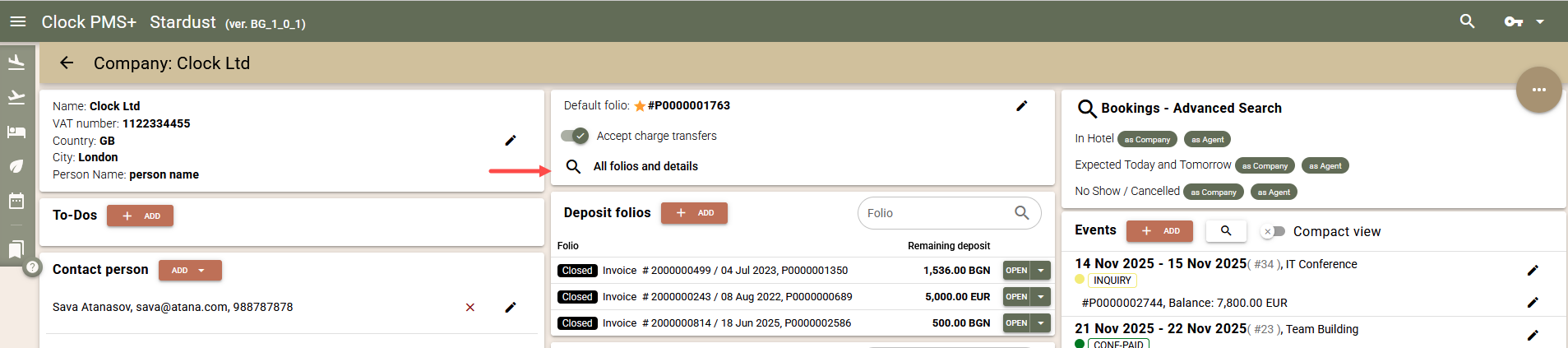
  • When editing company or profile data, we have added a button to open the company/profile itself. This way, you can edit all fields, including custom fields.
  • Folio - the loading of charges is optimised and much faster, for situations when the charges are relatively few, but the number of bookings is larger. 

Events

  • Archiving Meeting Rooms and Restaurants - By archiving, you can hide from the lists and calendar the rooms that no longer exist due to renovation or other reasons. Because they have been used in old bookings, they cannot be deleted, but must be archived. Archiving will hide them for future use and exclude them as a unit from the licensing. The new functionality is related to two new fields in the Meeting Rooms and Restaurants:
    • Active from date - This field is mandatory. When creating a Meeting Room/Restaurant, fill in the date from which the room or restaurant is operational. For existing rooms and restaurants, the field is automatically populated. 
    • Active to date - When you decide to archive a Meeting Room or Restaurant, fill in the date from which the room is out of operation in this field.
  • Size of the Meeting Rooms/Restaurants - We have added a new field for the size of the room to each Meeting Room/Restaurant. In addition to serving as information in the Calendar, the field is intended for future statistical/KPI reports. To clarify the unit of measure of the values filled in each Meeting Room/Restaurant, we have added another field where you can fill in text for the unit of measure itself (e.g. 'm2', 'ft2', ...). By default, it is 'm2'. The setting is located in  Settings -> All Settings -> MICE -> General.
  • Default Transfer Folio - In the Event screen, we have added a new field in the Folios section - Default Transfer Folio. The field is intended to transfer information to Bookings when you create bookings for the Event through the new "Guests / Rooming List Import" screen. The folio, selected in "Default Transfer Folio" will be transferred to the booking - in the "Transfer to Company/Agent folio" option. This is the easiest way for all charges from the rates to be directed to one, summarising folio for the Event. Regarding the Booking and the "Transfer to Company/Agent folio" option, we remind you that the charges from the rate, the rate package and the city tax are transferred to the folio of the Event/Company. The charges selected in the booking (Daily charges), the manually made charges, as well as the automatic ones related to the room type, are directed to the booking's folio. At the moment, the new field in the event "Default Transfer Folio" is only used via "Guests / Rooming List - import", but soon it will also be possible to use it when manually creating bookings for an Event.
  • Charge transfers - This option determines whether charges can be transferred to the Event or Company's folio. The option is set in the company itself and concerns the company's folios and the folios of the company's events. We have moved the Charge transfers field from the Company to the Event screen. This makes it easy and quick to access. We have added the information in the Folios section, as well as the ability to quickly open the Company and change the setting.
  • We have added a new BEO template for the visual editor, which contains both gross and net amounts for all elements. This will give your counterparties clearer information about the value of the Event.

Splitting bookings for easier room sharing.

In different situations, two bookings need to share the same room. Cases requiring this may be a combination of individual bookings or bookings from different companies, etc. Sharing a room by two bookings required that a room number be pre-allocated to both bookings. This pre-allocation creates inconveniences in the management of the rooms. We have added new functionality to facilitate room sharing. Here are details about it:

  • There is no need to create two bookings in advance. Create one booking for two or more guests and check the option "Split additional guests on check-in", available under the "Adults / Children" fields.
  • Upon check-in, the system will automatically split the booking into two, with the main guest remaining in the first booking and the other guests being transferred to the new booking. The two bookings will share the same room.
  • The second booking created by the splitting, is a copy of the first one, with all the main data being transferred. There is a peculiarity in the number of the second booking. Instead of receiving a new number, as is usual when copying, the number of the second booking is like the number of the first one with ".2" added at the end. That is, if the original number was "L12002", the number of the split booking will be "L12002.2". 
  • When splitting the bookings, the price will also be split. The split is proportional to the guests. This means that if there are 2 guests, the price will be split in two, and if there are three guests - the first booking (with the main guest) will receive 1/3 of the price, and the second (with 2 guests) 2/3 of the price. The split price is recorded as a manual price in the two bookings.
  • The split function can also be invoked manually. This can be done both before check-in and after check-in. The requirement is that the booking has an allocated room and that there are more than one guest (profiles) added. You can access the new function from the booking preview screen using the "Functions" button.

Other improvements

  • Setup of the colour of the navigation bar - When you use multiple hotels and each hotel is on a separate tab in the browser, you have to check the name of the hotel to know which hotel you are working in at the moment. To make this task easier, you can now choose a colour for the navigation bar for each individual hotel. In this way, you will find it much easier to orient yourself in which of the hotels you are at a given moment. The new setting is located in Settings -> All Settings -> Hotel -> User Interface. There are two settings - for the background colour and the font colour. Save after changing them to see the effect. 
  • All OOS statuses for a given room - You can easily see a list of all entered OOS statuses for a specific room. Open Settings -> All Settings -> Rooms -> Rooms Find the room and open the edit screen. At the bottom of the screen, select the "Room statuses" button. From there, you can delete incorrectly entered statuses, as well as see a log of the changes to the OOS statuses. 
  • Meals - summary report - we have added a filter by restaurant. This will allow properties with more restaurants to get a clearer forecast for dining. 
  • In BookDirect - we have added explanatory texts to the prices as to whether the prices include or exclude taxes. With this, in addition to making it clearer for guests, we also satisfy the requirements of the meta-search providers.
  • In the "Housekeeping Tasks" screen - we have added a filter by sector. 
  • Arrivals/Departures Summary report - we have added another column for the occupied rooms from the blocks. The residual block is displayed. Through the new data, you can make much more accurate planning of the expected occupancy. The column has been added only in the new report, which you can find in "All Reports (new)".

Fixes

  • Datecs fiscalisation - an issue with fiscalisation of fractional quantities smaller than 1 (for example 0.25) has been eliminated. In such fractional quantities, in rare situations, the receipt was not fiscalised due to differences in rounding. 
  • An issue has been resolved where, if a quantity greater than 1 is specified in a charge template associated with the rate, that quantity is charged, instead of charging the correct quantity - 1.
  • Event templates - the automatic allocation of Meeting Rooms and Restaurants was not correct if Layout was selected. The automatic logic did not correctly account for either the selected Layout or the capacity of the rooms for it.
  • D-edge - we have changed the algorithm for extracting information about the Agent, by looking at the two possible places where it can be provided.
  • When using the e-menu from the POS for room service from the guest's Self Service Portal, in rare situations, when there is no open folio in the booking, an error occurred during the transfer from the POS to the hotel account.
  • Occupancy/Revenue Forecast and Pace report - reported revenue from expired or consumed blocks. Revenue is now reported on the remaining number of rooms in the block.
  • Housekeeping Tasks screen - in older versions of Chrome, an error occurred when editing tasks or automatic allocation. Also, an error occurred when trying to edit a task and set 0 credits. 

Integrations

  • AppConnector - In some cases, the Atomize integration appeared to be enabled, even though it wasn't;
  • SALTO KS - Salto's newest access control solution, SALTO KS, has been integrated and your guests can now easily access their rooms and other restricted areas of the hotel conveniently from their Self Service Portal. More information about the integration and how it can be configured can be found HERE;
  • Gastronovi POS - The charges coming from the hotel and end-of-day transfer were missing the charge custom fields data. This is now fixed and the custom fields are properly filled in;
  • ROMANIAN eFactura integration - To comply with the requirement for the electronic sending of documents in Romania, we have integrated an automated interface with eFactura. An article with a description and configuration information will follow!
  • GERMAN fiscalisation - The statuses of the Daily Closures and Dsfinvk Reports were not always properly received form Fiskaly, causing the Daily Closures to appear as PENDING or displaying error. Now it is fixed.
  • BELGIUM Federal Statistics - The export contained data of all guests, as now this is fixed , and only the data of the main booker is sent;

Clock Update (19 Nov 2024)

New features 

Online check-in 

Attribute Based Sales (ABS)

One of our main goals is to provide you with tools to increase your sales and discover new revenue streams. We are happy to introduce our new development in this area Attribute Based Sales (ABS).

This method of selling hotel services is based on the understanding that your hotel rooms are not exactly the same. Some have a better view, others are a bit bigger, others have a desk, others are far from the elevator, others are on a low floor and so on. On the flip side, stand the guest preferences. Each guest has different preferences in terms of room, and some are willing to pay an extra price to get a room that more closely matches their preferences. It is in this direction that we have developed our new tool  Attribute Based Sales. 

Here's how it works:

  • It's based on Room Features. If you already use them to manage guest room requirements, you can specify which ones to sell and at what price.
  • In each feature, you can select a charge template, and specify the price in it. You can also enter a price of 0 if you decide to provide a free choice of features. In the feature itself, you can specify whether the price from the charge template is a one-time price or is per night. Once you select a charge template for a feature, it is already included in the list that will be offered to the customer. Room features without the charge template are not displayed to the guest.
  • Shape the commercial presentation of the room feature- add a description and a photo.
  • Attribute Based Sales are currently included in the Online Check-In application. To enable the step, select in the application settings - Attribute Based Sales (ABS).
  • The guest will see the room features you set up with their prices, descriptions and a photo. The system reports the Room Type in the guest's booking and offers the features associated with the room numbers of that type.
  • Follows the guest's selection of features. Here we have tried to make everything clear to the guest, in terms of what they can choose.
  • To begin with, in the list of room features he sees only those for which there are available room numbers, i.e. if the feature is selected, it is guaranteed that the guest will be provided with the corresponding room.

  • The guest can select multiple room features. In this process, after each selection the system updates in real time the remaining room features, disabling those that are not compatible and available. This means that for that particular combination of features, you either do not have a similar room, or you do but it is no longer available.

For example: If a guest selects the feature "Quiet Room" (a room that faces the patio for example), and those rooms do not have a balcony, the feature "Room with Balcony" will be disabled for selection because for that combination, there is nothing to offer the guest. The same applies if there is no such room number available. 

  • The guest can turn the different features on and off, thus being able to choose the combination that suits him best in terms of choice and price.

After confirming his choice, the following happens:

  • The charge templates from the room features will be added to the booking, such as "Daily Charges”;
  • The booking will be assigned a room number, which matches the selected features;
  • On the booking, the option "Disable Room Change” is included;

This way, the guest will get what he/she has selected and the hotel staff will see that the guest has paid for the selected room. The "Disable Room Change" option will prevent staff from making mistakes when trying to allocate another room.

Note: Please note that this functionality may work fine in case you do not allocate room numbers before guests arrive. This way, the system will have more available room numbers to use for Attribute Based Sales. If you use the "Automatic Room Allocation" option, which allocates room numbers at the time of booking and if your hotel is full, there will be no available room numbers for the Attribute Based Sales module to sell their features.

Upsell rates (Special Offers)

This functionality has long existed in the system, but can now be taken advantage of by those using the  Online check-in app. Through it, you can upgrade the room type and package of guests by offering them higher and more expensive product levels.

Functionality is organised so that you can use both your standard rates and specially designed ones. This means you can choose from two strategies - offer the guest to book a more expensive room type or package by paying the difference in the standard rates, or by paying a lower ("promotional") rate for the higher package. In the latter case, by managing a separate (promotional) rate plan, you can use rate restrictions to manage when those rates are available or not, including building a dynamic promotional strategy based on Occupancy Adaptable Rates.

The Special Offers step comes before the Attribute Based Sales step. This way, the two steps can work together, i.e. if a guest has booked a Double Room and chooses to pay extra for a Suite, then on the Attribute Based Sales step, the Suites features will be offered.

To include the Special Offers step in the Online check-in, in the app settings, select Upsell rates (Special Offers). 

For more on the behaviours and settings of the new features, please see Attribute Based Sales (ABS) and Special Offers through Online Check-in.

Tour Operator Contracts

Packages

With the recent changes, we want to resolve the following package cases:

  • New Year's Eve Dinner, which is mandatory for all guests;
  • Christmas dinner, which guests can choose whether they want it or not;
  • X-day golf/spa/ski package, for guests who have purchased them;
  • Additionally, through the packages, you can now also opt for  flat-rate discounts such as “full seats” - we've removed the restriction on negative pricing in the packages for this purpose.
  • For the packages that are on fixed dates (holidays), we have made a new table with conditions “Holiday Packages”.

    • For these,  a date must be specified. If the booking has an overnight stay on that date, one condition for charging the package is met. The package itself is charged  on the date in question.
    • Holiday Packages can be activated with an Activation Code or with a “Multiplier (Per)”- this is also the second condition for charging.
      •  with Activation Code (case study: “Christmas Dinner Optional") - as many times as the code is in the booking, the package service will be charged (on the date in question), 1 code = 1 dinner. If adults and children have different prices, two lines should be configured with different activation codes and different prices.
      • with Multiplier (Per) ( case study: “Mandatory New Year's Eve Dinner”). The service is always charged with a certain amount (multiplier), in this case, you do not have to fill in codes in the bookings. per Booking; per Guest; per Adult; per Child.

Examples:

  • If the multiplier "per Child" is selected and there are no children in the booking, the service will not be charged.
  • If there are 2 rows configured - one “per Guest” and a second “per Adult” both will run and duplicate the services for adults. 
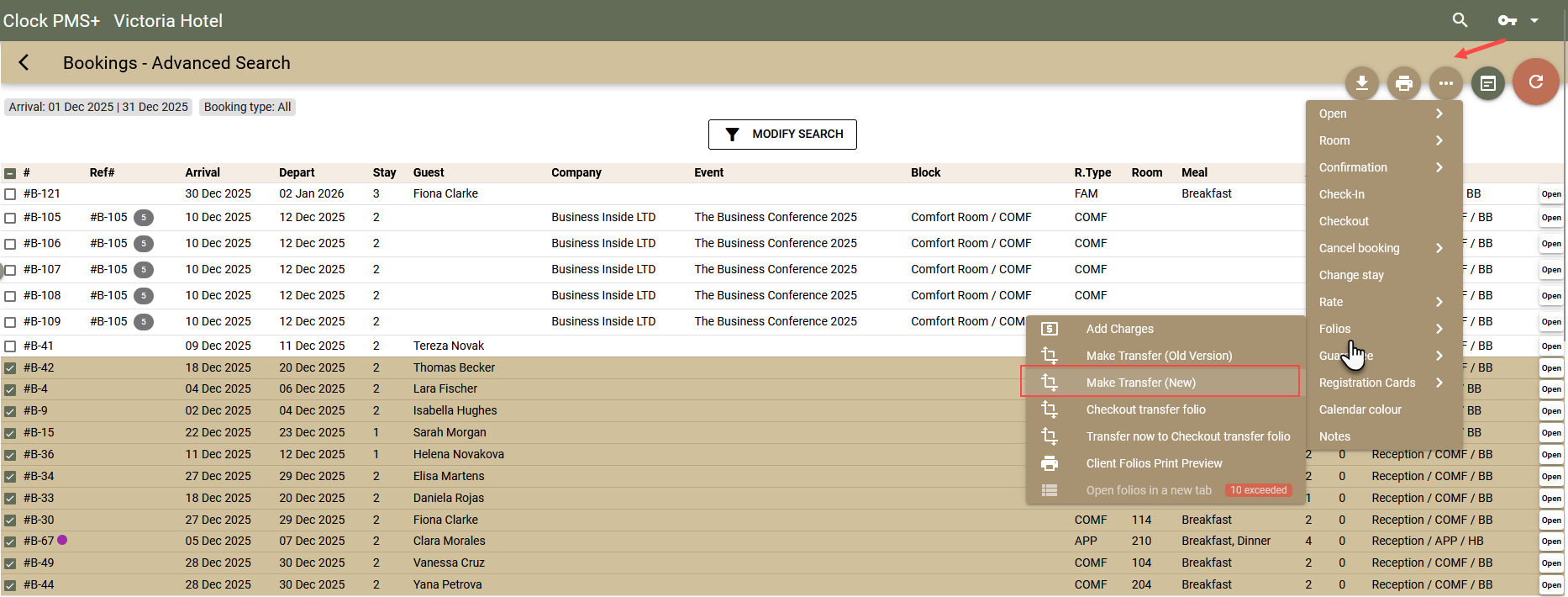
  • If Adults and Children have different prices, two lines should be configured with different multipliers (Per Adult/Per Child) and different prices.

For X day packages, we have made changes to the “Package Services” section:

  • Added charging scheme: On Arrival, On Departure, Every day, First N days.
  • Current packages recorded in the contracts were migrated to “On Arrival”, to keep the current behavior. 
  • First N days - means the first N days of the booking stay. Feature: if N (say 7) is greater than the stay (say 3), 3 packages will be charged (as many as the stay, but no more). 
  • The activation code still works as before. As many codes are added to the booking, as many times a package will be added, according to the chosen charging scheme. 

Example: 

  • Configured package for first 3 days;
  • 1 code in the booking = 3 charges ( 1 for each of the days). 

Detailed information on setting up package services can be found in TO Contracts - Packages.

Discounts

We have also made changes to Discounts and Free nights to work alongside the new packages.

In both places (Discounts and Free nights) you can specify which accruals affect which conditions. For each Discount or Free night, depending on your contract, you can specify whether to apply to: Accommodation, Extra board, Package. checkbox "Package" applies to both types of packages: Holiday Packages or Pa. 

Note: Note also the following feature: the behaviour is identical if you do not select any checkbox or select all of them. In both cases, the discount will be applied to all items.

In addition, to make it easier to view your contract details, we've made it so that the contract lines retain their original order. The system now sorts them according to the order in which they were added by the user.

Improvements

  • Information on Room Upgrades. We want to clarify that the term "Room Upgrade" does not refer to the Upsell Rates (Special Offers) features listed above. It refers to cases where the guest has booked a Double Room but the hotel has decided to provide a higher room type, such as a Double Deluxe or Suite, either because there are no available Double Rooms or because they want to increase guest loyalty in this way. In these situations, the originally booked room type was lost until now. We have taken a broader approach to solving this problem. We don't keep track of what the original booked room type was because that would prevent us from distinguishing between booking edits or upsell rates and room upgrades. What the system does track is whether there is a difference in the Room Type that the rate is for and the Room Type that the guest is using (the room of arrival and the rooms of their moves). In other words, whether the guest is using what they are paying for. If the system detects a difference between usage and rate, it marks the booking as a "Room Upgrade". An indication of this is visible in the booking screen, below the room itself. Also both (or more) room types are visible - the rate and the accommodation. Currently this information is only visible in the booking screen, but will be included in new versions of the Arrivals, In Hotel, Departures screens, and as a filter in the Advanced Search.

  • In Hotel / Expected Events - we've added more periods. In addition to the existing 14-day report, we've added two more choices - a quick 31-day period button and a random period button. The report was also optimised for printing.
  • BookDirect extra services - for the extra services for which you selected the "Allow date selection" setting, there are now two more options: "Allow on Arrival” and “Allow on Departure”. Thus, depending on the nature of the service, you can set the system to allow or not allow the selection of this service on the corresponding date of the guest's stay. For existing services, the "Allow on Arrival" field is automatically filled in as was the previous behaviour of the system.
  • BookDirect - Waiting list URL - We have added the ability to integrate an external Waiting list management system. If you wish to integrate such a system you need to set up a link to it. Once you set the link, a link to it will appear in BookDirect  Notify me when available". The link is always present after the list of room types on the second page. Additionally, if the hotel has no rooms available, it also appears at the top of the screen to get the guest's attention. To set up the link for integration with a waiting list system, select BookDirect - Settings -> Website Integration -> Waiting list URL. The text "Notify me when available", can be changed from the BookDirect translation screen.
  • BookDirect - Card Verification - For users who do not have the option to use the direct integration with a payment provider, we have added a basic credit card number verification against the industry standard. Basic verification is only about whether the number itself meets the standard, but in no way guarantees that the card is valid and can be used.
  • In all screens of Channel Managers regarding Company mapping, we have changed the company selection field to allow searching for the company by name.
  • When archiving a room number, we now check for OOS statuses added to it for future periods. It also checks for future bookings that this room has been assigned to. Before archiving the room, it is necessary to remove its future uses and blocks.

Fixes

  • Events -  corrected the error text that appeared when recording a Catering or Room Reservation for the wrong period, so it is now clear what the issue stems from;
  • BookDirect- fixed an issue where after creating a booking for multiple rooms, the confirmation for all rooms was not being received. The issue was occurring when the last step required the user to fill in a “Language” field and different languages were selected for the guests.
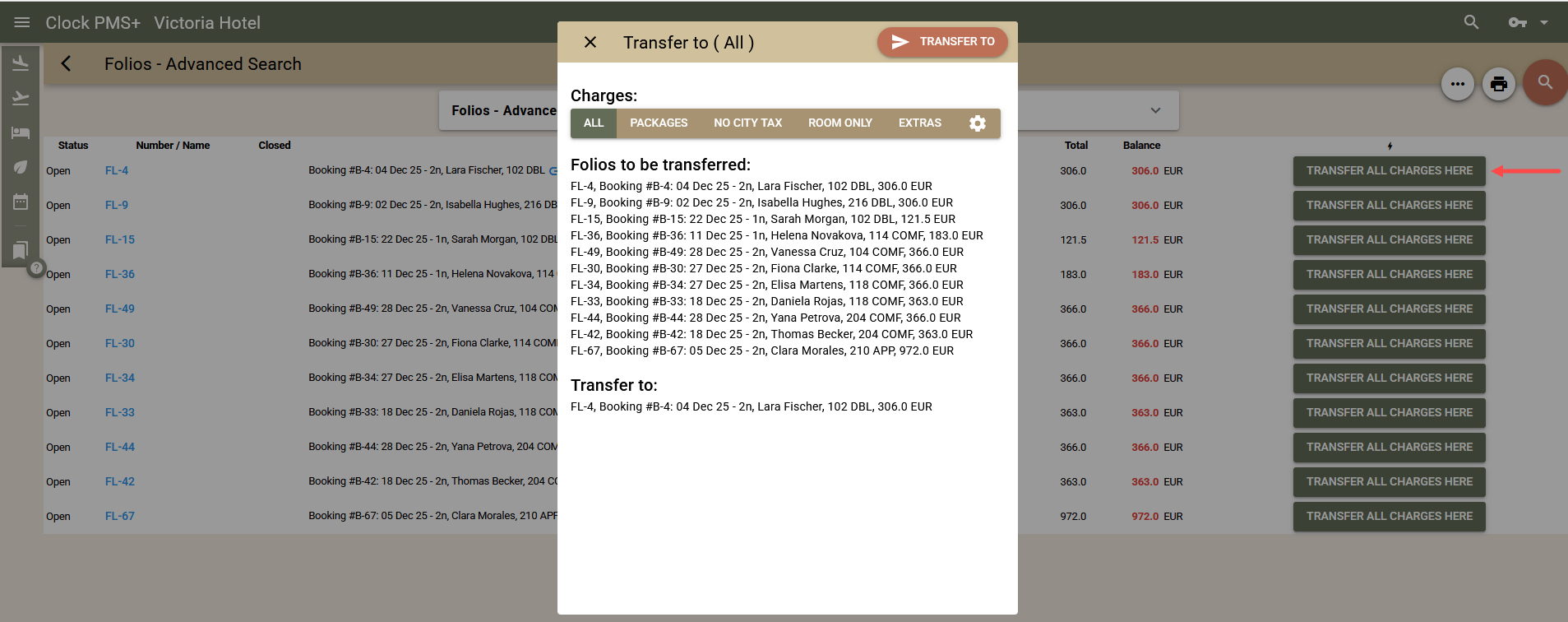
  • Payments Report - corrected an issue where GL codes were not outputting correctly in cases where the report was running for a different account than the one the user was logged into;
  • Charges By Rooms Report - corrected data presentation so that services were not displayed for both virtual and component rooms at the same time.

Localisations

  • Norway: KID Number Added to the System. In Norway, the Invoice KID number is used to streamline payment and document reconciliation. The KID number serves as a unique identifier for each sale. It is automatically generated during the folio closing process and is included in the folio printout. Please Note: To activate the automatic generation of KID numbers for your Clock account, please contact the Clock PMS+ Support team.

Clock Update (16 Oct 2024)

Events Update

Activity Calendar

  • We changed the leading view of the calendar. Your feedback determined the old view to be more comfortable, readable, and printable. Therefore, we made the main view to be for a period, not for a day, visually matching the compact view of the old calendar. We also combined new features to it.

  • The period views work with 7, 14 or 31 days, allowing you to access the information you need with one click on the period or start date button.
  • To all period views (Activities, Half-Day, Day) you can now quickly get information about all Activities just by hovering over them, without even having to click. Also, again from all the views you can edit activities or create new ones. 

  • The direct link to the Calendar (from the navigation) is no longer tied to the New Event screen. We've adapted this calendar to be print-friendly, and improved the print view as well.
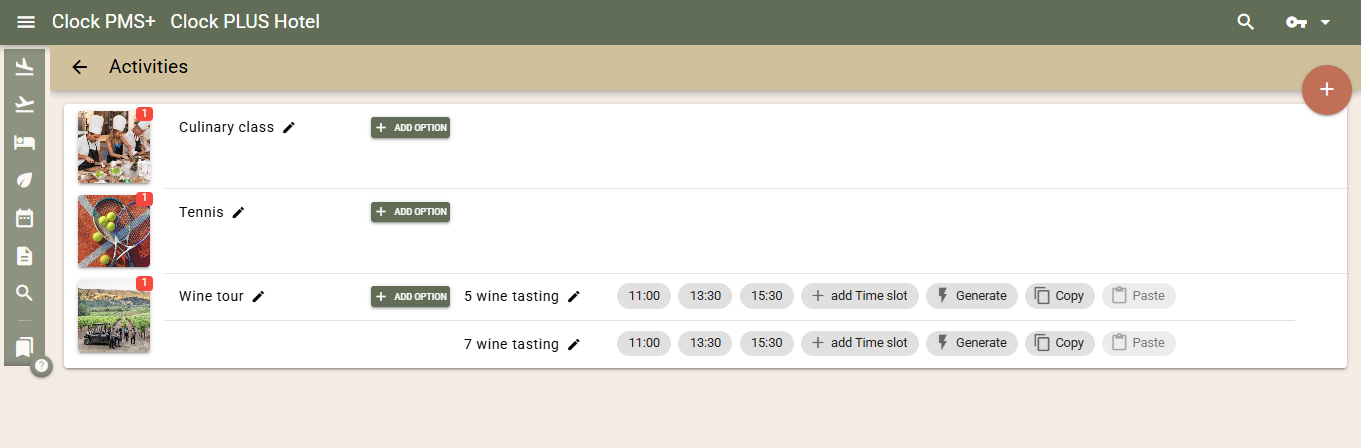
  • We have changed the way we create activities through the calendar. Previously, slots were selected first and "blue" boxes appeared, then everything was saved. Creating the activity is now more traditional and linear - after selecting a time, you save the activity immediately, and this allows you to add charges to it at the same time.
  • When creating a new calendar activity, if there is no event selected, you can create a new one, similar to the old organization.

  • To the filters, we have added the ability to exclude sections with Meeting room bookings or Catering. This way you can focus on what you are interested in or print only one section or the other.
  • To the Activities in the calendar, we added information about the Company and Activity Type.
  • In the Catering section, we have improved the label for the total number of guests for the hour. When there were a lot of bookings, the value was not reading well.

Calendar - Hotel Occupancy

  • Hotel occupancy is now shown at the top, not at the bottom.
  • We added a new quick button to show/hide Hotel Occupancy (the icon with the bed). 
  • In Hotel Occupancy, by default it NO longer displays the occupancy percentage. This made the table twice as compact. If you want, you can show the % occupancy from the settings icon in the top right corner.
  • We added the TOTAL of available roomto the table.

Event screen

  • We changed the event details section to be more readable, including the note which is wider and keeps the entries.
  • New Event screen - we show all the Event fields on the create form so you don't have to edit it afterwards.

  • Event Contact Person - the contact creation and editing forms now contain all the contact fields. The search has also been changed. Screens have been redesigned to be clearer and make better use of screen space. The suggestion of related contacts has been improved, and they are retrieved from both the Company and the Event. When selecting or creating a Contact, it is also added to the Company, to make it easier to use in future Events.
  • In dialogs (e.g. editing Catering, Charges, Templates, etc.) you can quickly close screens with the "Esc" key instead of pressing the "x" key.
  • We have added the number of related bookings.
  • ToDos - we've split them into Active and Completed, with Completed hidden by default.
  • We've expanded the edit form for Activities to make better use of the available space. We've also changed the Start, Duration, and End fields so you can see both dates and easily create multi-day activities.
  • In the list of Activities, we added information about Activity Type. 
  • Adding Activities - You can now add activities directly from the Event screen without using the calendar.

  • We also fixed two issues - the screen was not always refreshing after recording. The data was being saved, but it wasn't showing on the screen, which led to confusion. Also, the ToDos were being created with the wrong "Channel". They were visible in the Event, but not visible in the general ToDo search because of the channel.
  • To the full screen of the block (which is full screen), we added all the details for the block - rate, manual price, adults and children, and code.

Event templates

  • We added the Activity Type field to the screen that lists all Activities part of the Event Template.
  • You can also now add a Template directly from the Event screen without going through the Calendar. 

Other Improvements

  • Folios - added a filter for charges by revenue group.
  • Folios - voided folios - additional information - time and the user who voided - is now displayed in the main view.
  • Folios - a limit of 15 000 charges in a folio is applied. So far we have only generated ToDo's when a certain number of charges is reached. However, many folios remained unprocessed and this caused problems in subsequent operations with them.
  • Folios - added the option to redeem gift vouchers purchased through the Gift Voucher webshop.
  • Folios - (hotel) billing info - we added City to the folio printouts in the Issued by section
  • Adyen - when paying with an S3 card (e.g. virtual cards received from the channel manager) a second card is no longer created.
  • Payment Report (new) - has been optimized and works on backend.
  • Added the 'Urgent' checkbox in the ToDo Action Plan configuration
  • Charges By Rooms Report - added the option to see the booking guest details - names and number of guests. To view this information select the 'show Guest data' checkbox after generating the report. In addition, we have redesigned the report so that by default only rooms for which there are charges are displayed. If you want to see all rooms, regardless of whether they have charges on the given date, select the 'show Rooms without charges' checkbox. Printing is optimised.

Fixes

  • Self Service Portal - the button for adding additional services has been changed to prevent double clicks.
  • Virtual Rooms - with certain configurations of virtual rooms, there was a discrepancy in the number of available rooms in Rate and Availability and Occupancy Forecast.
  • Events - archived rates are no longer available for selection in the Blocks.
  • Events - changed 'related bookings' to reflect only the number of active bookings.

Clock Update (03 Sep 2024)

Discover Our New Time-Saving Features

We’re excited to introduce several powerful new features in our software that are designed to streamline your workflow and enhance productivity.

Charge Packages

Say goodbye to repetitive clicks with our Charge Packages feature. Imagine you're managing an event and need to apply a preset menu to the occasion. With Charge Packages, you can select the preset menu, and all the associated menu items will be automatically charged to the event with a single click. This feature is perfect for efficiently processing bundled services or items, saving you time and reducing the chance of errors.

To set up Charge Packages:

  • Navigate to Settings -> Charges & Taxes -> Charge Packages.
  • Add a new package and give it a name. You can also add a longer description.
  • Add the items to the package, for each item select: 
    • Charge Template
    • Quantity: If you fill in a quantity, the charge will be with that fixed quantity. However, it is more interesting if you leave the field blank. Then the quantity of the charge will be whatever quantity you fill in for the package when you use it. On the other hand, the system will suggest for the quantity of the package - the PAX in the Event, Meeting Room Bookings or Catering - so the Quantity will be as many as there are PAX.

Example:

Let's say you have an Event package where the Audio/Video fee is quantity 1 and costs 100 EUR, and the room rental is 10 EUR per person. In this case, the charge template for the Audio/Video must be a quantity of 1, and the charging rate for the room must be an empty quantity. 

Let's say the meeting room booking is for 23 guests. When you charge this package to the Meeting Room Bookings, it will automatically suggest for the package quantity - 23. The resulting chargers though are - Audio/Video 1 * 100 EUR, Room Rental 23 * 10 EUR.

  • Price: You may enter a price per charge. If you don't fill anything in, the price set in the chargemaster itself will be used. This feature allows you to use a single Charge Template with different prices in different packages.
  • Print text: Using the print text you can control the presentation of the charge in the folio. If you don't fill in anything, the print text from the charge template will be used.

To-Do Action Plans

Planning complex projects just got a lot easier with the To-Do Action Plans feature. Let’s say you’re organizing a wedding. You can create a comprehensive action plan that includes all the To-Dos involved, such as booking the venue, sending invitations, arranging catering, and more. Each task can be scheduled for a relative date—like sending invitations two months before the wedding or confirming the menu one month out—ensuring nothing slips through the cracks.

To set up To-Do action plans: 

  • Navigate to Settings -> MICE -> To-Dos - Action plans and add a new plan.
  • Fill in the fields of the To-Do you want to create.
  • If you fill in the Assigned User field then this To-Do will always be assigned to the selected user. If you leave the field blank, it can be allocated to the user you select when using the plan. This way, certain tasks can have specific assignees, while other tasks will be assigned to a user you select.
  • The date of the To-Do is relative and can be rendered against two dates - "Date Created" and "Date Arrived"
  • In Offset Days - fill in how many days before or after the relative date should the To-Do be created. For example for "7 days after the creation of the Event" - fill in "7". For "30 days before the Event Arrives" fill in "-30" (i.e. a negative number to be before arrival).

Usage

To add a To-Do Action Plan to an Event:

  • Open the Event and in the To-Do section, select the Action Plan button.
  • Find and select the Plan.
  • The creation and arrival dates of the Event will automatically populate. If you wish you can change them, thus the To-Dos will be created according to the newly entered dates.
  • You can also fill in a user, as they will be assigned to tasks for which no user has been selected.
  • Save. The To-Do will be added to the Event with the appropriate fields, dates and users. You can add as many plans as needed to each Event.

Event Breadcrumbs

Navigating through your recent activities has never been easier. Our new Event Breadcrumbs feature provides shortcuts to the last accessed events, allowing you to quickly pick up where you left off without the hassle of searching through your event history. Whether you're managing multiple events or need to revisit specific details, this feature ensures you can effortlessly retrace your steps.

On the Event screen and in the Event search, you will see a toolbar showing the last 20 Events open in the current browser. If they don't add up on your screen, or you can't navigate by the brief description, you can open the list with the toolbar button on the right. The list displays the last 20 Events with more information about each one. Click the event to open it or select it with the right button to open it in a new tab.

BookDirect Service Groups Merchandising

We’re thrilled to introduce a new feature in Book Direct designed to help hotels maximize their revenue while improving the guest experience: Service Groups Merchandising.

Offering extra services to your guests is a great way to enhance their stay and boost your revenue. However, when the list of available services becomes too long, it can overwhelm guests and reduce the likelihood of them selecting additional options. That’s where Service Groups come in.

With Service Groups, you can now categorize and group related services—such as spa treatments, dining options, or room upgrades—into compact, easy-to-navigate sections. Each group is presented with a gallery and description, making it visually appealing and simple for guests to explore all the available options.

For example, instead of displaying a long list of individual spa services, you can create a “Spa & Wellness” group that includes massages, facials, and other treatments. Guests can easily browse this group, making it more likely they’ll add multiple services to their booking.

By organizing your offerings into Service Groups, you not only make the selection process more user-friendly but also increase the chances of upselling more services. It's a win-win for both your hotel and your guests.

To organize additional services in Book Direct in Service Groups:

  • Navigate to Settings -> Charge Templates. From the 'More' menu, select WRS Service Groups. There is a link to the same settings in Book Direct Settings -> WRS Extra Services -> WRS Service Groups.
  • Add a new Group by filling in the name.
  • Once added, you can add pictures for it to display as a gallery in Book Direct. Pictures are added from the Groups list - with the button opposite each group.
  • For each group you can add translations and descriptions for the supported languages - Settings - Content - Common Translations - WRS Service Group.
  • Finally, you need to set a Service Group for the Services you sell through the WRS. Navigate to -> Settings - Charge Templates -> WRS Charge templates -> column 'Group'. Set the group to only those services you wish to group. Save! 
  • Services without a group will appear in Book Direct as before - alone in the list.
  • In the list in Book Direct, all Groups are presented first, then the services without groups.
  • If you wish to change the order of the Groups, you can do so from Setting -> Charge Templates -> More -> WRS Service Groups Sorting.

Online Check-In: More flexibility

Our latest update to the  Online Check-In App enhances flexibility, making the check-in process even smoother and more convenient for your guests.

  • Payment can be skipped. 

We've made a small but useful update to our check-in app. Previously, you could either require guests to make payments in advance or opt not to collect payments during the online check-in process. With this new feature, you can now prompt guests for payment during check-in while giving them the option to choose whether to pay online or at the hotel. This update provides a bit more flexibility, allowing guests to decide on the payment method that works best for them, whether that's taking care of it online or handling it in person upon arrival. Check the new setting "Payment can be skipped" in On-line checkin app.

  • Registration of adults and children

To increase the utility of the app in countries where registration cards are required, including for children, we have modified the related setting. Previously, it was possible to choose whether to register one guest or all adults. The "Registration Guests" setting now includes three values: "Main guest only," "All adults," and "All adults and children."
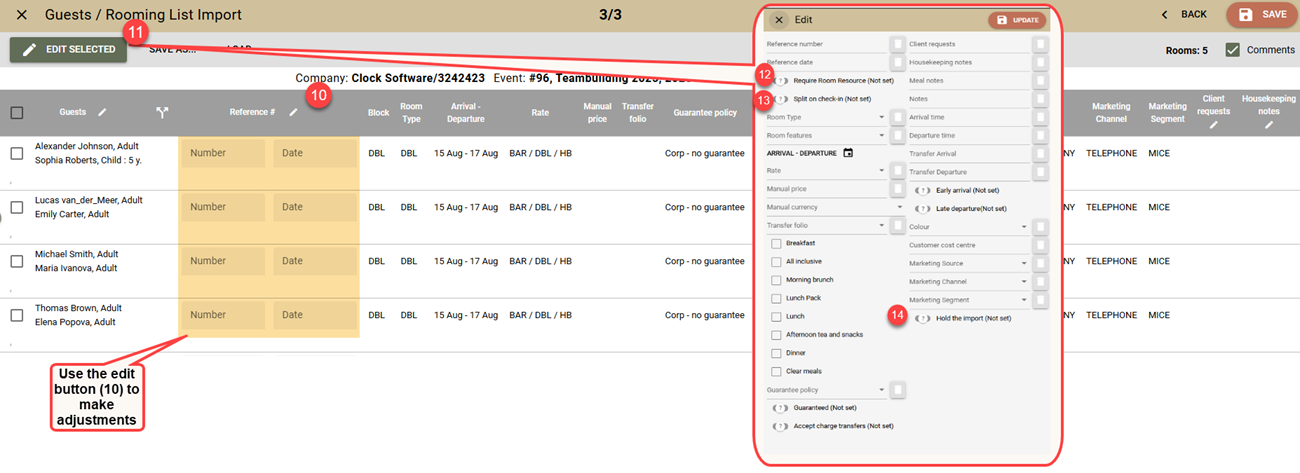
  • Skip the splash screen

If you don't like the first splash page in Online Check-in, which is intended for your logo, you now have the option to remove the image. This way, the splash screen will be skipped, and the user will proceed to the next page without delay.

In-Platform Payments: New Reconciliation Reports

We’re pleased to introduce two new reconciliation reports for In-platform Payments users: Payments Reconcile and Payout Reconcile. These tools are designed to simplify your financial oversight and ensure accuracy in your transactions.

  • Payments Reconcile: Track Every Transaction

The Payments Reconcile report helps you track payments in Clock within a specified period. It answers the question, "Where is my money?" by showing whether each payment has been paid out, when it occurred, and which payout batch it belongs to, or if it’s still pending. The report summarizes payments by payout batches but allows you to drill down for detailed insights on each group.

  • Payout Reconcile: Verify Your Payouts

The Payout Reconcile report provides clarity on each payout made to your bank account. It details the transactions included in each payout—such as payments, refunds, and chargebacks—along with the collected fees and commissions, and the net amount transferred. This comprehensive view helps ensure that all payouts are accurate and complete.

  • Why These Reports Matter

These reports enhance financial management by offering detailed visibility into transactions and payouts, making it easier to reconcile accounts and verify accuracy.

Improvements

Event Confirmation App - Signature

We’ve enhanced our document signing app to improve transparency and usability. Previously, the signature was collected but not visible within the document. Now, the signature, along with the signer’s name and date is visibly placed inside the document, and the complete, signed document is automatically sent to the customer. Additionally, if the document is printed later, the printout will also include the signature and the signer’s name.In the back office, we've made it easier to identify signed documents by adding a dedicated icon within the app. This allows staff to quickly recognize which documents have been signed, streamlining document management. 

Contract (TourOperator) Rates - Special Activation Codes for Discounts or Additional Charges

With the new functionality, you can trigger Discounts or Extra Charges only for selected bookings that, for example, participate in a promotion. This is done by filling in Activation Codes in the Booking and setting the conditions for Discounts or Additional Charges (bundled charges) corresponding to these codes in the Contract. Here is more information:

  • In the Contract, add the Discount or Additional Package (Accrual) Codes in the Activation Codes section.

  • For a given discount, you can fill in the "Activation Code" field. It will only be applied if the same code is filled in the booking.
  • In the discount, we have added one more field - "Exclusive". This field means that if this discount qualifies and is applied, no other discount will be applied along with it. This field is particularly useful for the following situation. If you have a booking with a code, then both discounts WITHOUT a code (they apply to everyone) and those with a code (for the specific booking) can be applied to it. However, it's all too likely that you don't want the NO code discounts to apply. So mark the discount with a code for "Exclusive". Then only that will apply, and the others will be ignored even if they qualify.

  • We have added a new section for Package Items. For now, this functionality can only charge services on the day of arrival. For this, the booking must have the same activation codes as you have set in the package item. The special thing here is that the more times the code is present in the booking, the more charges the booking will receive. If the code is added once in the booking - you will have one charge, if the code is added three times in the booking, you will have three charges.

  • One more improvement in the booking screen - activation codes are offered to choose according to the selected rate, instead of being handwritten. This ensures that you won't get the code wrong and will always choose from those codes that are defined for the specific contract. 

Additionally, we've added another small improvement - we're making more optimal use of the screen. By default, the Tour Contract is displayed in two columns and takes up more optimal space on your monitor. If there are lines of the contract that are very long and their content doesn't add up, using the new button on the top-right of the screen, you can "expand" the contract across the full width and so see the long lines more easily.

POS - room transfer - all guests in the room

We have changed the screen in the POS for room transfer to show the names of all guests in the room. The booking/room search by guest name also now searches by all guest names. This change makes room transfers much more convenient, whether the guests are families, colleagues from a corporate event, or delegates from a conference. The deep integration between the POS and PMS makes the combination of the two products unique.

Occupancy/Revenue Forecast and Pace Report - only Room revenue

We have added a new parameter to the report, allowing you to choose whether to view the total revenue (as before) or only the room revenue (revenue groups: rooms and packages). We would like to remind you that the report provides important information about expected revenue, including potential revenue from blocks, which is further divided into revenue from guaranteed and optional blocks.

Other Improvements

  • Disabled OTA Virtual card tokenization: To optimize your expenses related to credit card transactions, we have changed the card tokenization logic so that virtual credit cards from channel managers are not automatically tokenized. This way, you will avoid the costs associated with these transactions.
  • WorldLine/SixPayments: We have added an option in the settings for alternative payment methods for BANCONTACT.
  • The new Event screens now open by default from the navigation and other links. We hope that the effort we have put into the new screens and features has improved your experience and productivity. We value your feedback! 
  • Event Creation Screen: When adding a new company, we have also added the field "Accept charge transfers" so that you can reflect this important feature right at the time of its creation.
  • BookDirect - Cart Expiration: We have improved the logic regarding when the cart expires to make the screen clearer for guests when they encounter such a situation. The cart "expiration" occurs when a guest selects rooms and adds them to their cart but does not complete the booking process. In such cases, the system keeps the cart for 6 hours from the time the first room is added. If the user does not complete the cart within 6 hours, the system marks the cart as expired and notifies the user upon their next action with it. We would like to remind you that rooms added to the cart are not reserved, are not held for the current user, and may become unavailable in the meantime. If this happens, the system performs an additional check and prevents the payment and booking of the rooms. 
  • We have added a new option to the Housekeeping Tasks screen: "Show Housekeeping Sector". This option shows or hides a column with the housekeeping sector, which is useful if you use it. Housekeeping sectors allow you to group rooms and common areas in a way that is convenient for the Housekeeping department. Additionally, it is part of the algorithm for automatic task assignment. You can also obtain summarized information in the Housekeeping Forecast Report using it. If you are not using this field yet, you might want to consider exploring it. 
  • Folios (new): the search for charge templates in the charging screen now works on all words, not just the first as before.
  • Folios (new):  for the closed folios we have added the date and time, as well as username
  • For customers from Zimbabwe, we have added the code for their new national currency - ZWG.

Fixes

  • For documents imported from a CSV file, quick search by number was not working. The search will now work for them, but only for those imported after the fix.
  • When printing multiple selected registration cards at once, there was no "page break." Due to differences in the support of "page break" instructions across different browsers, it is now possible that additional blank pages may appear in some browsers. Unfortunately, a consistent solution that works across all browsers and operating systems cannot be found.

Integrations

  • PUSH / Webhook Notification Activation via API

No more back-and-forth emails with Clock support for activation! To simplify and automate the subscription process, activation is now available directly through the API with a single API call. All partners using this feature have been notified via an email campaign. For more details, please refer to the relevant section in the API documentation.

  • Private Analytics and Google BigQuery Export

With the updates to Clock, we have introduced the ability to add a contact person to a booking, allowing flexibility to differentiate between the booker and the guest. Previously, the contact person field was not available in the Google BigQuery bookings table and could not be included in private analytics reports and dashboards. This issue has been resolved, and the new field contact_person_id now references the table containing guest information.

  • LightSpeed POS L Series Hotel Transfer – Prevention of Duplicate Charge Transfers

In rare instances, finalizing a LightSpeed POS L Series bill hours after it had been transferred to the hotel could result in duplicate charges, particularly if the folio containing the original charges was already closed. The interface behavior has been optimized: now, before new charges sent by LightSpeed POS L Series upon bill finalization are processed, they are foreshadowed by negative charges. This replaces the previous behavior, which involved voiding the old charges.

  • Door key issue process - Card ID added to Door key issue process

More RFID-based door lock systems are now functioning online, where information is not stored directly on the RFID physical bearer (such as a card or bracelet). Instead, the system reads the RFID ID and sends it to the door lock system to communicate with the lock and grant access. By default, the Card ID is not required but can be easily enabled in the Room Key Settings. Once enabled, the Card ID becomes mandatory and is stored in the door key request to ensure proper communication with the door lock system.

Clock PMS+ Update (31 Jul 2024)

Housekeeping Assistant

Cleaning guest rooms is a primary task of housekeeping, but it is far from the only one. In addition to the rooms, housekeeping must also take care of the corridors, stairs, landings, lobbies, restaurants, meeting rooms, service areas, outdoor spaces, etc. All these activities can now be managed in the improved version of the Housekeeping module. Housekeepers can now be "connected" to their assigned tasks. Through the new application "Housekeeper App", they can use mobile devices to track and complete their tasks, charge for the minibar, and report any issues found. This leads to real-time communication, better team interaction, and consequently, more satisfied customers. Here are the details of our improved version:

Tasks for Everything

We have changed the structure of housekeeping tasks so that they not only pertain to hotel rooms but also to meeting rooms, restaurants, or other common areas. Meeting rooms and Restaurants are part of the configurations of the "Events" module, and all other areas you want to manage housekeeping tasks for can be defined in the new setting Housekeeping Assistant->Common Areas.

Create a housekeeping task and choose whether it pertains to a Hotel Room, Meeting Room, Restaurant, or Common Area.

Note: Please note that currently, tasks for meeting rooms, restaurants, and common areas are not generated automatically, but you can create new tasks for these areas through the "Housekeeping tasks" screen.

Housekeepers

To more effectively manage your employees, we have created a new list. In this list, you can enter all housekeepers and indicate whether they are currently on shift or not. This will help you optimise the task assignment process. Besides making it easier to assign tasks to housekeepers, the system will also help by filtering employees on shift. You can also use the new functionality for automatic task assignment. If you prefer, you can continue using the feature the old way, i.e., without having to predefine the housekeeper list, using a housekeeper number, or manually entering a name each time.

Information on how to configure the list can be found in the article "Housekeepers".

Housekeeper App

With the new app, each housekeeper receives and completes their tasks on a mobile device. No prior installation is needed; it is extremely convenient as the only thing the housekeeper needs to do is scan a QR code. They can use their personal smartphone, a company smartphone, or a tablet. There is no limit to the number of devices and housekeepers you wish to use the system. Get acquainted with the capabilities of the new app Housekeeper App - functional capabilities and activation.

Housekeeping Live Monitor

  • We added the possibility for the monitor to be started for a specific sector (2). This way, the Sector Manager can monitor changes only for the rooms they are responsible for. Accordingly, the sound indication will be only for the monitored rooms.
  • The Housekeeping Manager, on the other hand, can use another new feature - "grouping by sectors" (1), thus clearly seeing all rooms in the hotel and their respective housekeeping sector.
  • List of changes (3). With a new button in the upper right corner, you can review all changes since the monitor was last started, seeing information on the time, room, and its new status. This way, even if you miss the sound signal, you can later review everything that has happened during the time you missed (up to 24 hours back).

Other Improvements

  • Mass creation of tasks. We have added the ability to create tasks for many rooms/meeting rooms/areas at once. Thus, instead of adding tasks one by one, you can much more quickly create tasks for selected common areas, for example. You use the same screen as before, but instead of one room/meeting room/area, you can now select multiple ones from the list. You can use the new option when creating tasks through the updated screen "Housekeeping tasks".

Clock PMS+ Update (22 Jul 2024)

New features

Room Allocation - Cutting-Edge Allocation Intelligence

Take advantage of our new room allocation algorithm to maximize your occupancy or reduce peak hotel housekeeping workload. Here's what options you can choose to intelligently allocate room numbers to bookings:

  • To take advantage of the new algorithms, change the setting "Allocation algorithm" by navigating to Settings->All Settings->Rooms->Rooms, and switch to the page "Other".

 Here are all the algorithms, including the old ones:

  • Ordered. An old algorithm. Allocates rooms to bookings in a sequential manner, depending on the set room sequence (sorting);
  • Random. An old algorithm. Allocates rooms to bookings randomly;
  • Dense. A new algorithm that allocates rooms to bookings to maximize occupancy by finding free rooms with the minimum number of free nights before arrival. This maximizes occupancy.
  • Equal usage. A new algorithm that allocates rooms to bookings to evenly distribute the workload among all hotel rooms and avoid crowding where possible. This facilitates the work of Housekeeping and ensures that all rooms are cleaned upon guest arrival. 
  • Occupancy dependent. A new dynamic algorithm that combines the previous two and changes its behaviour depending on the hotel's occupancy. You set the hotel's occupancy percentage threshold at which the algorithm switches from "Equal usage" to “Dense”.

    Example: For instance, if you set 70%, it means that if the hotel's occupancy for the booking period is 65%, the "Equal usage" allocation will be used, and if it is 75%, the “Dense” allocation will be used.

    • When allocating a room for each booking, its period and the maximum occupancy of the hotel during that period are considered.
    • If you allocate many bookings at once, the algorithm is determined for each booking and its period. This allows behaviour to adapt to the different occupancy, for example, on weekends and weekdays.

Important: Please note that for this model to function, your hotel's occupancy needs to be known in advance. This means the algorithm will work best if you book room types (not numbers) and allocate rooms to bookings a few days in advance or for each following day, for example.

Events - New Rights

We have added new permissions to finely regulate your employees' access to information and functions of the "Events" module. We have added two permissions for two categories of users:

  • View Right (Event: Access). This right can be granted to employees who use event information. They will be able to use searches, Banquet Event Order, Function Sheet, and other printouts without being able to edit event data.
  • Create and Edit Right (Event: Create or Edit). This right grants access to create new events and edit activities within them. Additionally, it covers sending emails related to the event.
  • Users without any of the above rights will not have access to operational information related to events.
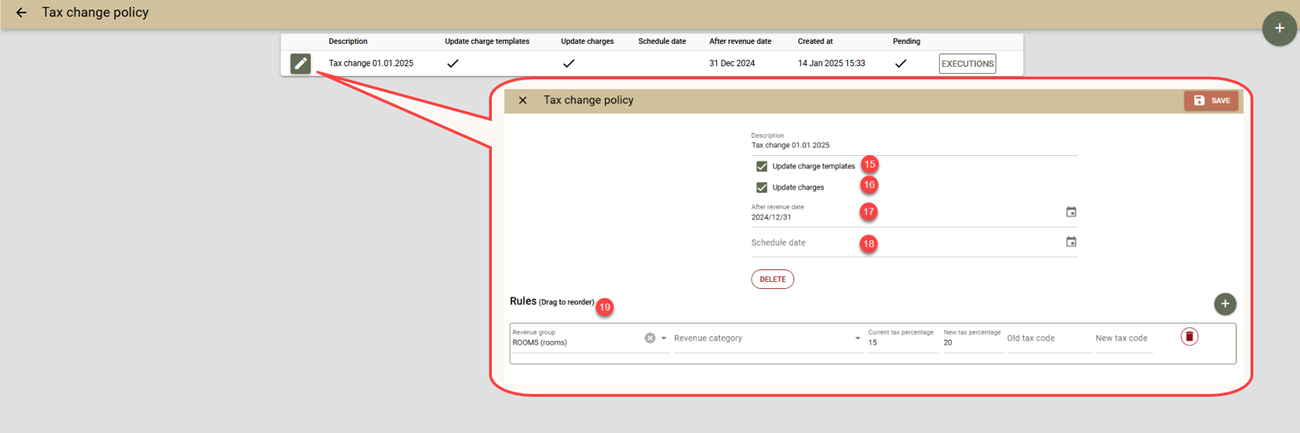
Important: The two new rights are automatically granted to all users who have company-related permissions. If necessary, review your employees' permissions and grant or revoke permissions for specific users.
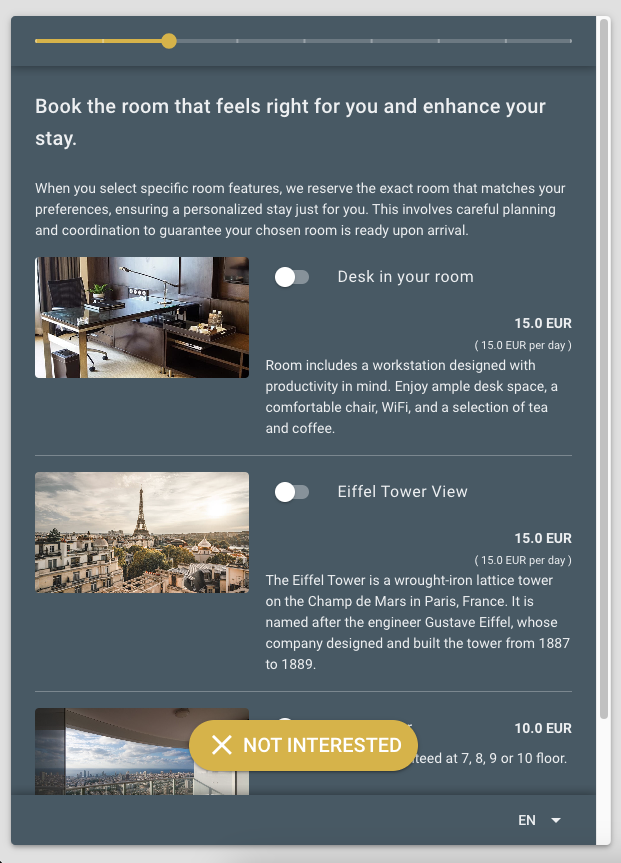
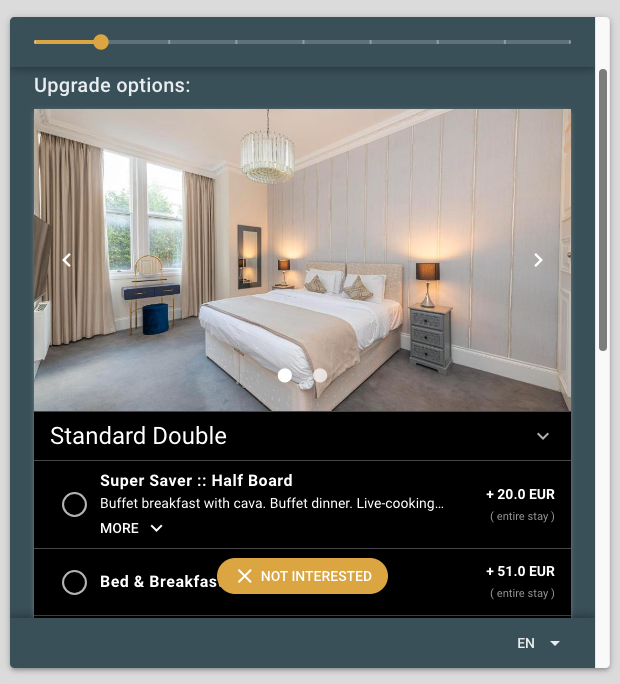
Improvements

  • Occupancy Forecast - When using the segmentation function, virtual rooms were included in the summary data for occupied rooms by segments. We determined that such information in totals is more confusing than helpful, so now only data for real rooms is displayed in the totals. There is no change in the sections of the room types themselves - data for the occupancy of the type, whether real or virtual, continues to be displayed as before.
  • Meal Report (new) - Compact view - Print optimisation - In cases where a specific room number is allocated for a booking, the room type name will no longer be displayed.

Fixes

  • Events - The link to the Event Confirmation App was incorrect when sending an email that was first generated and then saved as a document. The link is now correct, regardless of the sequence in which the document was created.
  • Events - If the event had the status “Optional”, templates could not be used. When creating activities from a template, the activities are now created with the status of the event.
  • Payment Autopilot - settings - In certain situations, the "Additional Amount" field required a value on the edit screen, even when it was not necessary.
  • Printing the standard registration card form no longer adds an extra page.
  • Closed Folios Report (new) - did not produce results when the "Include open/voided folios" option was enabled.
  • Charges By Rooms Report (new) - The revenue category filter did not function correctly.
  •  Credit Card Transaction Report - In certain situations, the report could not be generated and would produce an error of the type 'Error: Request failed with status code 422 ActiveRecord::RecordNotFound...'.

Integrations

  • LightSpeed POS L-Series - The End-of-day transfer in some cases processed periods not matching the financial day 24 hours period. The behaviour is enhanced to ensure matching of the reports between LightSpeed POS L-Series and Clock POS.
“Easy to use” “Fast, intuitive, and reliable” “Saves a lot of time” “New staff learn it quickly” “Accessible from any device” “Less manual work” “Fewer booking mistakes” “Responsive and helpful support”